8 May 2026 · 2 min read
The Mantle’s Elevator: The Merlin Kimberlites
An exploration of the Merlin Diamond Mine in the Northern Territory, where Devonian kimberlite pipes brought deep-mantle diamonds to the surface.
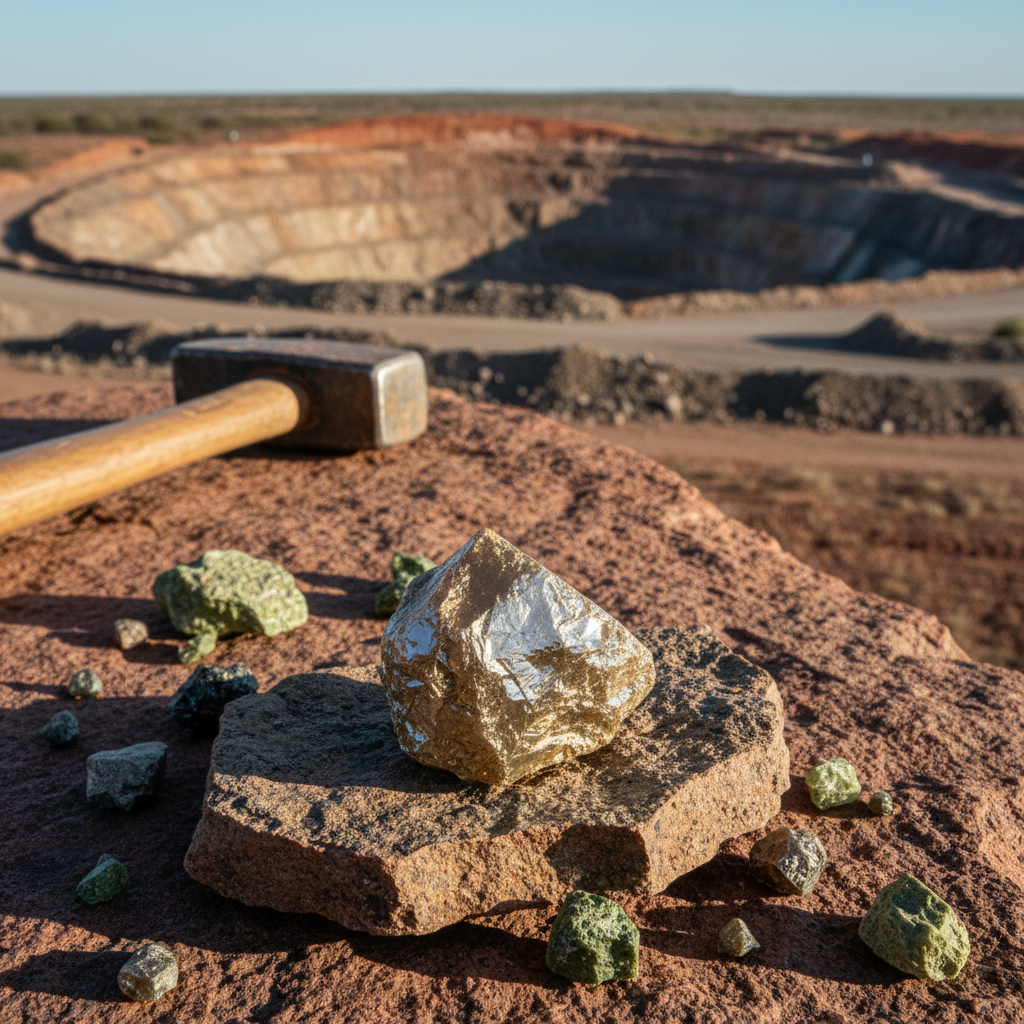
Beneath the red dirt of the Northern Territory, a series of narrow, vertical vents contain the remnants of a subterranean firestorm that bypassed the crust to deliver diamonds to the surface. These are the pipes of the Merlin Diamond Mine, where the earth’s deep mantle spoke through a rare type of volcanic rock known as kimberlite.
The Messenger from the Mantle
Kimberlite is not a standard lava. It is a hybrid rock, a chaotic slurry of mantle minerals and gas-charged magma that travels from depths of 150 kilometers or more at supersonic speeds. At the Merlin field, located on the eastern edge of the Arnhem Land plateau, these eruptions occurred roughly 360 million years ago during the Devonian period.
Unlike the basalt flows of the eastern coast, kimberlite does not form expansive mountains. Instead, it creates carrot-shaped pipes that taper as they descend. At Merlin, these pipes are relatively small—some only a few dozen meters across—but they are dense with information about the high-pressure environment of the lithospheric mantle.
The Geometry of Success
The presence of diamonds at Merlin is a result of the "Diamond Stability Field," a specific zone of temperature and pressure found only beneath thick, ancient cratonic crust. The Merlin field sits atop the North Australian Craton, a stable tectonic block that has remained relatively cool and undisturbed for billions of years. This stability allowed carbon to crystallize into diamond rather than graphite.
The diamonds themselves are older than the kimberlite that carries them. They are xenocrysts—foreign crystals—that were already sitting in the mantle when the kimberlite magma tore through. The magma acted as a high-speed elevator, whisking the stones to the surface before they could be chemically "burned" or converted back into common carbon by the lower pressures of the upper crust.
"To find a diamond is to find a survivor of a journey that would destroy almost any other mineral known to science."
The Paleochannel Trap
Geology rarely leaves its treasures in plain sight. After the Merlin pipes erupted, hundreds of millions of years of erosion ground down the surface of the Northern Territory. The tops of the kimberlite pipes were sheared away, and the diamonds they contained were washed into ancient river systems, or paleochannels.
- Pipes: The primary source, where diamonds remain trapped in the blue-ground kimberlite rock.
- Alluvium: The secondary deposits found in nearby gravels and sands, moved by water.
- Indicator Minerals: Grains of garnet and chromite that geologists track like breadcrumbs to find the hidden vents.
The Large Stone Paradox
While many diamond mines rely on a high volume of small stones, Merlin became famous for its "specials"—diamonds weighing more than 10 carats. In 2003, it produced the "Australia Kong," a 104.73-carat stone that remains the largest diamond ever found on the continent. These large stones suggest that the mantle beneath the North Australian Craton was particularly rich in large, clear carbon crystals.
Today, the pits at Merlin are quiet, but they remain a primary window into the deep architecture of the Australian continent. They prove that even the most stable, ancient landscapes can be punctured by the violent, transformative chemistry of the deep earth.
More like this
- The 5,000-Year-Old Volcanoes That Still Smoke in the SouthIn Victoria's Newer Volcanics Province, 400 volcanic vents erupted as recently as 5,000 years ago—the youngest volcanic field in mainland Australia, where craters still hold blue lakes and scoria cone
- The 300-Million-Year-Old Forest That Died Standing UpIn New South Wales, a 300-million-year-old fossil forest preserves dozens of trees buried upright by a Permian volcanic eruption—an entire ecosystem frozen in ash.
- The 1.85-Billion-Year-Old Caldera That Still Feeds the FurnaceIn South Australia's Middleback Ranges, a 1.85-billion-year-old volcanic caldera collapsed and later became one of the world's richest iron ore deposits.