8 May 2026 · 3 min read
The Heavy Anchor: The Olympic Dam Breccia
An exploration of the Olympic Dam deposit in South Australia, a 1.6-billion-year-old subterranean "supergiant" mineral system formed by catastrophic hydrothermal explosions.
Deep beneath the rolling wheat fields of the Yorke Peninsula, a jagged seam of volcanic rock marks the moment Australia narrowingly avoided being torn in two. This is the Gawler Range Volcanics’ lesser-known cousin: the Olympic Dam deposit, a subterranean mountain of iron, copper, and uranium that crystallized in the dark 1.59 billion years ago.
The Mesoproterozoic Breach
The South Australian Craton was once a place of catastrophic instability. Around 1.6 billion years ago, a massive plume of mantle heat rose beneath the crust, stretching the lithosphere until it began to crack. This was the Hiltaba Event, a period of magmatic fury that didn't just leak lava onto the surface, but pumped mineral-saturated fluids into every fracture of the deep earth.
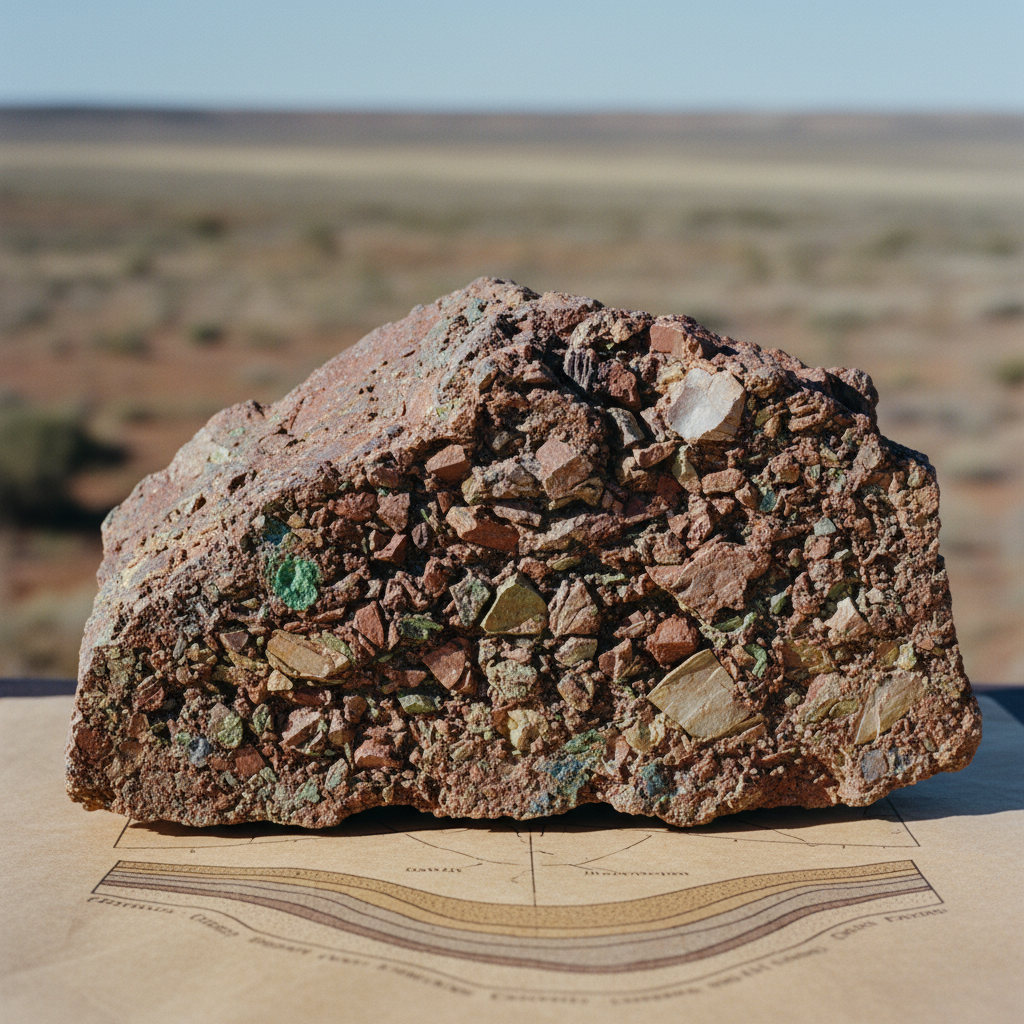
The Olympic Dam Breccia Complex is the physical remains of this violence. It is not a neat layer of sediment or a smooth flow of basalt, but a chaotic jumble of shattered granite. Imagine a subterranean cathedral of rock, kilometers wide, that was repeatedly blown apart by high-pressure steam and then cemented back together by hematite and copper.
The Chemistry of the Void
What makes this site unique is the sheer density of its mineralization. As the granite was pulverized by hydrothermal explosions, it created a massive "sponge" of broken rock. Hot, acidic fluids circulated through these gaps, leaching metals from the surrounding crust and depositing them in the cooling voids.
Unlike most mineral deposits that follow thin veins or narrow seams, the wealth here is disseminated through a massive volume of rock. It is a "Supergiant" deposit, defined by its scale:
- Over 2 billion tonnes of ore-bearing breccia.
- The world's largest single known deposit of uranium.
- Massive concentrations of rare earth elements and gold.
- A core dominated by dense, heavy hematite (iron oxide).
A Gravity of Its Own
Because the hematite core is so much denser than the surrounding suburban-looking granites of the Stuart Shelf, it created a subtle but measurable "heavy" spot in the Earth's crust. It was this gravity anomaly, detected in the 1970s, that allowed geologists to find the deposit despite it being buried under 350 meters of younger, flat-lying sedimentary cover.
There is a quiet irony in the landscape above. The surface is a silent, arid expanse of red dust and saltbush, showing no hint of the geological riot below. The rocks at the surface are Cambrian limestones and sandstones, relatively young and undisturbed, acting as a lid on a Mesoproterozoic pressure cooker that has been cold for over a billion years.
The deposit is a fossilized hydrothermal engine, a place where the earth’s internal heat was converted into a concentrated hoard of heavy metals.
The Tectonic Anchor
The formation of Olympic Dam helped stabilize the Eastern Gawler Craton. By bleeding off the tremendous thermal energy of the mantle plume and "plugging" the fractures with dense minerals, the event effectively welded this part of the continent together. It turned a zone of potential rifting into a solid, heavy anchor.
Today, the site remains one of the most significant windows we have into the Mesoproterozoic era. It tells a story of a time when the Australian continent was still being assembled, defined not by the slow erosion of wind and water, but by the explosive movement of metals through the deep, dark architecture of the crust.
More like this
- The Mud That Became Mountains: The Flinders Ranges' Adelaide GeosynclineThe Flinders Ranges of South Australia preserve a 700-million-year story of rifting, sedimentation, and compression that turned ancient seafloor mud into towering quartzite ridges.
- The Gneiss That Remembers: The Proterozoic Basement of the Gawler CratonBeneath South Australia's Gawler Craton lies 1.7-billion-year-old gneiss—rock once buried 25 kilometres deep, now exposed by tectonic uplift and erosion, that records the assembly of Proterozoic Austr
- The Fused Shore: The Granites of the Bunger HillsIn Antarctica's Bunger Hills, 1.2-billion-year-old Australian granite reveals when two continents were one, fused by the same tectonic collision that built the Albany-Fraser Orogen.