9 May 2026 · 3 min read
The Magnetic Heart: The Iron Ore of the Hamersley Range
In Western Australia's Hamersley Range, 2.5-billion-year-old banded iron formations hold half the world's iron ore, recording when bacteria first oxygenated Earth's oceans.
The pilots flying supply routes over northwest Australia in the 1950s noticed something strange. Their compass needles wavered and spun. Below the wings, the red earth pulled at the magnetic field like a buried lodestone.
The source of that pull—the Hamersley Range—contains the largest concentration of iron ore on Earth. More than half the world's steel begins here, in rocks that formed before there was oxygen to breathe.
The Banded Sea
The Hamersley Group is a sequence of sedimentary rocks laid down between 2.6 and 2.45 billion years ago, during the Paleoproterozoic Era. At that time, Australia's Pilbara Craton sat beneath a shallow sea, and the atmosphere contained almost no free oxygen.
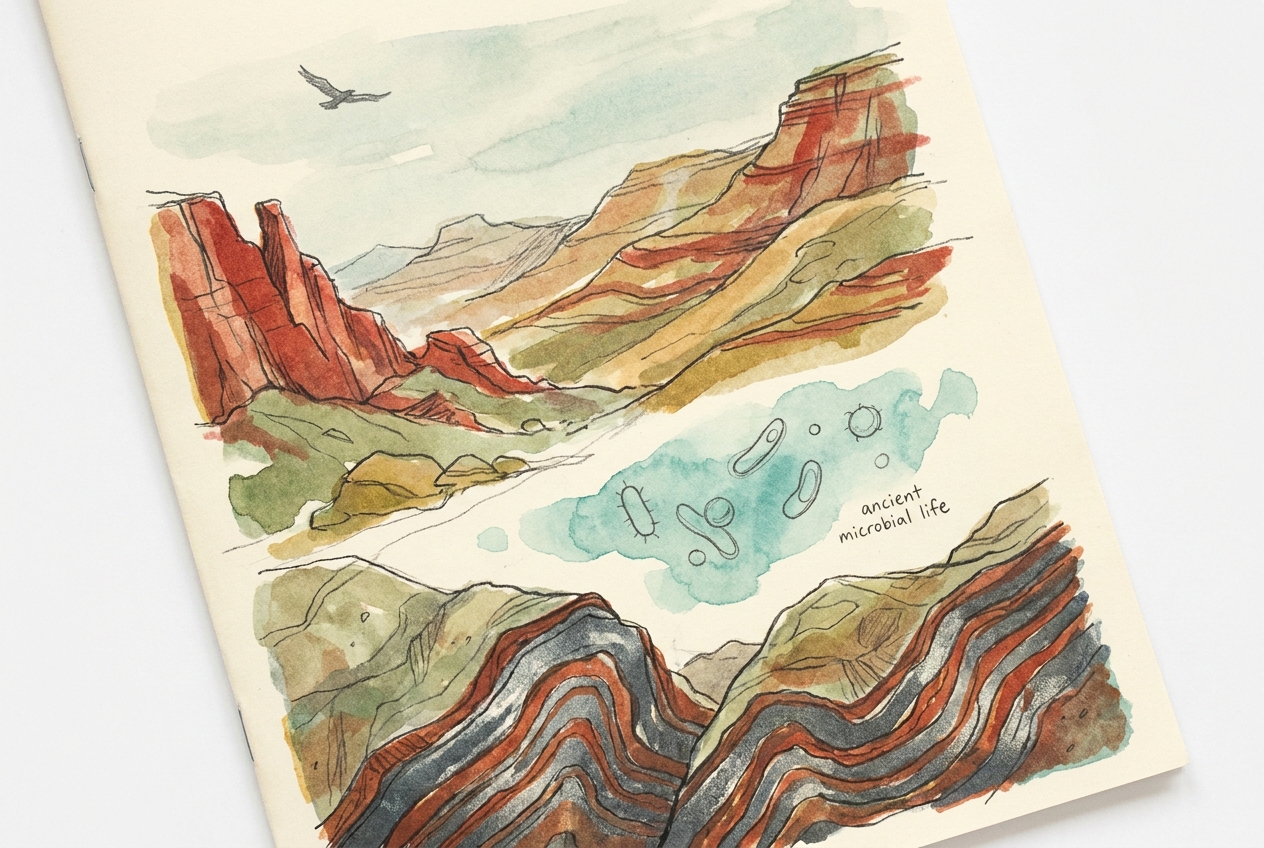
What makes the banded iron formations—or BIFs—so distinctive is their rhythm. Layer after layer of iron oxide (hematite and magnetite) alternates with chert or silica, creating stripes of dark grey, red, and white that can be traced for hundreds of kilometres. Each band pair represents a chemical cycle: iron dissolved in the anoxic ocean would precipitate out when photosynthetic cyanobacteria released oxygen, forming rust that settled to the seafloor. Then the oxygen would be exhausted, and silica would rain down until the next pulse.
The result is a stack of rock up to 2.5 kilometres thick, folded and tilted by later tectonic events but still preserving those original chemical rhythms with the precision of a metronome.
The Enrichment
The raw BIFs contain about 30 percent iron. The ore bodies mined today—running at 60 to 68 percent iron—are the product of a second process that happened much later.
Between 2.2 and 1.8 billion years ago, the Hamersley Basin was buried, heated, and compressed during the Ophthalmia Orogeny. Superheated fluids circulated through the BIFs, dissolving silica and leaving the iron behind. In some places, the process repeated during the Mesoproterozoic, when the region was gently warped and eroded, allowing groundwater to leach out more silica and further concentrate the iron.
The result is a peculiar landscape. The ridges of the Hamersley Range—Mount Bruce, Mount Tom Price, Mount Whaleback—are not mountains in the usual sense. They are the resistant cores of ancient basins, left standing after the surrounding softer rock eroded away. Their flat tops and steep sides betray their origin as sedimentary layers that have been inverted by time.
The Hamersley ore bodies are not deposits in the usual sense. They are ghosts—the residue left after everything else was dissolved and carried away.
The Red Earth
The iron gives the Pilbara its colour. The red dust that coats every surface, stains every creek, and turns the rivers the colour of blood after rain is hematite and goethite weathered from the BIFs. The same dust blows out to sea and falls on the Indian Ocean, fertilising phytoplankton blooms visible from satellites.
The mining began in earnest in the 1960s, after the Australian government lifted an export ban that had kept the iron ore secret for decades. Lang Hancock, the prospector who claimed to have discovered the deposits while flying through a storm, had been right: the Hamersley Basin held billions of tonnes of the stuff. Today, the operations at Mount Tom Price, Paraburdoo, and Yandi are among the largest open-pit mines in the world.
The Archive
The Hamersley BIFs are more than an economic resource. They are the most complete record of the Great Oxidation Event—the period between 2.4 and 2.3 billion years ago when oxygen first accumulated in Earth's atmosphere. The ratio of iron isotopes in the bands, the presence of trace elements like molybdenum and rhenium, and the patterns of rare earth elements all tell the story of a planet in chemical transition.
Before the BIFs, the oceans were rich in dissolved iron. After they formed, the iron was locked away in the crust, and oxygen could finally build up in the air. Life changed forever.
The Hamersley Range, for all its economic importance, is really a monument to that transition. A magnetic heart, still pulling at compass needles, still recording the moment the Earth learned to breathe.
More like this
- The 110-Million-Year-Old River That Runs Backwards UndergroundWestern Australia's 110-million-year-old dune system has been slowly dissolving into a labyrinth of caves where an ancient river still flows, carrying the taste of a Cretaceous desert.
- The 5,000-Year-Old Volcanoes That Still Smoke in the SouthIn Victoria's Newer Volcanics Province, 400 volcanic vents erupted as recently as 5,000 years ago—the youngest volcanic field in mainland Australia, where craters still hold blue lakes and scoria cone
- The 560-Million-Year-Old Garden That Never Saw a PredatorIn South Australia's Flinders Ranges, 560-million-year-old Ediacara surfaces preserve entire seafloor communities of fronds, discs, and quilts — a garden of soft-bodied life that flourished before pre