10 May 2026 · 4 min read
The Breathing Coast: The Coorong's Holocene Lagoon
South Australia's Coorong lagoon records 7,000 years of sea-level change, where shifting sand barriers and evaporite minerals preserve a living record of the Holocene.
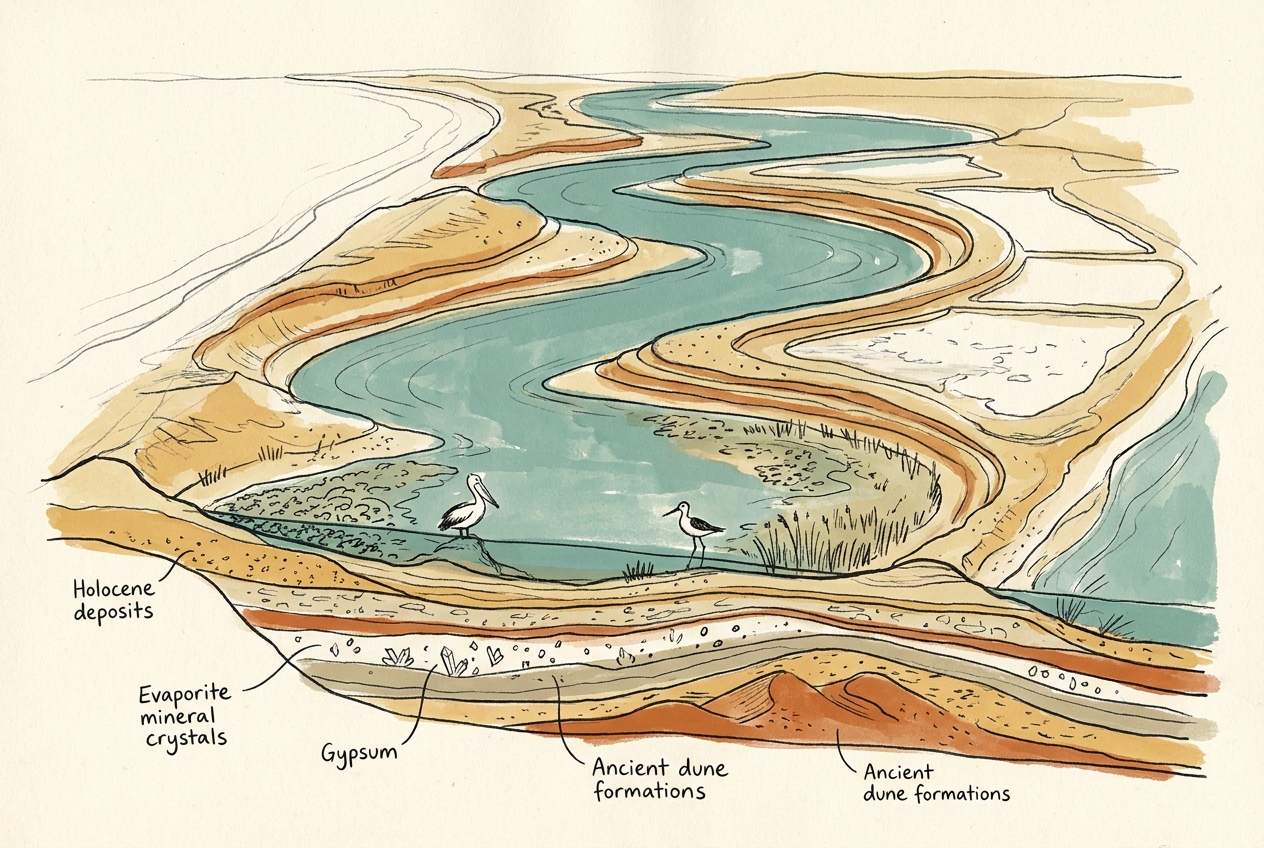
A narrow finger of seawater stretches 140 kilometres along South Australia's southeast coast, separated from the Southern Ocean by a thin strip of shifting dunes. This is the Coorong, a coastal lagoon that breathes with the tides through a single narrow inlet at the Murray Mouth. What looks like a simple estuary is actually a finely balanced archive of the past 7,000 years, where water chemistry, shell beds, and evaporite crusts record the slow dance between sea level and sediment.
The Barrier That Moves
The Coorong exists because of the Younghusband Peninsula, a barrier of quartz sand built entirely by wave action since the last ice age. When sea levels stabilised around 6,500 years ago, the rising ocean flooded the shallow depression behind the dunes, creating the lagoon we see today. But the barrier was never still. Sand from the southeast drifts northward along the coast, pushed by the prevailing swell, and accumulates against the Murray Mouth. The inlet closes, opens, migrates — sometimes within a single human lifetime.
This constant rearrangement means the Coorong is not one lagoon but many, depending on where the mouth happens to be. When the inlet is open, seawater floods in. When it closes — as it did for extended periods in the 19th century — the lagoon becomes a chain of hypersaline basins, evaporating under the inland sun.
The Salinity Gradient
The Coorong's most distinctive feature is its extreme north-south salinity gradient. Near the Murray Mouth, the water is brackish, a mix of river outflow and ocean swell. Fifty kilometres south, at Pelican Point, salinity is three times that of seawater. At the southern terminus, near Salt Creek, it can reach ten times ocean levels — a brine so dense that only specialised microbes survive.
This gradient creates a corresponding sequence of minerals. In the northern reaches, carbonate muds precipitate from the alkaline water, forming soft white sediments rich in aragonite needles. Further south, where evaporation concentrates the brines, gypsum crystals grow on the lagoon floor — thin, transparent blades that catch the light like submerged glass. In the most extreme southern basins, the mineral dolomite forms, a magnesium-rich carbonate that rarely precipitates directly from seawater anywhere on Earth today. The Coorong is one of the few places where scientists can watch dolomite form in real time.
The Shell Records
The lagoon floor is layered with the shells of tiny molluscs and foraminifera, each species sensitive to a narrow range of salinity. Coxiella, a small gastropod, thrives only in the hyper-saline southern reaches. Its shells accumulate in beds that can be several metres thick. By coring these deposits, geologists can read the history of the inlet's openings and closures stretching back millennia.
During the Medieval Warm Period, around 1,000 years ago, the inlet appears to have remained open for centuries, allowing marine species to colonise the entire lagoon. During the Little Ice Age, the mouth closed more frequently, and the southern Coorong became so saline that only the hardiest species survived. These shifts are recorded not just in which species are present, but in the chemistry of their shells — the ratio of magnesium to calcium in the aragonite changes with water temperature and salinity.
The Coorong is a coast that writes its own history in calcium carbonate, each shell a datum point in a 7,000-year survey of sea level.
The Living Crust
In the southern Coorong, the most extreme environment, microbial mats coat the lagoon floor. These layered communities of cyanobacteria and archaea trap sediment and precipitate minerals, forming structures that closely resemble stromatolites — the same kind of microbial mats that built Earth's earliest reefs 3.5 billion years ago. Here, in the hypersaline brine, the boundary between geology and biology dissolves.
The mats produce a distinctive wrinkled surface, leathery to the touch, that stabilises the sediment and prevents erosion. When the lagoon dries out completely during drought years, the mats desiccate into paper-thin crusts that curl at the edges. When the water returns, they rehydrate and resume growth. This resilience has allowed microbial life to persist in the Coorong through every major climate shift of the Holocene.
The Stakes
The Coorong today is under pressure. Upstream extraction for irrigation has reduced the Murray River's flow to a fraction of its natural volume. The Murray Mouth has been dredged continuously since 2002 to keep it open. Without sufficient freshwater inflow, the salinity gradient shifts southward, compressing the habitats that depend on each chemical zone.
But the lagoon also demonstrates something hopeful. Its sediments record previous periods of closure and hypersalinity, and each time, the system rebounded when the mouth reopened and fresh water returned. The Coorong has breathed open and closed for seven millennia. Whether it can survive the pace of human-driven change is a question the shells are still recording.
More like this
- The 110-Million-Year-Old River That Runs Backwards UndergroundWestern Australia's 110-million-year-old dune system has been slowly dissolving into a labyrinth of caves where an ancient river still flows, carrying the taste of a Cretaceous desert.
- The 5,000-Year-Old Volcanoes That Still Smoke in the SouthIn Victoria's Newer Volcanics Province, 400 volcanic vents erupted as recently as 5,000 years ago—the youngest volcanic field in mainland Australia, where craters still hold blue lakes and scoria cone
- The 560-Million-Year-Old Garden That Never Saw a PredatorIn South Australia's Flinders Ranges, 560-million-year-old Ediacara surfaces preserve entire seafloor communities of fronds, discs, and quilts — a garden of soft-bodied life that flourished before pre