22 May 2026 · 3 min read
The Magma That Tempered a Billion-Year Blade: Western Australia's Mount Augustus
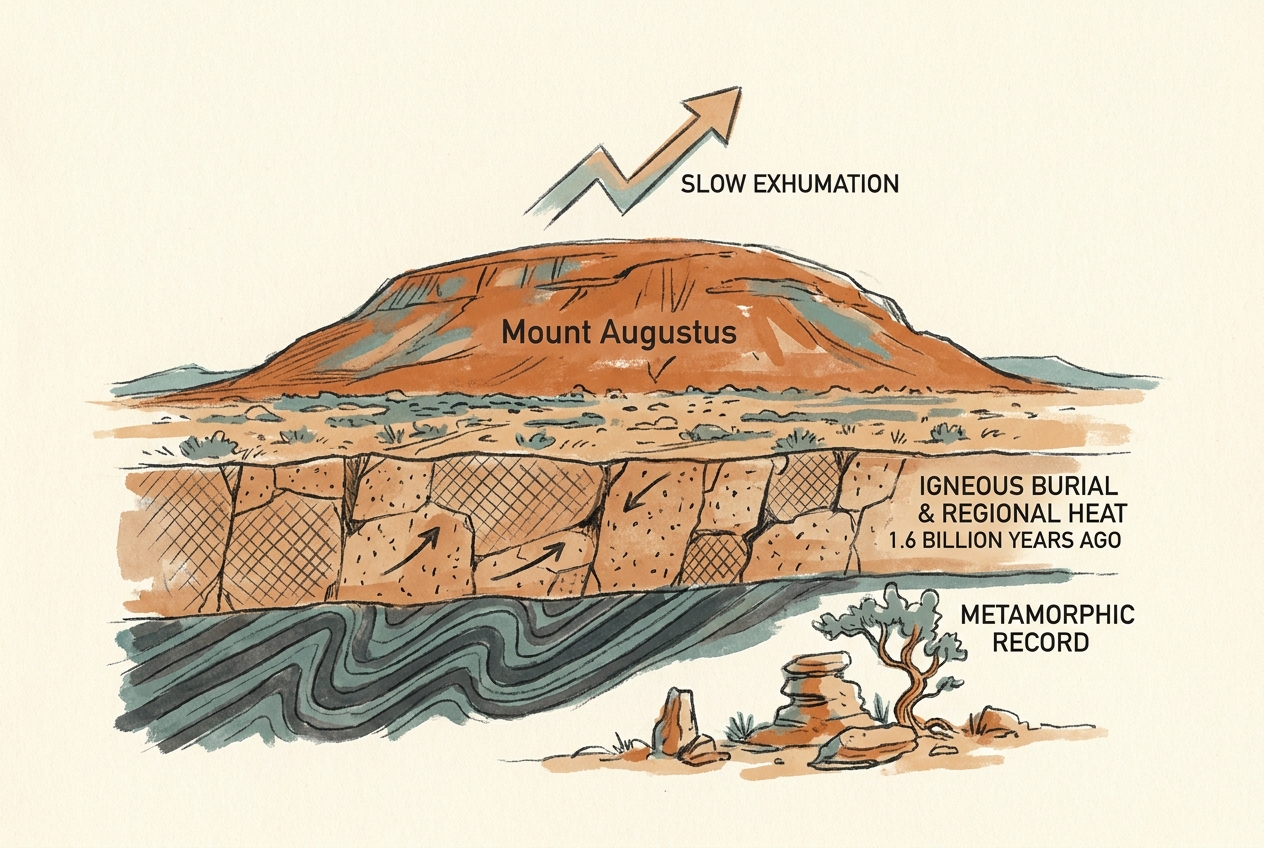
How 1.6-billion-year-old granite and metamorphosed sandstone in Western Australia's Mount Augustus record a story of deep burial, regional heat, and the slow exhumation of a continent.
Mount Augustus rises 858 metres above the red plains of inland Western Australia. It is not, as guidebooks sometimes claim, the world's largest monolith—that title belongs to Uluru. But Mount Augustus is a more instructive rock. It is a single mountain built from two radically different stories, one igneous, one metamorphic, bound together by a billion years of burial and uplift.
The Granite That Rose and the Sediment That Fell
The mountain's core is a 1.6-billion-year-old granite pluton, part of the Gascoyne Complex. This granite formed when magma intruded into older crust during a period of continental assembly in the Proterozoic. As the pluton cooled and crystallised, the overlying land rose into a mountain range. Erosion immediately set to work.
Sand and gravel shed from that range accumulated in a basin alongside the granite. Over millions of years, those sediments compacted into sandstone and conglomerate—layers that would eventually become the mountain's spectacular ridgeline. The relationship between granite and sediment is intimate: you can walk from one to the other in a few hundred paces.
The Heat That Turned Sand to Quartzite
What makes Mount Augustus geologically unusual is what happened next. The sedimentary pile was buried deeply—perhaps several kilometres down—and heated by the regional metamorphism that accompanied later tectonic compression. The sandstone recrystallised into quartzite, a rock as hard as the granite beside it.
This is the key difference from Uluru. Uluru is arkose sandstone, relatively soft, cemented but not metamorphosed. Mount Augustus's caprock is quartzite, metamorphosed and resistant to erosion. The mountain's flat summit and sheer cliffs are a direct product of that thermal history. The metamorphism happened around 1.0 to 0.8 billion years ago, during the Edmundian Orogeny, when crustal forces squeezed and heated the region.
The granite cooled from magma; the quartzite was baked from sand. The same mountain preserves both births.
The Exhumation That Left a Ridge
For the last 800 million years, the landscape has been slowly stripped away. The softer rocks surrounding the granite-quartzite core eroded, while the resistant cap held firm. What remains is a ridge 8 kilometres long, trending north-south, with the granite exposed on the lower slopes and the quartzite capping the summit.
The process is called exhumation—the removal of overburden by erosion, not by tectonic uplift. Mount Augustus is a relic of a thicker crust that has been planed down around it. The mountain is a negative image of the vanished landscape: a remnant of what was once buried, now standing above the plains because it was harder than everything else.
Aboriginal people of the Wajarri language group call the mountain Burringurrah. A Dreaming story tells of a boy who was turned to stone after breaking a taboo, his body forming the ridge. The geology tells a parallel story of resistance: the rock that refused to erode.
What the Mountain Records
Mount Augustus is not a single formation but a contact zone between two geological epochs. The granite records a time of magmatic addition to the continent. The quartzite records a time of burial and heating. Together, they preserve a billion-year interval in which Australia's western crust was assembled, buried, metamorphosed, and slowly exhumed.
You can see the contact clearly on the mountain's eastern face: pink granite below, grey quartzite above, the boundary sharp as a knife cut. There is no missing time between them—the sediment was laid directly on the eroded granite surface. It is one of the most complete exposures of Proterozoic crustal architecture anywhere on the continent.
The mountain stands today because of that deep history. Every ridge and cliff is an expression of ancient heat and pressure, not of recent uplift. Mount Augustus is not a monument that rose from the plain. It is the last fragment of a world that has been carried away grain by grain, leaving only the parts that could endure.
More like this
- The 110-Million-Year-Old River That Runs Backwards UndergroundWestern Australia's 110-million-year-old dune system has been slowly dissolving into a labyrinth of caves where an ancient river still flows, carrying the taste of a Cretaceous desert.
- The 5,000-Year-Old Volcanoes That Still Smoke in the SouthIn Victoria's Newer Volcanics Province, 400 volcanic vents erupted as recently as 5,000 years ago—the youngest volcanic field in mainland Australia, where craters still hold blue lakes and scoria cone
- The 1.75-Billion-Year-Old Reef That Outranks the BarrierA 1.75-billion-year-old microbial reef in the Kimberley is the largest biological structure ever built by a single species, preserving a world without predators.