23 May 2026 · 4 min read
The Lava That Sowed a Desert: Central Australia's Uluru and Kata Tjuta
How 550-million-year-old alluvial fans and shallow marine sediments, later metamorphosed and uplifted, became Uluru and Kata Tjuta—and why their stark difference in rock type records a vanished mounta
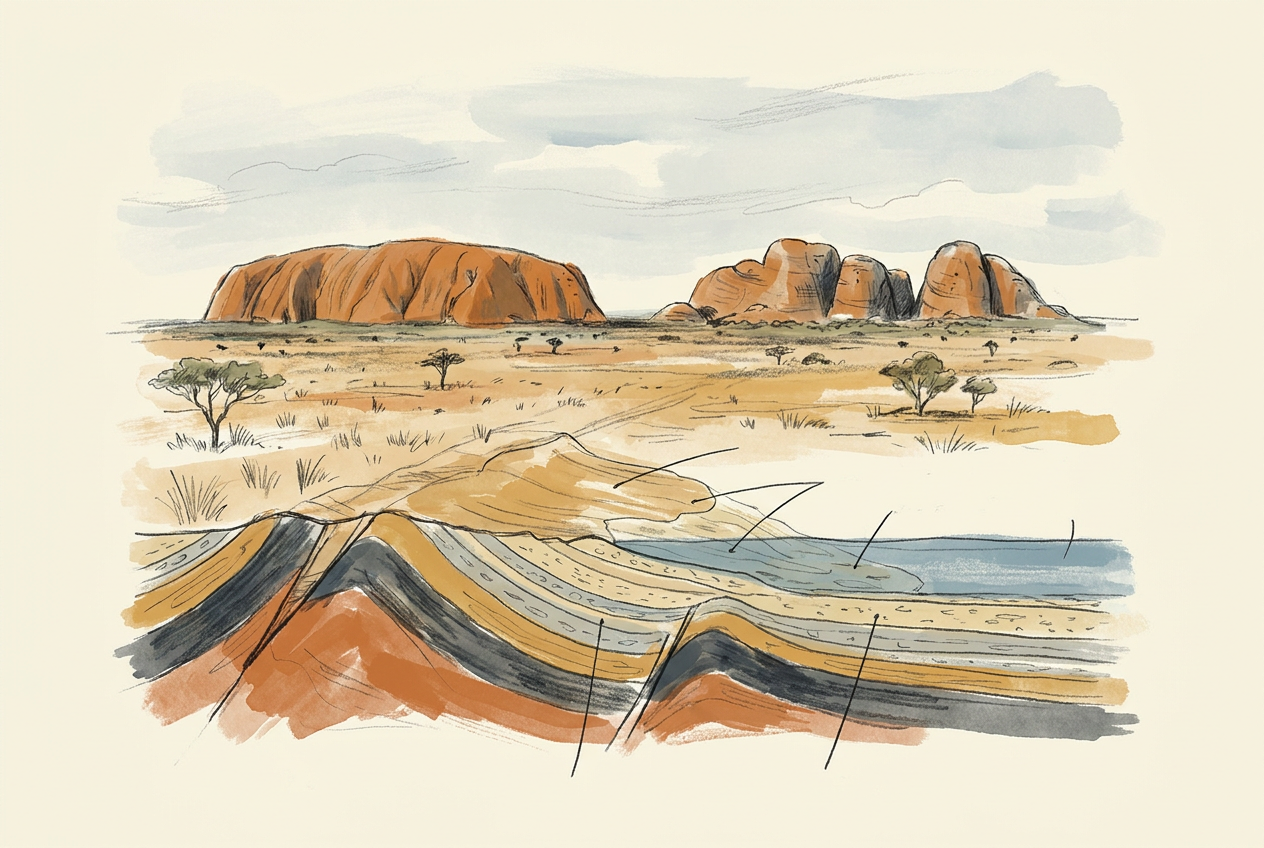
The two monuments rise from the red plain of Central Australia less than thirty kilometres apart, yet they could not be more different. Uluru is a single immense loaf of sandstone, smooth and monolithic. Kata Tjuta is a cluster of thirty-six rounded domes, fractured and steep. The reason for their difference lies not in what happened to them recently, but in what happened half a billion years ago, when neither existed as rock at all.
What the Sandstone Remembers
The raw sediment that became Uluru was deposited around 550 million years ago, during the late Neoproterozoic. At that time, central Australia lay near the equator, flanked by a mountain belt that has since entirely vanished. Rivers and flash floods carried sand and gravel from those mountains into a broad, shallow basin that geologists call the Amadeus Basin.
At the site of modern Uluru, the sediment was unusually well sorted. The currents that delivered it were steady enough to wash away finer clay and silt, leaving behind a clean, quartz-rich sand. That sand accumulated in thick beds, layer upon layer, in what was likely a large alluvial fan or a braided river system. Over millions of years, the weight of overlying sediment compressed the sand into sandstone.
At Kata Tjuta, the same mountain range delivered a different kind of debris. The sediment there was coarser, more poorly sorted, and rich in angular fragments of granite and other hard rocks. This was not the product of gentle rivers but of violent flash floods that carried boulders and cobbles short distances before dropping them in steep alluvial fans. The resulting rock is not a clean sandstone but a conglomerate—a mass of pebbles and cobbles set in a sandy matrix.
One mountain delivered its sand in steady pulses. The other in violent surges. The rock remembers the difference.
The Burial That Made Them Hard
After deposition, both formations were buried under several kilometres of younger sediment. The Amadeus Basin continued to subside, and the weight of overlying rock—combined with heat from the Earth's interior—began to transform the loose sediment into solid rock.
This process, called diagenesis, did more than simply harden the sand. In the Uluru sandstone, silica-bearing groundwater percolated through the pore spaces and precipitated quartz cement, binding the grains into an extremely hard, erosion-resistant rock. The Kata Tjuta conglomerate underwent a similar transformation, but its heterogeneous composition—a mix of quartz, feldspar, and rock fragments—made it more susceptible to chemical weathering along grain boundaries.
Around 400 million years ago, during the Alice Springs Orogeny, the entire region was compressed and uplifted. The once-horizontal sedimentary beds were tilted nearly vertical. The mountains that had supplied the sediment were themselves eroded away, leaving only their alluvial debris behind.
The Sculpting of Two Silhouettes
For the last 300 million years, erosion has been the dominant force shaping both formations. But the same processes have produced radically different results.
Uluru's clean quartz sandstone is chemically inert. Rainwater cannot easily dissolve the quartz grains, and the rock lacks the internal fractures that would allow water to penetrate. Erosion occurs mainly by exfoliation—thin sheets of rock peeling away from the surface, like layers of an onion. This produces the characteristic smooth, steep slopes and the gentle fluting that runs vertically down the monolith's faces.
Kata Tjuta's conglomerate is chemically reactive. The feldspar and other minerals within it weather to clay when exposed to water. Rain penetrates the countless joints and fractures that crisscross the rock, and over millennia, water has widened these cracks into gullies and valleys. The result is a landscape of separate domes, each one a remnant of the original formation that has been isolated by erosion along fracture zones.
The difference in colour is also a story of weathering. The red-brown hue of both formations comes from a thin coating of iron oxide—rust—that formed on the rock surfaces over tens of thousands of years of exposure. Beneath this patina, the fresh rock is grey.
A Continent's Memory in Stone
Uluru and Kata Tjuta are not volcanic plugs or ancient reefs or meteorite scars. They are the eroded remnants of a mountain range that no longer exists, preserved in the very sediment that range shed. The mountains that once stood here were likely as high as the modern Himalayas. They have been completely ground away, and their debris now forms the red plains and rocky monuments of central Australia.
The two formations endure because their sandstone and conglomerate are harder than the surrounding rock. The softer sediments that once buried them have long since eroded, carried away by wind and water to become the vast, flat plains of the Amadeus Basin. What remains are the hardest parts—the ancient alluvial fans of a lost mountain belt, now standing in silhouette against a desert sky.
More like this
- The 110-Million-Year-Old River That Runs Backwards UndergroundWestern Australia's 110-million-year-old dune system has been slowly dissolving into a labyrinth of caves where an ancient river still flows, carrying the taste of a Cretaceous desert.
- The 5,000-Year-Old Volcanoes That Still Smoke in the SouthIn Victoria's Newer Volcanics Province, 400 volcanic vents erupted as recently as 5,000 years ago—the youngest volcanic field in mainland Australia, where craters still hold blue lakes and scoria cone
- The 560-Million-Year-Old Garden That Never Saw a PredatorIn South Australia's Flinders Ranges, 560-million-year-old Ediacara surfaces preserve entire seafloor communities of fronds, discs, and quilts — a garden of soft-bodied life that flourished before pre