17 June 2026 · 4 min read
The Magma That Crystallised a Lithium Empire: Western Australia's Greenbushes Pegmatite
How 2.5-billion-year-old pegmatite veins in Western Australia's Greenbushes became Earth's richest hard-rock lithium deposit, recording a continent's slow dance with tectonic collision.
A single outcrop in Western Australia's Darling Range, no larger than a few city blocks, produces more lithium than any other piece of ground on Earth. The Greenbushes pegmatite is not a vein or a dyke in the ordinary sense—it is a freak of deep time, a pocket of crystallised magma that concentrated lithium, tantalum, and tin into proportions that mining geologists once considered impossible. The rock that built batteries began as hot, wet granite.
The Anatomy of a Pegmatite
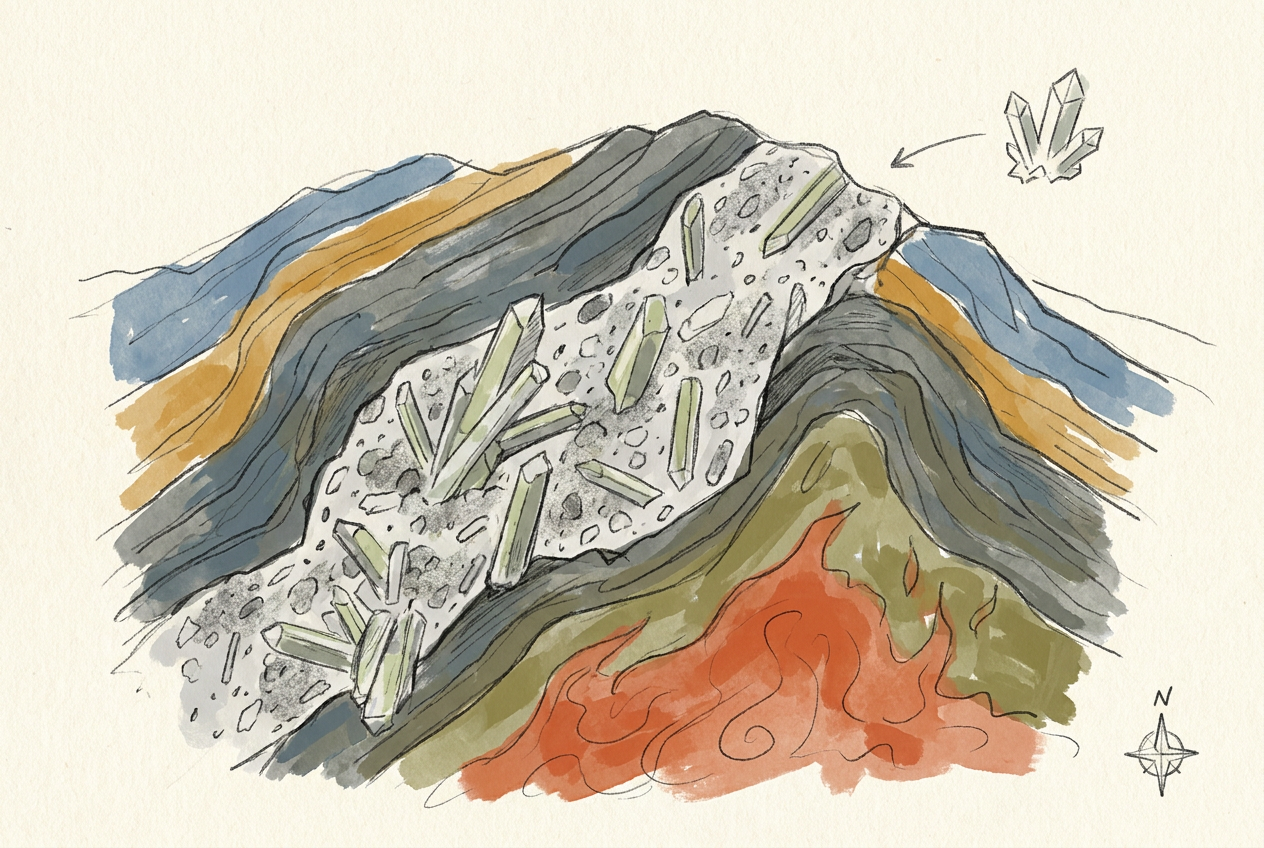
Pegmatites form when the last vestiges of a cooling granite magma become saturated with water and volatile elements. The water lowers the melting point and thins the melt, allowing atoms to migrate freely and crystals to grow enormous. At Greenbushes, the host granite intruded 2.5 billion years ago into ancient metamorphic rocks of the Yilgarn Craton, one of Earth's oldest surviving pieces of continental crust.
What makes Greenbushes exceptional is the sheer volume of incompatible elements—lithium, caesium, rubidium—that the melt scavenged from the surrounding crust. These elements do not fit neatly into the crystal structures of common minerals like feldspar and quartz, so they accumulate in the residual liquid. At Greenbushes, that residual liquid was exceptionally rich, and it cooled slowly enough to allow the lithium-bearing mineral spodumene to form crystals up to several metres long.
The pegmatite body itself is a zoned structure: a coarse-grained outer shell of feldspar and quartz, then a core of almost pure spodumene, then a central cavity lined with gem-quality crystals of lepidolite, pollucite, and tantalite. Each zone records a different stage of crystallisation, a frozen chronology of chemical exhaustion.
The rock that built the modern battery was emplaced when the only life on Earth was single-celled and the continents were still assembling.
A Collision Preserved in Crystal
The Greenbushes pegmatite did not form in isolation. It belongs to a belt of lithium-rich pegmatites that runs through the southwest of Western Australia, a zone that marks the suture between two ancient continents. Around 2.5 billion years ago, the Yilgarn Craton collided with the Pilbara Craton to the north, folding and thickening the crust and generating the heat that melted the deep crust into granite.
The collision also created the structural pathways—fractures, faults, and shear zones—that allowed the volatile-rich melts to rise. Without that tectonic collision, the lithium would have remained dispersed through the crust at concentrations too low to mine. The pegmatite is a direct product of plate tectonics, a scar from the assembly of the first supercontinent.
This tectonic story is written in the minerals themselves. The lithium-mica lepidolite contains caesium, a fingerprint of extreme fractionation. The tantalite carries niobium, another incompatible element. The ratios of these trace elements are so distinctive that geologists can match Greenbushes pegmatite fragments to the same event across the entire southwest of Australia.
From Pegmatite to Power
The Greenbushes deposit was discovered in 1888, but it was not lithium that drew the first miners. It was tin, then tantalum—a metal used in electronics and military alloys. For more than a century, the lithium-rich spodumene was discarded as waste rock. The tailings piles from the tin and tantalum operations contained more lithium than most known deposits in the world.
The shift came in the 1990s, when the demand for lithium-ion batteries began to climb. By the 2010s, Greenbushes had become the largest hard-rock lithium mine on the planet, producing spodumene concentrate that is shipped to refineries in China and Australia. The pegmatite that formed during the assembly of Earth's first continents now powers laptops, electric vehicles, and grid-scale batteries.
Yet the geology imposes limits. The pegmatite body is a finite lens, not a seam that extends indefinitely. At current extraction rates, the high-grade ore at Greenbushes will be exhausted within decades. The deeper, lower-grade zones remain, but the easy lithium—the crystallised wealth of a 2.5-billion-year-old melt—is a non-renewable inheritance.
The Deeper Record
Pegmatites like Greenbushes are rare because they require an improbable sequence of conditions: a fertile granite source, a tectonic collision to drive the melt upward, a slow cooling rate, and a crust rich enough in incompatible elements to supply the necessary concentration. Most pegmatites are small and barren. Greenbushes is the statistical outlier, the jackpot of crustal evolution.
The same geological forces that made the deposit also preserved it. The Yilgarn Craton has remained tectonically quiet for two billion years, a stable shield that protected the pegmatite from erosion, burial, or metamorphic overprinting. The deposit sits within a few hundred metres of the surface, exposed by slow weathering of the overlying rock. It was not always there; it was revealed by the patient removal of a billion years of cover.
Lithium is the lightest metal, the third element on the periodic table, forged in the Big Bang and scattered through the galaxy. On Earth, it concentrated in pegmatites like Greenbushes through a chain of geological accidents that spans half the age of the planet. The rock that holds it is not just an ore body. It is a record of how the Earth concentrates its rarest elements, how tectonic collisions create wealth, and how a billion-year-old crystal can reshape a civilisation.
More like this
- The 5,000-Year-Old Volcanoes That Still Smoke in the SouthIn Victoria's Newer Volcanics Province, 400 volcanic vents erupted as recently as 5,000 years ago—the youngest volcanic field in mainland Australia, where craters still hold blue lakes and scoria cone
- The 1.85-Billion-Year-Old Caldera That Still Feeds the FurnaceIn South Australia's Middleback Ranges, a 1.85-billion-year-old volcanic caldera collapsed and later became one of the world's richest iron ore deposits.
- The 190,000-Year-Old Lava Tube That Still Holds a River of StoneIn Queensland's Undara volcano, 190,000-year-old lava tubes preserve the longest known flow on Earth—a frozen river of basalt that still shelters bats, ferns, and the memory of Pleistocene fire.