17 June 2026 · 3 min read
The Lava That Built a Skyline of Spires: Queensland's Glass House Mountains
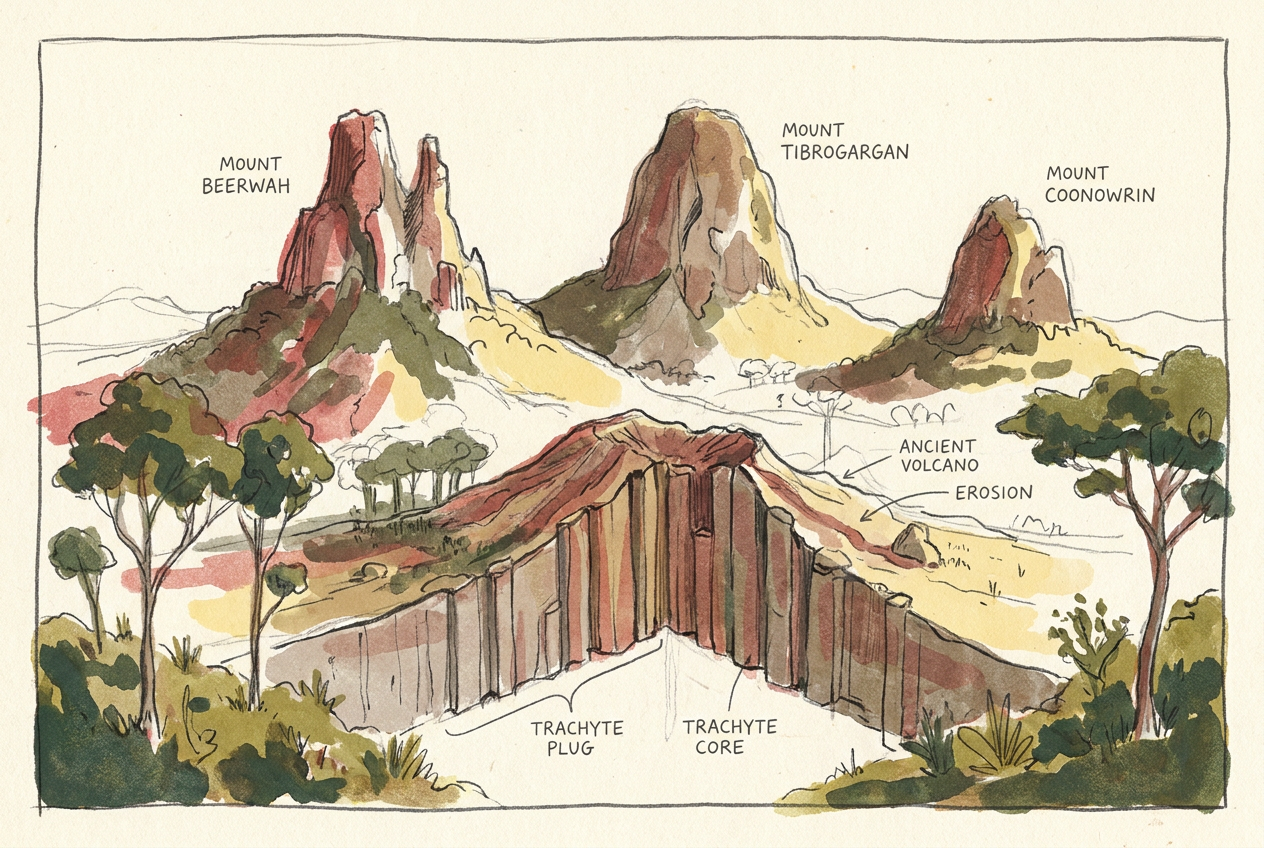
How 26-million-year-old volcanic plugs in Queensland's Glass House Mountains reveal the inner plumbing of ancient volcanoes, their trachyte cores now standing as a landscape shaped by time and weather
On a clear morning, the Glass House Mountains rise from the coastal plain north of Brisbane like the exposed roots of a vanished world. Captain Cook named them in 1770, mistaking their trachyte spires for glass furnaces. He was wrong about the glass, but right about the fire.
A Landscape of Plugs
These are not mountains in the usual sense. They are volcanic plugs—the solidified throats of ancient volcanoes that erupted between 26 and 22 million years ago. The softer outer rock has long since eroded away, leaving only the hard, crystalline cores.
The largest, Mount Beerwah, rises 556 metres above sea level. Its name comes from the Kabi Kabi word birra-wah, meaning "place of the sky." Mount Tibrogargan, named for a father figure in Aboriginal mythology, stands nearby with a distinctive, hunched profile. In total, sixteen plugs dot the landscape, each a remnant of a separate vent.
The Chemistry of Hardness
What makes these plugs so resistant to erosion is their composition. The magma that fed them was alkaline trachyte—a silica-rich, low-viscosity lava that cooled slowly inside the volcanic conduit. This slow cooling allowed crystals of sanidine feldspar, augite, and magnetite to grow large enough to see with the naked eye.
Trachyte is harder than the surrounding basalt and sedimentary rock. As the landscape was worn down over millions of years, the plugs remained standing. The same process that created the plugs also produced columnar jointing—vertical fractures that formed as the lava cooled and contracted. On Mount Ngungun, these columns are visible as parallel stripes running up the cliff face.
The mountains are not the remains of the volcano. They are the volcano's skeleton.
A Chain of Fire
The Glass House Mountains are part of a larger volcanic province that stretches from northern New South Wales to central Queensland. This province formed as the Australian continent drifted northward over a stationary hotspot in the Earth's mantle—the same hotspot that today sits beneath the Tasman Sea.
As the continent moved, the hotspot punched through the crust at different points, creating a chain of volcanoes that grew younger toward the north. The Glass House Mountains are among the oldest in this chain. Further north, the Warrumbungle volcanoes in New South Wales are about 17 million years old. The youngest activity, at Mount Warning in northern New South Wales, occurred around 23 million years ago.
This pattern of migrating volcanism is a direct record of plate motion. Each plug marks the position of the continent above the hotspot at a particular moment in geological time.
Life on the Plugs
The steep, rocky slopes of the plugs create unusual habitats. The trachyte weathers slowly, producing thin, acidic soils that favour specialised plant communities. On Mount Tibrogargan, the rare Pultenaea species grows only on the upper slopes, adapted to the nutrient-poor conditions.
Aboriginal people have lived among these mountains for at least 20,000 years. The Kabi Kabi people used the trachyte for stone tools, and the mountain summits held ceremonial significance. The plugs appear in Dreaming stories that explain their formation as a family turned to stone.
The Shape of Time
The Glass House Mountains are a lesson in geological inversion. What was once deep underground—the volcanic conduit—now stands above the surrounding plain. The landscape has been turned inside out by erosion.
Each plug is a snapshot of a single volcanic event that lasted perhaps a few thousand years. The surrounding plain preserves the remnants of lava flows and ash deposits from those same eruptions. Together, they tell the story of a continent moving over a plume of hot rock, leaving behind a trail of fire that still shapes the skyline.
More like this
- The 110-Million-Year-Old River That Runs Backwards UndergroundWestern Australia's 110-million-year-old dune system has been slowly dissolving into a labyrinth of caves where an ancient river still flows, carrying the taste of a Cretaceous desert.
- The 5,000-Year-Old Volcanoes That Still Smoke in the SouthIn Victoria's Newer Volcanics Province, 400 volcanic vents erupted as recently as 5,000 years ago—the youngest volcanic field in mainland Australia, where craters still hold blue lakes and scoria cone
- The 300-Million-Year-Old Forest That Died Standing UpIn New South Wales, a 300-million-year-old fossil forest preserves dozens of trees buried upright by a Permian volcanic eruption—an entire ecosystem frozen in ash.