17 June 2026 · 3 min read
The Ash That Swallowed a Herd of Diprotodons: Queensland's Mammoth Cave
How 500,000-year-old volcanic ash and limestone collapse in Queensland's Mammoth Cave preserved the bones of Australia's largest-ever marsupial, recording the Ice Age extinction of megafauna.
On the floor of a cave in central Queensland, a diprotodon skull the size of a car battery lies embedded in grey silt, its cheek teeth still wearing the grinding pattern of the last leaves it ate. The animal died half a million years ago, but the cave did not kill it. The ash did.
A Collapse That Became a Tomb
Mammoth Cave, part of the Mount Etna cave system near Rockhampton, is not a typical limestone cave. It formed in 400-million-year-old Devonian limestone, but its entrance was created by a collapse — a sinkhole that opened into a vertical shaft. The shaft became a natural trap.
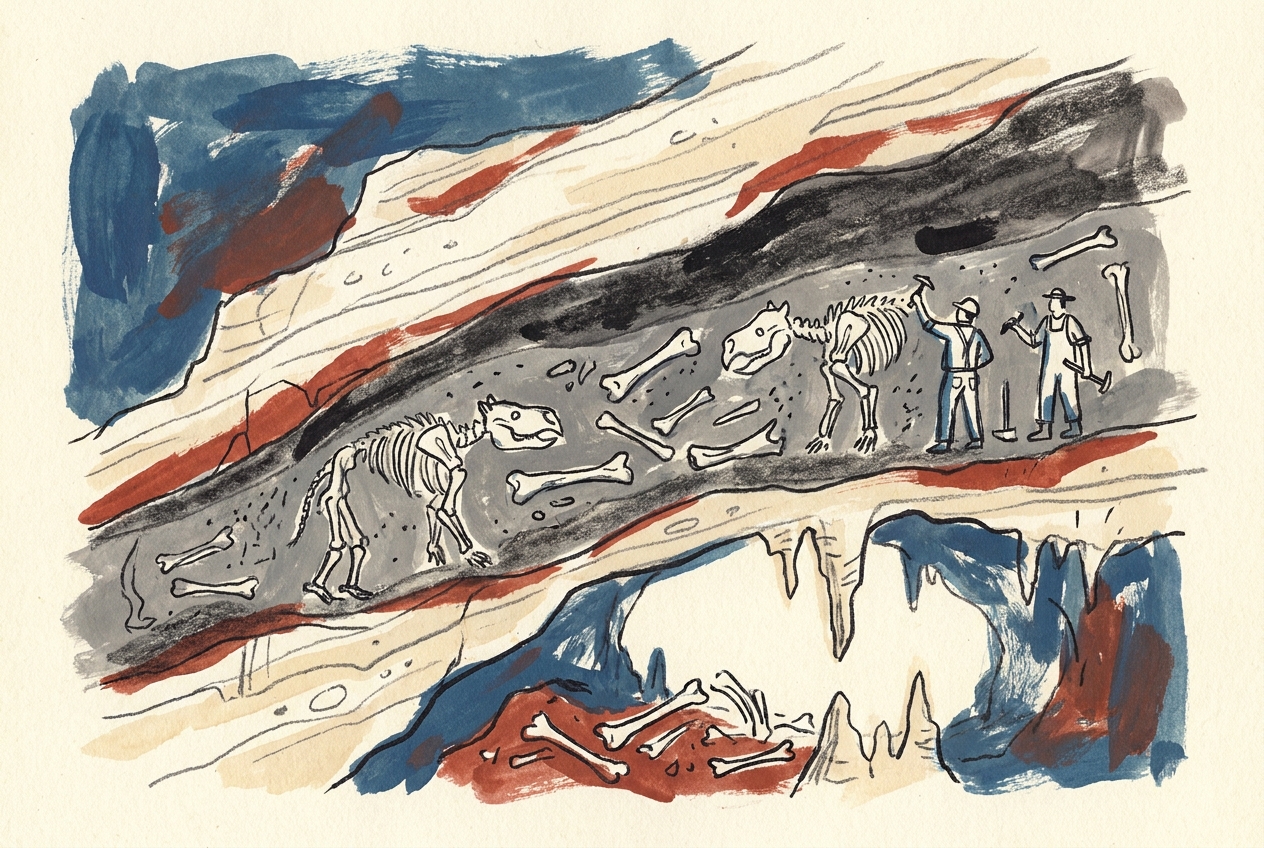
During the Middle Pleistocene, volcanic ash from eruptions in eastern Queensland's volcanic province settled across the landscape. Rain washed the ash into the sinkhole, mixing with sediment and bone. Animals that fell in — or were washed in during flash floods — were buried in layers of ash-rich silt that hardened into a cement-like deposit.
The preservation is exceptional. Bones are not just mineralised; they retain their original shape, surface texture, and sometimes the microscopic structure of the bone tissue. The ash acted as a desiccant, drawing moisture away and slowing bacterial decay.
The Largest Marsupial That Ever Lived
The most common large fossil at Mammoth Cave is Diprotodon optatum, the largest marsupial ever to walk the Earth. Adults stood nearly two metres at the shoulder and weighed as much as a small car — about 2,800 kilograms. They were wombats on a colossal scale.
The diprotodons of Mammoth Cave were not alone. Their bones are mixed with those of Thylacoleo carnifex, the marsupial lion — a stocky, tree-climbing predator with blade-like premolars designed for shearing flesh. Also present: giant kangaroos (Procoptodon), short-faced kangaroos (Sthenurus), and the giant goanna Megalania, which grew to six metres.
One bone bed in the cave contains the remains of at least 12 individual diprotodons, stacked like cordwood — a herd that died together, probably from a single catastrophic event.
The Ash Layer That Ends a World
The extinction of Australia's megafauna happened roughly 46,000 to 50,000 years ago, but the Mammoth Cave fossils are older — around 500,000 to 280,000 years old. The site records a landscape before humans arrived, when giant marsupials still roamed the eucalypt woodlands of eastern Queensland.
The sediments show a pattern: wet periods when the forest thrived, dry periods when the waterholes shrank. The diprotodons survived these cycles. What they could not survive was the combination of climate change and the arrival of the first humans — but that story is not told in this cave.
What Mammoth Cave preserves is a snapshot of a world that was already ancient when humans first saw it. The ash that killed these animals also kept their bones safe for half a million years, waiting for someone to dig them out.
A Record Written in Silt
The Mount Etna cave system contains more than 50 fossil-bearing sites, but Mammoth Cave is the richest. Excavations in the 1970s and 1980s recovered over 20,000 individual bones. The deposit is so dense that paleontologists sometimes work with dental picks and brushes, removing centimetres of sediment per day.
The ash itself tells a story. Chemical analysis of the silt shows it came from eruptions in the McBride Volcanic Province, about 500 kilometres to the northwest. The eruptions were not large by global standards — small, explosive events that scattered ash across the landscape. But that ash was enough to seal the fate of anything caught in the sinkhole.
Today, Mammoth Cave is closed to the public. The entrance is gated, the bones left in place. The diprotodons lie where they fell, still wrapped in the ash that preserved them.
More like this
- The 560-Million-Year-Old Garden That Never Saw a PredatorIn South Australia's Flinders Ranges, 560-million-year-old Ediacara surfaces preserve entire seafloor communities of fronds, discs, and quilts — a garden of soft-bodied life that flourished before pre
- The 300-Million-Year-Old Forest That Died Standing UpIn New South Wales, a 300-million-year-old fossil forest preserves dozens of trees buried upright by a Permian volcanic eruption—an entire ecosystem frozen in ash.
- The 1.75-Billion-Year-Old Reef That Outranks the BarrierA 1.75-billion-year-old microbial reef in the Kimberley is the largest biological structure ever built by a single species, preserving a world without predators.