10 July 2026 · 4 min read
The 1.85-Billion-Year-Old Caldera That Still Feeds the Furnace
In South Australia's Middleback Ranges, a 1.85-billion-year-old volcanic caldera collapsed and later became one of the world's richest iron ore deposits.
On the Eyre Peninsula of South Australia, a 1.85-billion-year-old volcanic caldera collapsed into itself and then filled with lava that cooled into a single, 15-kilometre-long body of granite—a frozen pluton that later became one of the world's richest iron ore deposits.
The Caldera That Became a Batholith
The Gawler Craton is a vast chunk of ancient continental crust that forms the core of southern Australia. Around 1.85 billion years ago, a series of volcanic eruptions built a large caldera complex near what is now the town of Whyalla. Unlike the steep stratovolcanoes of the Andes or Indonesia, these were broad, shield-like structures that periodically collapsed under their own weight. When the roof of the magma chamber fell in, it created a depression that filled with hundreds of cubic kilometres of molten granite.
That granite cooled slowly, over millions of years, deep beneath the surface. Geologists call this kind of body a batholith—a massive intrusion of igneous rock that forms the frozen plumbing of an ancient volcanic system. The Hiltaba Suite granite, as it is known, extends across much of the Gawler Craton. But one part of it, the Middleback Range, underwent a second act that turned ordinary granite into extraordinary ore.
The Iron That Came from the Sea
The iron in the Middleback Ranges did not come from the volcano itself. It came from the ocean. Between 1.6 and 1.8 billion years ago, the shallow seas that covered the Gawler Craton were rich in dissolved iron, precipitated out of seawater by oxygen-producing cyanobacteria. These banded iron formations—layer upon layer of silica and iron oxide—accumulated on the seafloor in beds hundreds of metres thick.
When the Hiltaba Suite granite intruded, it did more than just cool. It heated the surrounding seawater-saturated sediments, driving hydrothermal fluids through the banded iron formations. These fluids dissolved the silica and concentrated the iron, upgrading it from around 30 percent to over 60 percent purity. The result was a series of iron-rich lenses and pods, folded and faulted by later tectonic events, that now form the ridges of the Middleback Range.
The Middleback Ranges are not mountains in the usual sense. They are the exposed cross-sections of a 1.85-billion-year-old volcanic plumbing system, stripped of their cover by 500 million years of erosion.
The Quarry That Exposed a Volcano
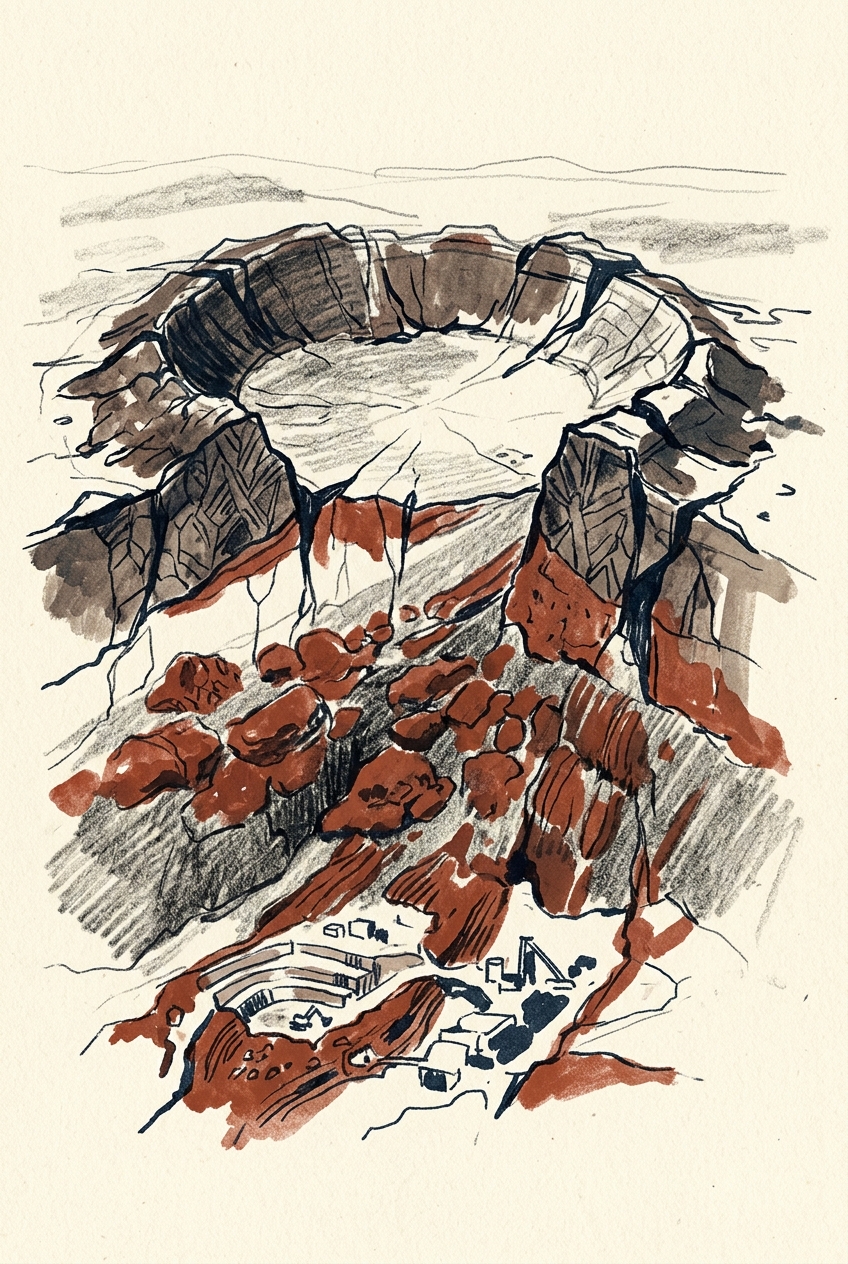
Today, the Middleback Ranges are dominated by open-cut iron ore mines—the largest of which, the Iron Knob, has been operating since 1899. The mine cuts through the heart of the ancient caldera, exposing the contact between the Hiltaba Suite granite and the banded iron formations it altered. In the pit walls, you can see the original volcanic textures: the coarse-grained granite, the sharp contact zones where hydrothermal fluids once flowed, and the folded, rust-red bands of iron ore that were once seafloor sediment.
The scale is hard to grasp. The Iron Knob deposit alone produced over 200 million tonnes of iron ore before it was exhausted in the 1990s. The surrounding deposits—Iron Prince, Iron Baron, Iron Duke—are still being mined today. Together, they form the backbone of South Australia's steel industry, supplying the blast furnaces at Whyalla that have operated continuously since 1964.
The Landscape That Remembers
What makes the Middleback Ranges unusual is not just their economic value. It is the way they preserve the anatomy of a volcano that has been dead for nearly two billion years. The caldera walls, the feeder dykes, the hydrothermal alteration zones—all are exposed in three dimensions by the mining activity. Geologists have mapped the system in extraordinary detail, reconstructing the sequence of eruptions, collapses, and intrusions that built the complex.
Erosion has done the rest. The softer sedimentary rocks that once covered the caldera have been stripped away, leaving the harder granite and iron formation as a series of ridges that rise 200 to 300 metres above the surrounding plain. From a distance, they look like the ribs of some enormous buried animal, exposed by the slow work of wind and water.
The Fire That Still Burns
There is a certain irony in mining iron ore from a volcano. The same heat that concentrated the iron two billion years ago is now being released again, in the blast furnaces of Whyalla and the steel mills of Asia. The energy stored in the Hiltaba Suite's hydrothermal system, the chemical work of the banded iron formations, the tectonic forces that folded and faulted the deposits—all of it converges in a single tonne of steel.
Standing on the rim of the Iron Knob pit, looking down at the exposed granite and the rust-red ore, you are looking at the end point of a chain of causation that stretches back to the Archean oceans. The volcano that built this landscape never erupted in any human lifetime. But its heat still shapes the world.
More like this
- The 300-Million-Year-Old Forest That Died Standing UpIn New South Wales, a 300-million-year-old fossil forest preserves dozens of trees buried upright by a Permian volcanic eruption—an entire ecosystem frozen in ash.
- The 3.5-Billion-Year-Old Cones That Still Catch LightIn the Pilbara's Dresser Formation, 3.5-billion-year-old stromatolites preserve the oldest direct evidence of life on Earth—microbial mats that built layered domes in a volcanic caldera.
- The 825-Million-Year-Old Rift That Failed But Built a WorldA failed 825-million-year-old rift left a 650-kilometre volcanic chain and sedimentary basin in South Australia that preserved the Ediacaran fossils and still shapes the landscape today.