10 July 2026 · 3 min read
The 190,000-Year-Old Lava Tube That Still Holds a River of Stone
In Queensland's Undara volcano, 190,000-year-old lava tubes preserve the longest known flow on Earth—a frozen river of basalt that still shelters bats, ferns, and the memory of Pleistocene fire.
On the rim of an extinct volcano in eastern Queensland, a bridge of solidified lava spans a gorge that has not held a river in 300,000 years. The rock is basalt, but its surface glistens with a black, glassy sheen—the frozen skin of a flow that moved at walking pace, then stopped, and never moved again.
The Undara Lava Tube
Undara is a shield volcano in the McBride Volcanic Province, about 250 kilometres southwest of Cairns. It erupted 190,000 years ago, during the Pleistocene, when Australia's climate was wetter and the eastern highlands were still volcanically restless. The eruption produced a flood of basalt that covered 1,550 square kilometres—one of the longest lava flows on Earth.
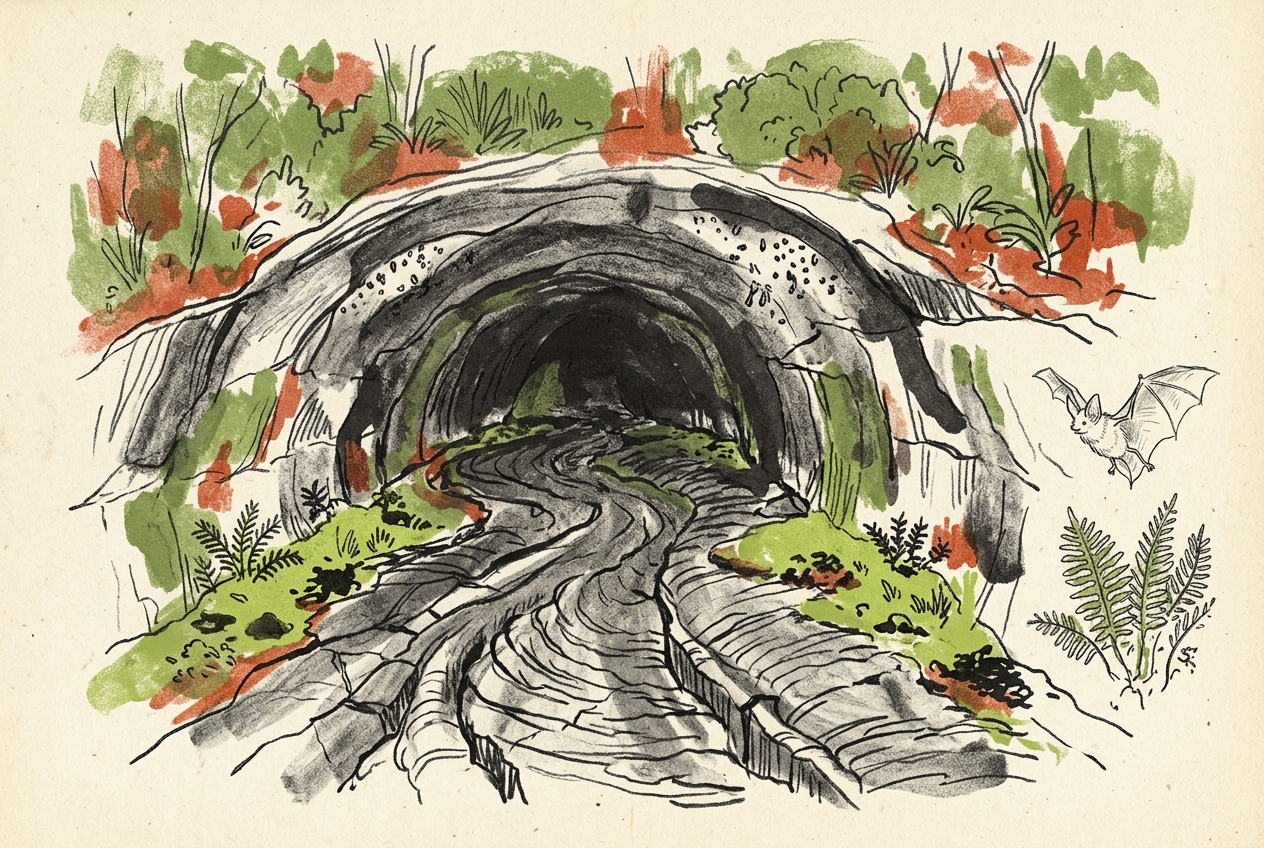
As the surface of the flow cooled and crusted over, the molten interior continued to move downhill, draining out like water from a pipe. What remained was a network of hollow tunnels: lava tubes. Undara's main tube runs for nearly 100 kilometres, making it the longest known lava tube system on the planet. Its roof collapsed in places, creating skylights and entrance pits where trees now take root and wallabies shelter.
Lava does not carve its path; it builds it, one crusted surface at a time.
A Landscape of Frozen Flow
Walking through a lava tube at Undara is to walk inside a vanished river. The walls are striated with flow marks—ropy pahoehoe textures preserved in mid-creep. The floor is corrugated with pressure ridges that formed when the last pulses of lava pushed against the hardened ceiling. In places, stalactites of remelted basalt hang from the roof, formed when hot gases burned through the crust.
The tubes are not merely geological curiosities. They are microclimates. Bats roost in the cool darkness. Ferns and mosses grow where light filters through collapsed sections. The temperature inside a tube can be 15 degrees Celsius cooler than the surface—a refuge for species that retreated south during the last glacial maximum and never left.
How a Shield Volcano Sleeps
Undara is a shield volcano, named for its low, broad shape that resembles a warrior's shield lying on the ground. Unlike the steep stratovolcanoes of subduction zones, shields are built by thin, runny basalt that spreads over great distances. Undara's slopes rise only 150 metres above the surrounding plain, yet the volume of its lava is immense: more than 23 cubic kilometres.
The volcano has not erupted in 100,000 years, but seismic imaging shows that magma still exists at depth beneath the McBride Province. The province sits on a hot spot—a plume of mantle material that has been rising beneath eastern Queensland for the past 35 million years as the Australian plate drifts northward. Undara is not dead; it is dormant.
The Life of a Tube
Lava tubes do not last forever. Over thousands of years, water seeps through cracks in the basalt, dissolving minerals and depositing secondary calcite and opal. Roots of fig trees penetrate the ceiling, widening cracks until sections collapse. The longest tube at Undara is already broken into segments, separated by fallen blocks and sediment fill.
In 100,000 years, the tubes will be unrecognisable. The basalt will weather to red clay, the skylights will fill, and the forest will reclaim the ground. But for now, the landscape still holds the shape of a river of stone—a record not of destruction, but of motion arrested mid-stride.
More like this
- The 5,000-Year-Old Volcanoes That Still Smoke in the SouthIn Victoria's Newer Volcanics Province, 400 volcanic vents erupted as recently as 5,000 years ago—the youngest volcanic field in mainland Australia, where craters still hold blue lakes and scoria cone
- The 300-Million-Year-Old Forest That Died Standing UpIn New South Wales, a 300-million-year-old fossil forest preserves dozens of trees buried upright by a Permian volcanic eruption—an entire ecosystem frozen in ash.
- The 1.75-Billion-Year-Old Reef That Outranks the BarrierA 1.75-billion-year-old microbial reef in the Kimberley is the largest biological structure ever built by a single species, preserving a world without predators.