24 May 2026 · 3 min read
The Magma That Built a Mountain of Jade: Western Australia's Enderby Island Nephrite
How 1.2-billion-year-old metamorphism in Western Australia's Enderby Island created one of the world's largest deposits of nephrite jade, recording a collision between two ancient continents.
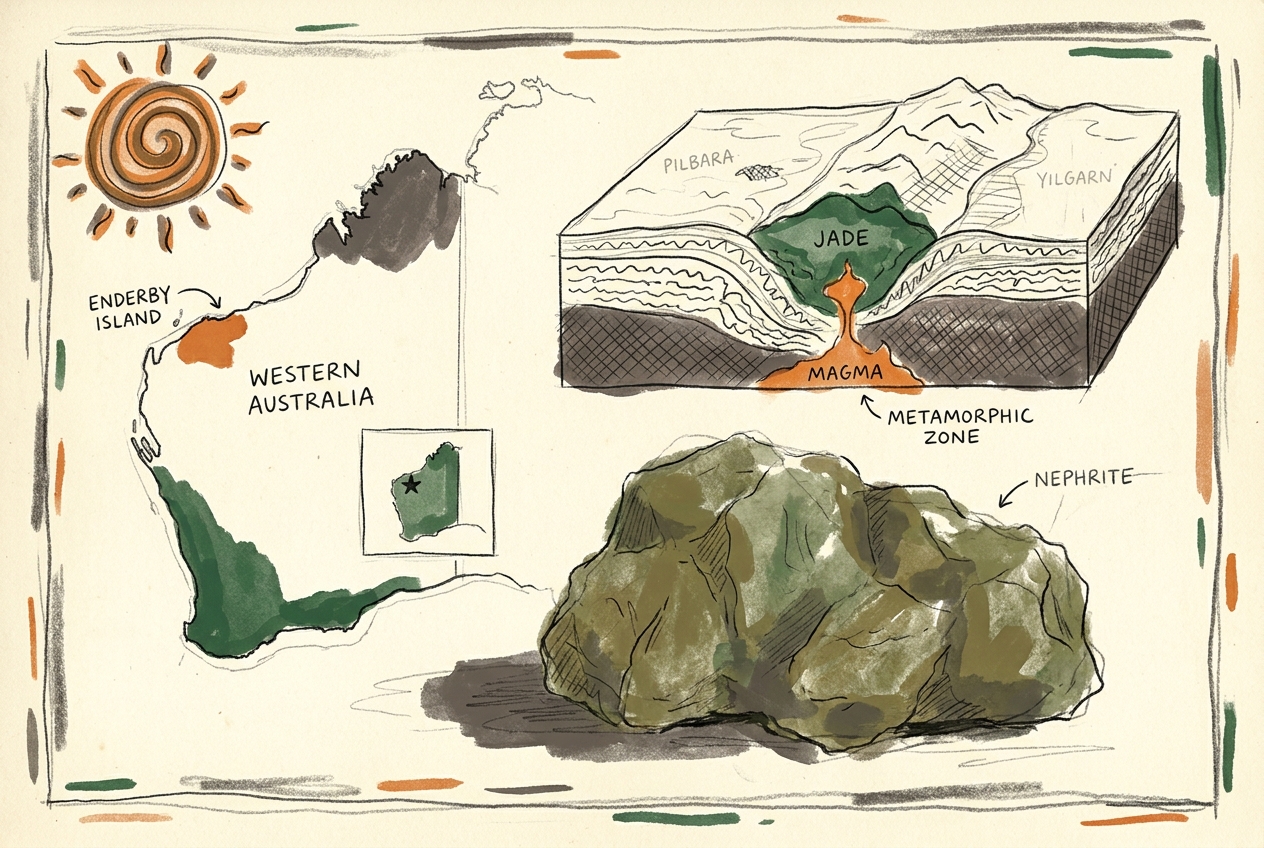
On the southern coast of Western Australia, a slab of rock the colour of frozen sea ice leans against the shore. It is nephrite jade—one of the two minerals sold as jade—and it forms a cliff more than a kilometre long. This is the Enderby Island jade deposit, and it is one of the largest known occurrences of nephrite on Earth.
The Collision That Cooked the Rock
The story begins 1.2 billion years ago, when two blocks of continental crust collided along what is now the coast of Western Australia. The Fraser Range and the Albany-Fraser Orogen record this event: a mountain-building episode that buried ancient oceanic crust and sedimentary rocks deep beneath the collision zone.
At depths of 15 to 20 kilometres, temperatures reached 500 to 700 degrees Celsius. The rocks underwent metamorphism—recrystallisation under intense heat and pressure. A magnesium-rich rock called serpentinite, itself an altered piece of ancient seafloor, reacted with silica-bearing fluids squeezed out of the surrounding sediments. The result was nephrite, a dense, tough amphibole mineral composed of interlocking fibres so tightly bound that the rock is nearly unbreakable.
Nephrite forms only under specific conditions: the right chemistry, the right pressure, the right temperature, and water circulating through the system. The Albany-Fraser Orogen provided all four.
A Landscape Carved by Ice and Time
The Enderby Island deposit lies within the Recherche Archipelago, a scatter of more than a hundred islands off the coast east of Esperance. The islands are the exposed tips of a drowned landscape, the result of sea levels rising after the last ice age.
Glaciers scoured this region during the Permian, 300 million years ago, and again in the Pleistocene. They stripped away the softer rock that once covered the jade, leaving the nephrite exposed in a massive pod—a lens-shaped body roughly 1.2 kilometres long and 30 metres thick. The ice also polished the stone to a smooth, dark green surface that glistens in the southern light.
Unlike the translucent green jadeite prized in Myanmar, this Australian nephrite is opaque, ranging from deep bottle-green to pale apple-green, often streaked with black veins of chromite. It is the same material the Māori of New Zealand called pounamu, carved into tools and ornaments for centuries.
The Stone That Cannot Break
Nephrite jade is among the toughest natural materials on Earth. Its fibrous microstructure, with crystals interwoven like felt, gives it a fracture toughness greater than steel. A hammer blow that would shatter granite will merely dent nephrite.
This toughness made it valuable to Aboriginal peoples long before European geologists identified it. Stone axes made from nephrite have been found across southern Australia, carried hundreds of kilometres from their source. The Enderby Island deposit shows evidence of quarrying—flake scars and half-finished blanks—that predates European contact by centuries.
In the 1960s, commercial miners recognised the deposit's scale. For two decades, blocks of jade were extracted by helicopter and shipped to Asia for carving. The operation ended in the 1980s, partly due to the difficulty of working such resistant stone, partly because the remote location made extraction uneconomic. The jade cliff remains, largely untouched.
The same forces that build mountains can, under the right conditions, produce something beautiful enough to be carried across a continent.
What the Jade Records
The Enderby Island nephrite is more than a gemstone. It is a record of a specific tectonic event—the assembly of the supercontinent Rodinia. The Albany-Fraser Orogen marks the suture where Australia's Yilgarn Craton, a 2.7-billion-year-old chunk of continental crust, collided with the much smaller Madura Province. Without that collision, there would be no jade.
Similar nephrite deposits occur in British Columbia, New Zealand, and Siberia—each one tied to a similar sequence of events: subduction, serpentinisation, metamorphism, and the right chemical exchange. Australia's Enderby Island deposit is unusual for its size, its exposure, and the clarity with which it records the process.
The jade cliff remains where the glaciers left it. It is a piece of deep Earth brought to the surface, polished by ice, and waiting for someone to read its history in the green of its grain.
More like this
- The 825-Million-Year-Old Rift That Failed But Built a WorldA failed 825-million-year-old rift left a 650-kilometre volcanic chain and sedimentary basin in South Australia that preserved the Ediacaran fossils and still shapes the landscape today.
- The 1.2-Billion-Year-Old Volcano That Turned Diamonds PinkIn Western Australia's East Kimberley, a 1.2-billion-year-old lamproite volcano brought diamonds from the mantle and, through a rare process of crystal deformation, produced 90% of the world's pink di
- The 400-Million-Year-Old Volcanic Arcs That Built a Continent's EdgeThe Lachlan Fold Belt is the largest accretionary orogen on Earth, a 400-million-year-old jumble of volcanic arcs and seafloor sediments that built the eastern third of Australia.