24 May 2026 · 3 min read
The Ash That Painted a Desert in Gold and Rust: South Australia's Arkaroola Hydrothermal System
How 1.6-billion-year-old hydrothermal veins in South Australia's Arkaroola region deposited copper, gold, and uranium, creating a mineralised landscape that still leaks hot water today.
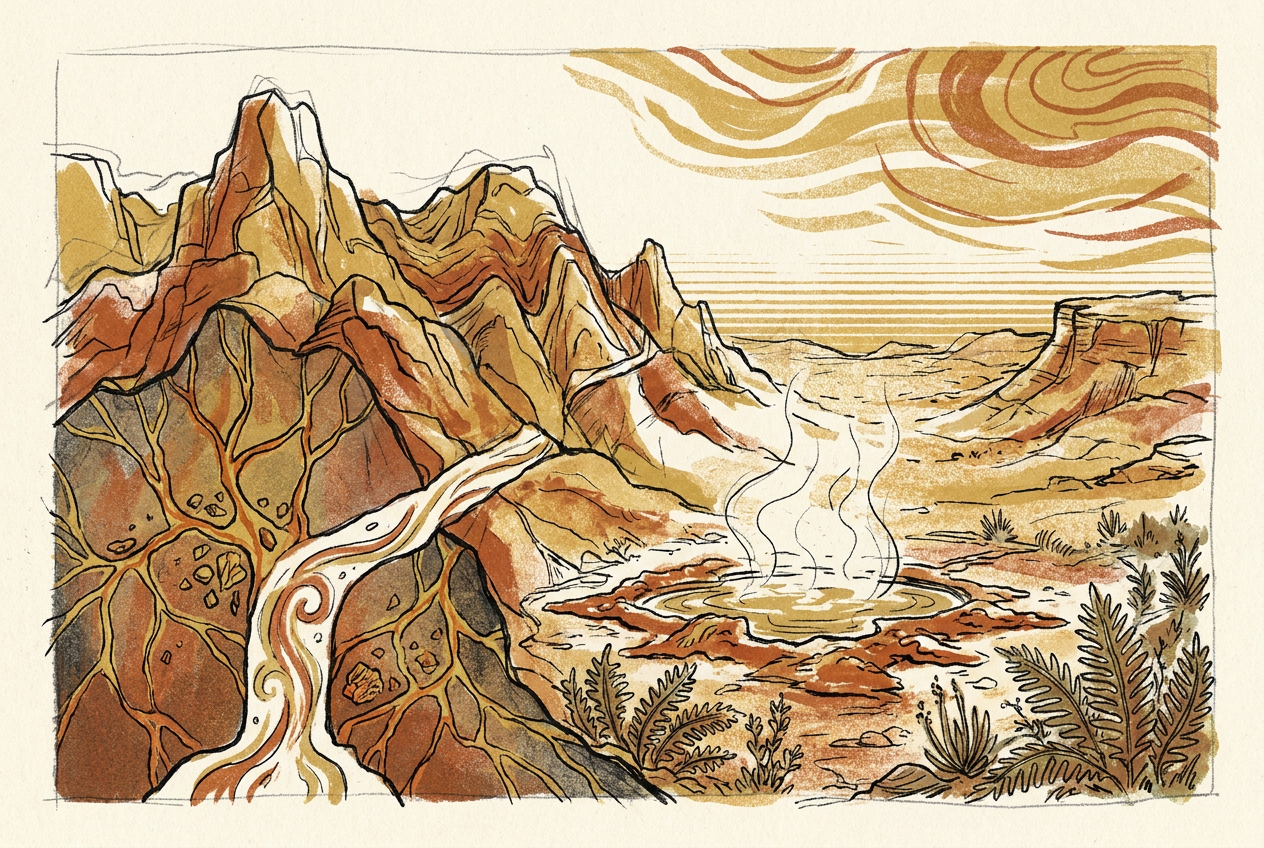
In the northern Flinders Ranges, a ridge of rust-red rock bleeds green. The green is malachite, a copper carbonate mineral that stains the cliffs of Arkaroola like a bruise. Beneath it runs a web of quartz veins, some as wide as a man's arm, carrying gold, silver, and uranium that have been seeping from the earth for more than a billion years.
The Plumbing of an Ancient Continent
The Arkaroola region sits on the Gawler Craton, a chunk of continental crust that stabilised around 1.6 billion years ago. Not long after it cooled, the crust began to crack. Deep fractures opened along the margins of the craton, and hot mineralised fluids—brines heated by buried granite—rose through the fissures like water through a wound.
These fluids carried dissolved metals leached from the surrounding rock. As they rose, they cooled and reacted with the host rock, precipitating their load. Copper came down as chalcopyrite and bornite, gold as native metal, uranium as uraninite and coffinite. The veins they filled are what geologists call a polymetallic hydrothermal system—a single plumbing network that deposited several different ore minerals in overlapping pulses.
The Arkaroola system is not a single mine but a district: more than 80 separate mineral occurrences spread across 600 square kilometres of broken, red country.
The Paralana Fault, a major structure running north-south through the region, acted as the master conduit. Along its length, the veins are richest where the fault bends or splays, creating pockets of dilation where the hot fluids could pool and deposit their cargo.
A Landscape That Leaks
The Arkaroola hydrothermal system did not switch off when the Proterozoic ended. It is still active today. At Paralana Hot Springs, groundwater heated by radioactive decay rises along the same ancient fractures, emerging at 65 degrees Celsius. The water carries radon gas, dissolved uranium, and a faint sulphur smell—the breath of a system that has been exhaling for a billion years.
This ongoing circulation has created a distinctive surface expression. The oxidised cap of the veins—the gossan—forms a hard, rusty carapace of iron oxides and secondary copper minerals. Prospectors in the 19th century followed these coloured outcrops into the hills, and their picks and shovels opened some of the first copper shows in South Australia.
The Arkaroola region was also the site of Australia's first commercial uranium mine, at Radium Ridge, worked between 1910 and 1914 for radium salts used in medical therapy. The miners dug by hand, following the green stains of autunite—a uranium mineral that glows yellow-green under ultraviolet light.
What the Veins Remember
The Arkaroola veins preserve a record of the Gawler Craton's thermal history. The mineral assemblages tell geologists the temperature and pressure at which the fluids deposited their load. Early high-temperature veins carry molybdenite and bismuth; later, cooler fluids deposited copper and uranium. The sequence records the slow cooling of the craton's interior over tens of millions of years.
The system also reveals something about the mobility of uranium. In most rocks, uranium is locked in trace amounts within minerals like zircon. But in the Arkaroola fluids, uranium moved as a dissolved complex, travelling kilometres before precipitating. This mobility is why the region contains some of the highest-grade uranium occurrences in Australia—and why it remains a target for exploration.
A single drill core from the Mount Gee area, taken in the 1970s, intersected a vein containing 56 percent uranium oxide. The core is stored in a shed in Adelaide, wrapped in lead foil, still radioactive enough to fog film.
The Unfinished Story
The Arkaroola hydrothermal system is not exhausted. The Paralana Fault continues to focus groundwater flow, and the heat from radioactive decay sustains a geothermal gradient that keeps the fluids warm. In 2003, a geothermal exploration company drilled into the system and encountered water at 98 degrees Celsius at a depth of 1.6 kilometres—hot enough to flash to steam.
The system also continues to leak uranium into the local drainage. The creeks that run off Radium Ridge carry elevated uranium concentrations, and the sediments of Lake Frome, downstream, contain uranium anomalies that reflect a billion years of erosion from the same veins.
What the Arkaroola system shows is that mineralisation is not a fossil event. It is a process that can persist as long as the crust remains warm, the faults remain open, and the water keeps circulating. The veins are not dead—they are sleeping.
More like this
- The 2.5-Billion-Year-Old Volcano That Still Holds 3,000 Tonnes of CopperIn South Australia's Olympic Dam, a 2.5-billion-year-old volcanic-hydrothermal system created the largest uranium deposit on Earth and a copper resource so vast it reshaped an industry.
- The 3.5-Billion-Year-Old Lava That Still Tastes of the MantleIn the Pilbara, 3.5-billion-year-old komatiite lavas preserve the chemical fingerprint of the Earth's pristine mantle—unaltered by plate tectonics or crustal contamination.
- The 1.1-Billion-Year-Old Magma Chamber That Became a Mountain RangeHow a 1.1-billion-year-old magma chamber in South Australia's Mount Painter Province cooked the surrounding rock into rare radioactive minerals, then rose from the earth as a mountain range that still