17 June 2026 · 4 min read
The Heat That Cooked a Billion-Dollar Vein: Tasmania's Renison Bell Tin
: How 370-million-year-old granites in western Tasmania forced tin-bearing fluids into fractured sedimentary rock, creating one of the world's richest tin deposits and a record of continental collisio
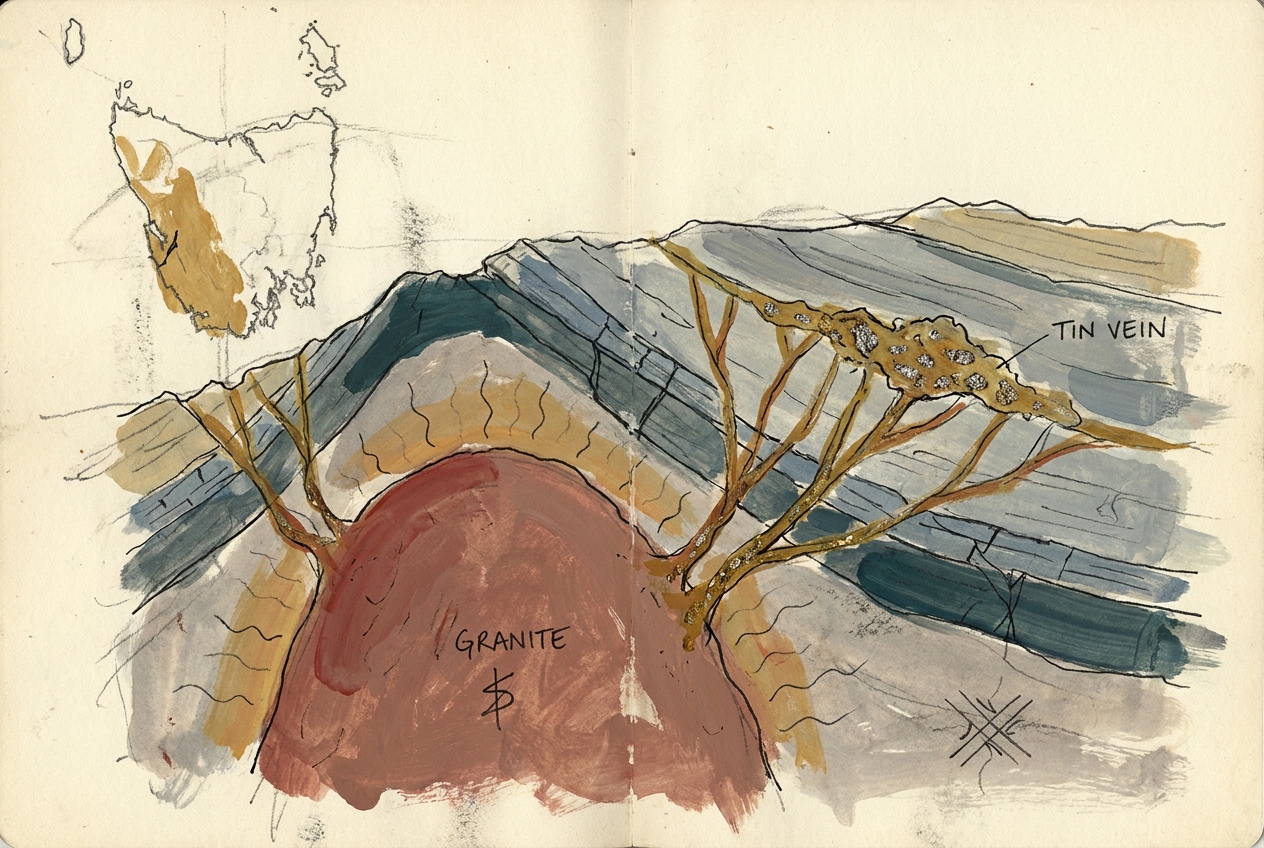
In western Tasmania, a ridge of dark grey rock called Renison Bell holds more tin than almost any other place on Earth. The metal did not arrive by chance. It was cooked out of a cooling granite pluton 370 million years ago, then forced into cracks in the surrounding sedimentary rock like steam finding a leak.
The Granite That Cried Tin
Deep beneath western Tasmania, a body of molten granite intruded into older sedimentary rocks during the Devonian period — a time when the supercontinent Gondwana was being squeezed by tectonic forces. As the granite cooled and crystallised, it expelled the last remnants of its fluid: hot, metal-laden brines that carried tin, tungsten, and copper.
These fluids rose through fractures in the overlying rock until they met the Dundas Group, a sequence of mudstone and sandstone deposited in a deep marine basin some 500 million years earlier. The chemical contrast between the hot brines and the iron-rich sedimentary rock triggered precipitation. Tin dropped out of solution as the mineral cassiterite, filling veins and replacing the rock itself.
The result was a series of tabular ore bodies — some up to 30 metres thick — that follow the bedding planes of the host rock like pages in a book. Miners call them "floors." Geologists call them replacement bodies. Either way, they represent one of the most concentrated tin systems on the planet.
The metal was not deposited all at once. It arrived in pulses, each new surge of fluid adding another layer to the vein.
A Landscape Built on Metal
Tasmania's west coast is a geologist's maze. The region has been folded, faulted, and intruded multiple times over 500 million years. The same tectonic forces that created Renison Bell also generated the Mount Read Volcanics — a belt of volcanic rock that hosts copper, lead, zinc, gold, and silver, including the famous Rosebery mine.
But Renison Bell is different. While most of Tasmania's mineral deposits are volcanic in origin, Renison Bell is plutonic — its tin came directly from a granite body that never reached the surface. The granite itself, known as the Meredith Granite, is exposed only in a few small outcrops. Most of it remains hidden kilometres underground, its presence betrayed only by the metal it left behind.
This is a common pattern in tin deposits worldwide. The metal is incompatible in most minerals, so it concentrates in the last, most evolved fraction of a cooling magma. Without a granite source, there is no tin. And without a chemical trap in the surrounding rock, the tin disperses into nothing.
The Deep Time of a Mine
Renison Bell has been mined continuously since the 1890s. Early miners followed surface outcrops of cassiterite — black, heavy, and surprisingly hard — into the hillside. As they dug deeper, they found the ore bodies grew richer and thicker. Today the mine extends more than 600 metres below the surface, following the same veins that formed in the Devonian.
The mining itself has become a kind of geology. Each new drive or cross-cut reveals another chapter of the deposit's history. Some veins are massive, almost pure cassiterite. Others are thin stringers that require careful sorting. The variation records the changing chemistry of the hydrothermal system over tens of thousands of years.
Geologists have identified at least four distinct phases of mineralisation at Renison Bell, each with a different ratio of tin to copper to iron. The earliest veins are copper-rich. The later ones are almost pure tin. This sequence suggests the granite source was cooling and evolving over time, releasing different metals as it solidified.
What the Tin Remembers
Tin is a stubborn metal. It resists corrosion, does not oxidise easily, and remains stable under most surface conditions. This is why cassiterite — tin oxide — is the only economically important tin mineral. It survives weathering, transport, and burial. Placer deposits of cassiterite, eroded from veins and concentrated in river gravels, have been mined since the Bronze Age.
At Renison Bell, the cassiterite never made it into a river. It stayed in place, locked inside the vein system, protected by the very rock that trapped it. The same tectonic forces that created western Tasmania's rugged mountains also preserved the deposit from erosion.
This is rare. Most ancient hydrothermal systems are destroyed by uplift and weathering. Renison Bell survived because it was buried quickly after formation, then exhumed slowly over millions of years. The result is a window into a process that normally happens out of sight, kilometres beneath our feet.
Every tonne of tin pulled from the ground at Renison Bell is a fragment of that deep history — a metal that spent 370 million years waiting to be found.
More like this
- The 5,000-Year-Old Volcanoes That Still Smoke in the SouthIn Victoria's Newer Volcanics Province, 400 volcanic vents erupted as recently as 5,000 years ago—the youngest volcanic field in mainland Australia, where craters still hold blue lakes and scoria cone
- The 1.85-Billion-Year-Old Caldera That Still Feeds the FurnaceIn South Australia's Middleback Ranges, a 1.85-billion-year-old volcanic caldera collapsed and later became one of the world's richest iron ore deposits.
- The 190,000-Year-Old Lava Tube That Still Holds a River of StoneIn Queensland's Undara volcano, 190,000-year-old lava tubes preserve the longest known flow on Earth—a frozen river of basalt that still shelters bats, ferns, and the memory of Pleistocene fire.