10 July 2026 · 3 min read
The 825-Million-Year-Old Rift That Failed But Built a World
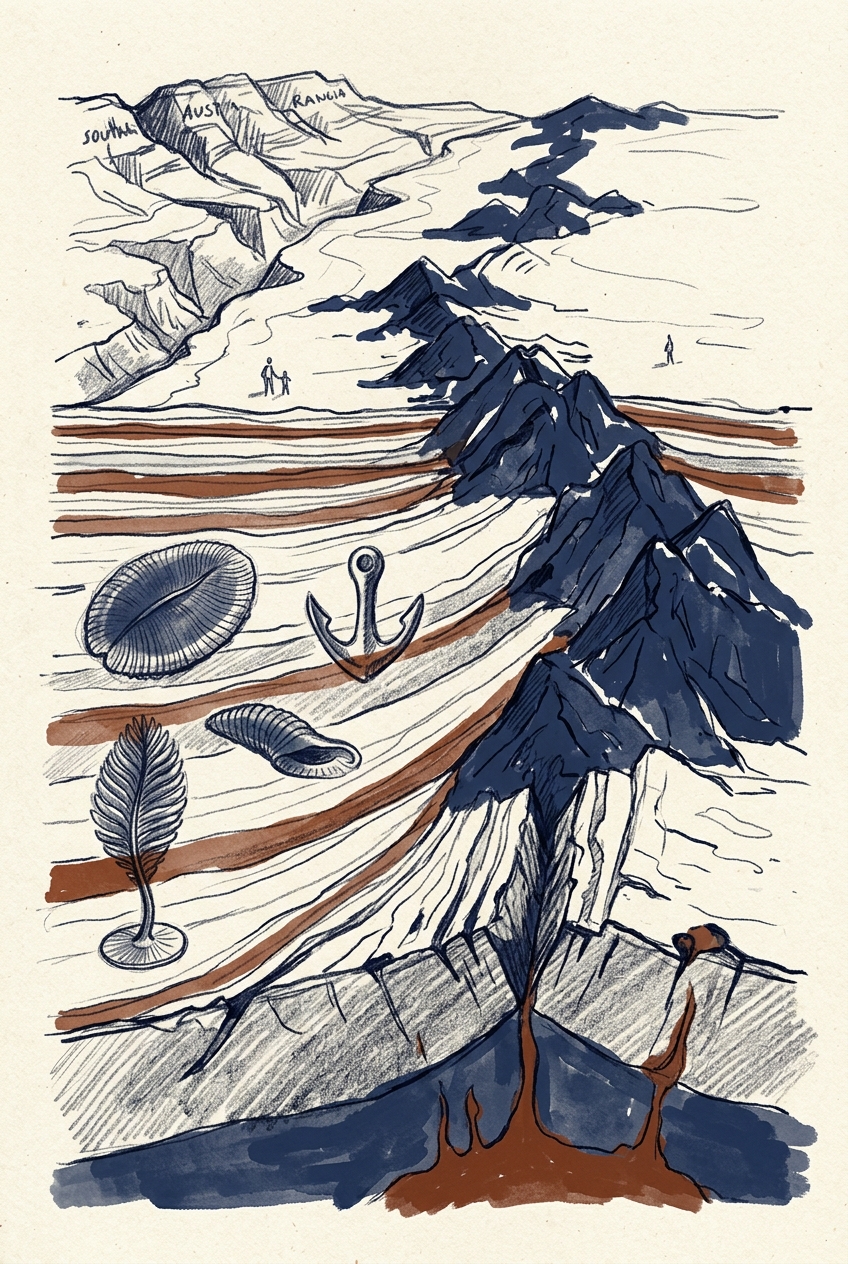
A failed 825-million-year-old rift left a 650-kilometre volcanic chain and sedimentary basin in South Australia that preserved the Ediacaran fossils and still shapes the landscape today.
Some time around 750 million years ago, a failed rift along the edge of the Neoproterozoic continent left behind something unexpected: a 650-kilometre-long chain of volcanic rock, buried, re-exposed, and now known as South Australia's Mount Lofty and Flinders Ranges. The same tectonic forces meant to split a supercontinent instead created one of the most complete volcanic-sedimentary archives on Earth—and, in the process, a landscape that still shapes where people live today.
A mantle plume that arrived too late
During the breakup of the supercontinent Rodinia, a mantle plume rose beneath what is now the eastern margin of Australia. It stretched and thinned the crust, but the rifting never fully succeeded. Instead of opening an ocean basin, the failed rift left behind kilometres of basaltic and rhyolitic lava flows, ash layers, and eroded volcanic debris, now gathered into the Adelaide Rift Complex.
The volcanic rocks of the Mount Barren Group and the Gairdner Dyke Swarm date to roughly 825 million years ago. They appear today as dark, weathered ridges that cut across the pastoral landscape between Port Augusta and the Eyre Peninsula. In places, the dykes still preserve their original columnar joints—cooling fractures that formed as thick basalt sheets shrank while solidifying. The failed rift never saw the sea, but it gave rise to a basin that later filled with the sediments of the Ediacaran and Cambrian.
A basin that recorded the dawn of animals
That basin became the Flinders Ranges. For 300 million years, from the Neoproterozoic into the Cambrian, it accumulated layer after layer of sediment—sandstone, limestone, shale—much of it laid down in shallow seas that repeatedly advanced and retreated. The underlying volcanic ridges controlled where the basin formed, funnelling currents and controlling water depth.
The result is a fossil archive unmatched anywhere else. The Ediacaran organisms—Dickinsonia, Spriggina, Funisia—preserved in these sediments owe their existence to that failed rift. Without the subsidence created by the volcanic event, there would be no deep basin to capture and preserve the soft-bodied communities that lived on the ancient seafloor.
The same failed rift that left volcanic dykes across the land also dug the trough that would later gather the fossils of Earth's first complex life.
A landscape that still moves
Today, the Flinders and Mount Lofty Ranges remain tectonically active. The boundary between the Archaean craton of the Gawler block and the younger sedimentary basin is a fault system that still shows Quaternary movement. The 1954 Adelaide earthquake, magnitude 5.4, was a reminder that the failed rift has not fully healed.
Uplift over the last few million years has exposed the old volcanic rocks and the sediments that once buried them. The result is a landscape of parallel ridges and valleys that run north-south, often marked by the dark outcrops of weathered basalt or the orange-red stain of iron-rich paleosols. The same structural weaknesses that guided Neoproterozoic magma now direct the course of rivers and the alignment of modern roads.
What a failed rift teaches
Most attention goes to successful rifts—those that split continents, opened oceans, and shaped the modern plate mosaic. But the failures are just as instructive. The Adelaide Rift Complex records a planet that tried to tear itself apart but could not, leaving behind a deep, sediment-rich trough and a chain of buried volcanoes. These features nurtured the first animal life, preserved its remains, and still control where the ground shakes today.
A tectonic near-miss, frozen in stone for three-quarters of a billion years, is not a failure at all. It is a foundation.
More like this
- The 560-Million-Year-Old Garden That Never Saw a PredatorIn South Australia's Flinders Ranges, 560-million-year-old Ediacara surfaces preserve entire seafloor communities of fronds, discs, and quilts — a garden of soft-bodied life that flourished before pre
- The 300-Million-Year-Old Forest That Died Standing UpIn New South Wales, a 300-million-year-old fossil forest preserves dozens of trees buried upright by a Permian volcanic eruption—an entire ecosystem frozen in ash.
- The 1.85-Billion-Year-Old Caldera That Still Feeds the FurnaceIn South Australia's Middleback Ranges, a 1.85-billion-year-old volcanic caldera collapsed and later became one of the world's richest iron ore deposits.