9 July 2026 · 2 min read
The 400-Million-Year-Old Volcanic Arcs That Built a Continent's Edge
The Lachlan Fold Belt is the largest accretionary orogen on Earth, a 400-million-year-old jumble of volcanic arcs and seafloor sediments that built the eastern third of Australia.
The volcanic rock beneath your feet in southeastern Australia was born in the Pacific Ocean, thousands of kilometres east of where it now rests. The Lachlan Fold Belt, a 400-million-year-old jumble of volcanic arcs, deep-sea sediments, and crumpled seafloor, was never part of the Australian continent until plate tectonics welded it on. It is the largest accretionary orogen on Earth, and it built the eastern third of a continent.
The Architecture of Collision
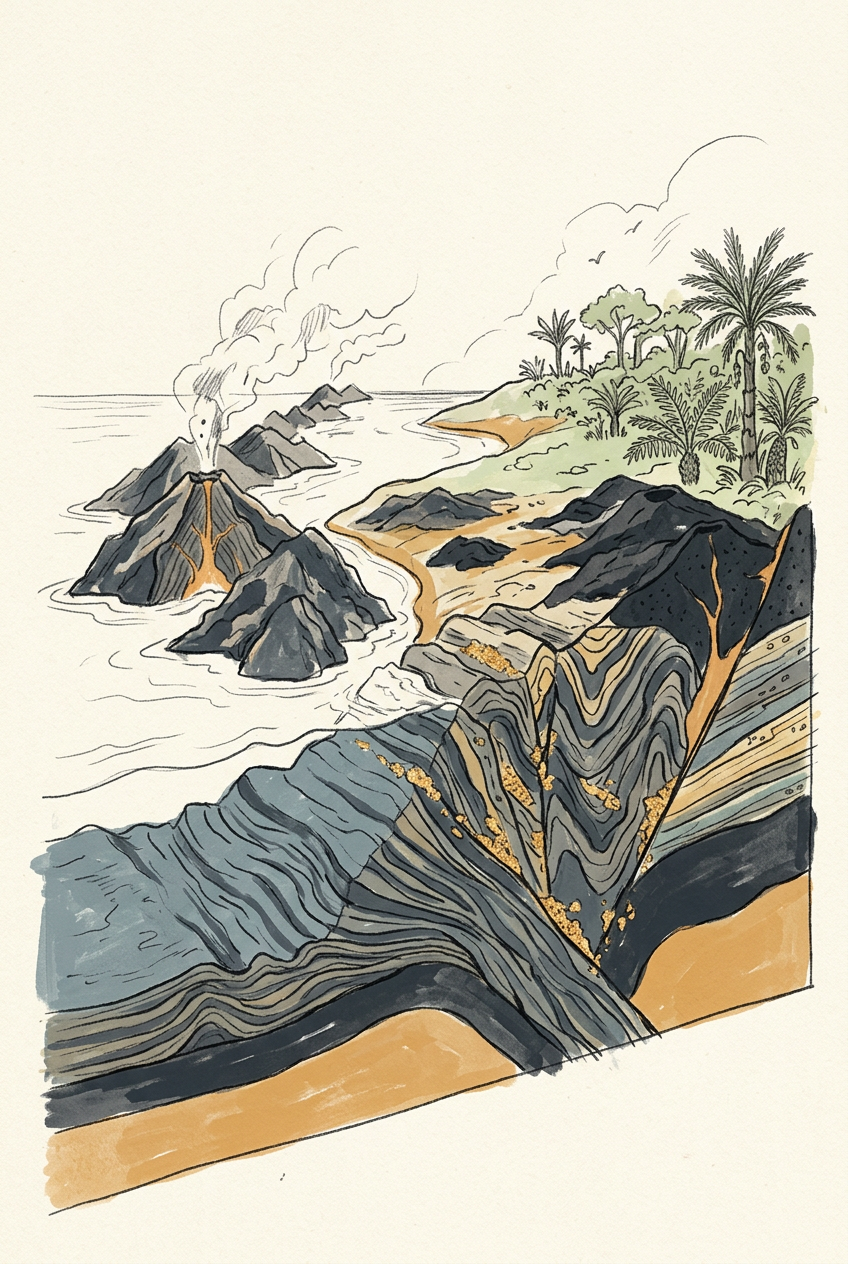
The Lachlan Fold Belt stretches from Queensland through New South Wales and Victoria to Tasmania. It formed during the Silurian and Devonian periods, roughly 440 to 360 million years ago, when a series of volcanic island arcs — chains of submarine volcanoes like those in the modern western Pacific — slammed into the eastern edge of the ancient Australian continent. Each collision added a new slice of crust, like pages being pressed into a book.
The rocks tell the story plainly. In the Snowy Mountains, you find the remains of deep-sea trenches: turbidites, black shales, and cherts that accumulated on an ocean floor long since consumed. Near Batemans Bay, pillow lavas preserve the shapes of magma that erupted underwater, their rounded forms still visible in roadcuts along the Princes Highway.
The eastern third of Australia is a geological patchwork, stitched together by forces that are still at work.
The Volcanic Engine
The volcanic arcs that built the Lachlan Fold Belt were not quiet. Silurian volcanoes erupted in shallow seas, building thick piles of lava and volcanic ash that now form the backbone of the Kosciuszko region. These volcanoes produced some of Australia's most valuable mineral deposits: the copper-gold porphyries of Cadia Ridge, the tin and tungsten of the New England region, and the slate-belt gold that drove the first gold rushes in New South Wales.
At Cadia, 400 kilometres west of Sydney, a 440-million-year-old volcanic complex still holds one of the world's largest gold-copper deposits. The ore formed when hot, mineral-rich fluids circulated through the volcanic rocks, depositing gold and copper in fractures and veins. The mining pit there today descends through the guts of a Silurian volcano.
A Continent Rebuilt
The Lachlan Fold Belt is not finished. The same plate boundary that drove those ancient collisions still runs along Australia's eastern margin, now expressed as the subduction zone east of New Zealand. The belt is being slowly uplifted, its rocks exposed by erosion, its gold deposits brought closer to the surface. The Snowy Mountains, the highest peaks in Australia, are the eroded core of this ancient mountain-building event.
What is remarkable is the scale. The Lachlan Fold Belt covers roughly 400,000 square kilometres — larger than Germany and France combined. It contains more than 100,000 cubic kilometres of volcanic rock. And it was assembled piece by piece, arc by arc, over 80 million years of relentless plate movement.
Australia did not always look the way it does now. The eastern seaboard, from the tropical beaches of Queensland to the cool forests of Tasmania, is built on ground that once lay beneath the Pacific. The continent grew not by splitting apart, but by catching the debris of a long-vanished ocean.
More like this
- The 5,000-Year-Old Volcanoes That Still Smoke in the SouthIn Victoria's Newer Volcanics Province, 400 volcanic vents erupted as recently as 5,000 years ago—the youngest volcanic field in mainland Australia, where craters still hold blue lakes and scoria cone
- The 300-Million-Year-Old Forest That Died Standing UpIn New South Wales, a 300-million-year-old fossil forest preserves dozens of trees buried upright by a Permian volcanic eruption—an entire ecosystem frozen in ash.
- The 1.85-Billion-Year-Old Caldera That Still Feeds the FurnaceIn South Australia's Middleback Ranges, a 1.85-billion-year-old volcanic caldera collapsed and later became one of the world's richest iron ore deposits.