9 July 2026 · 3 min read
The 1.2-Billion-Year-Old Volcano That Turned Diamonds Pink
In Western Australia's East Kimberley, a 1.2-billion-year-old lamproite volcano brought diamonds from the mantle and, through a rare process of crystal deformation, produced 90% of the world's pink di
Ninety percent of the world's pink diamonds came from a single volcanic pipe buried in the remote East Kimberley—a billion-year-old eruption that brought the rarest gemstone on Earth to the surface and then sealed it beneath sandstone for most of geological time.
The Eruption That Broke the Rules
Most diamonds arrive at the surface through kimberlite pipes, a type of volcanic conduit named after Kimberley, South Africa. The Argyle pipe, discovered in 1979 by geologists searching for alluvial diamonds, is something else entirely. It is a lamproite—a potassium-rich volcanic rock with a different mineral recipe and a much more violent temperament.
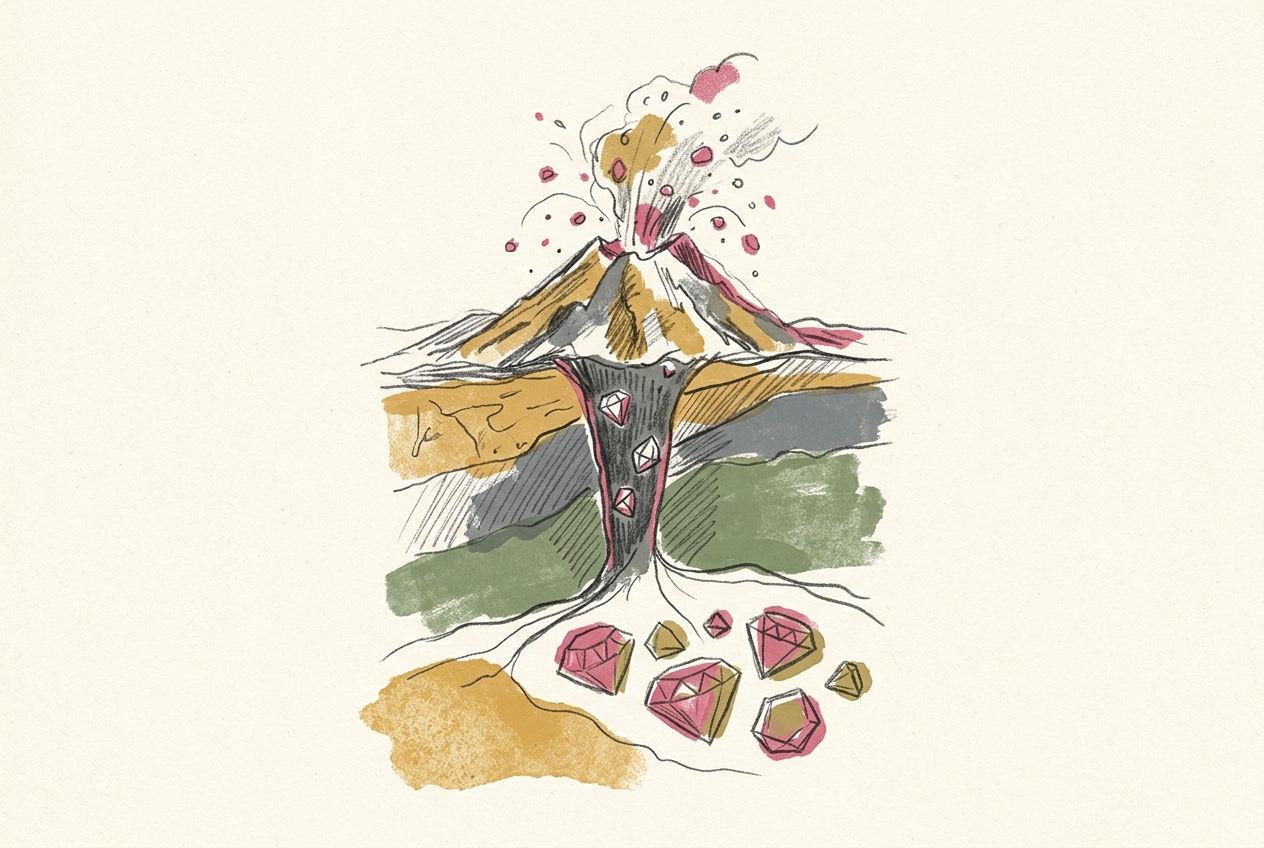
Around 1.2 billion years ago, a column of lamproite magma tore upward through the crust of what is now northern Australia. It moved fast, carrying cargo from the mantle: diamonds that had crystallised 200 kilometres deep, perhaps 500 million years or more before the eruption itself. The magma erupted explosively, forming a crater nearly two kilometres across. Within hours, the pipe had filled with volcanic breccia—broken rock, ash, and diamonds, all frozen in place.
What makes Argyle unusual is not just its rock type. Most lamproites are barren. Argyle contained one of the highest diamond concentrations ever found, up to six carats per tonne in the richest zones.
The Deformation That Created Colour
Diamonds are colourless when their carbon atoms form a perfect cubic crystal lattice. Colour appears when something disrupts that lattice. Nitrogen atoms clustered together produce yellow. Boron produces blue. But pink is different.
The pink diamonds of Argyle were not coloured by an impurity. They were coloured by pressure. During the violent ascent to the surface, the diamonds experienced plastic deformation—their crystal lattices were literally bent and twisted. This deformation, called lamellar twinning, alters how light passes through the stone. A diamond that was once colourless became pink, or red, or brown, depending on the intensity of the distortion.
One in a million rough diamonds from Argyle was pink enough to be sold as a gem. The rest were brown or otherwise imperfect, crushed and used for industrial abrasives.
The deformation happened in seconds, deep in the volcanic conduit. It required exactly the right temperature, pressure, and strain rate. Geologists still cannot replicate the process in a laboratory.
The Sandstone Seal
After the eruption ceased, the Argyle pipe sat exposed for millions of years. Then, around 800 million years ago, sediments buried it. The Proterozoic sandstone of the Carr Boyd Group covered the pipe hundreds of metres deep, protecting it from erosion.
That seal preserved the pipe while the surrounding landscape wore down. Over hundreds of millions of years, the Kimberley region was uplifted, weathered, and carved into its present form. The sandstone cap eroded away last, exposing the pipe again only in the recent geological past. By the time humans arrived in Australia, the pipe was hidden beneath a thin layer of soil and spinifex.
It took a satellite image, a helicopter pilot, and a persistent geologist to find it in 1979. Mining began in 1983 and continued for 37 years, producing more than 800 million carats of diamonds. The mine closed in 2020, but the pipe remains.
The pink diamonds themselves—those rare, deformed crystals—are gone. The volcanic conduit that made them is still there, filled with its billion-year-old breccia, waiting for the next cycle of erosion to uncover whatever the mantle sends next.
More like this
- The 5,000-Year-Old Volcanoes That Still Smoke in the SouthIn Victoria's Newer Volcanics Province, 400 volcanic vents erupted as recently as 5,000 years ago—the youngest volcanic field in mainland Australia, where craters still hold blue lakes and scoria cone
- The 300-Million-Year-Old Forest That Died Standing UpIn New South Wales, a 300-million-year-old fossil forest preserves dozens of trees buried upright by a Permian volcanic eruption—an entire ecosystem frozen in ash.
- The 1.85-Billion-Year-Old Caldera That Still Feeds the FurnaceIn South Australia's Middleback Ranges, a 1.85-billion-year-old volcanic caldera collapsed and later became one of the world's richest iron ore deposits.