21 May 2026 · 3 min read
The Magma That Blew a Hole in the Seafloor: Queensland's Mount Warning
How a 23-million-year-old volcanic shield in Queensland, now deeply eroded to its central plug, records the moment Australia rifted from Zealandia and a new continental margin was born.
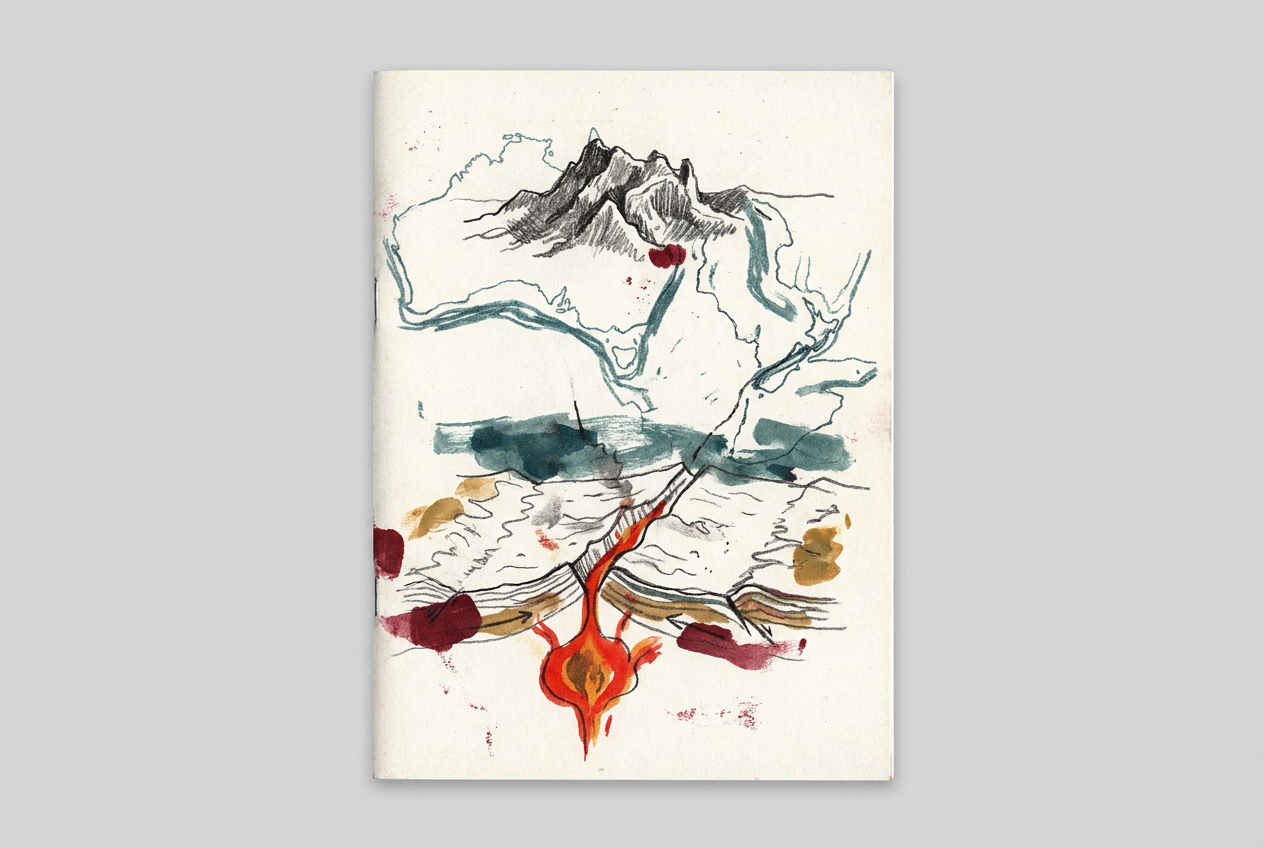
Twenty-three million years ago, a column of magma rose through the eastern edge of the Australian continent and met the sea. The eruption built a shield volcano that stood perhaps two kilometres above the ocean surface, its flanks shedding ash and lava into the Tasman Sea. Today, that volcano is gone. What remains is a single, dramatic peak — Mount Warning — and a story about the moment a continent tore itself apart.
The Volcano That Became a Plug
Mount Warning rises 1,156 metres above the lush farmland of northern New South Wales, but its true scale is hidden. The mountain is the central volcanic plug — the solidified throat of a much larger shield volcano that has been almost entirely stripped away by erosion. The original edifice, known as the Tweed Volcano, spanned roughly 100 kilometres across and extended far offshore, its lavas now found on the floor of the Tasman Sea and on the eroded remnants of the continent's edge.
The plug itself is composed of trachyte, a silica-rich volcanic rock that cooled slowly inside the conduit. It is harder than the surrounding basalt flows and sedimentary rocks, which is why it remains as a peak while the rest of the volcano has vanished. From the summit, looking east, you can see the outline of the ancient caldera wall traced by the semicircular rim of the Border Ranges — the eroded skeleton of the volcano's outer edge.
What makes the Tweed Volcano significant is not its size or its remnant, but what its existence tells us about the reshaping of eastern Australia.
The Rift That Left a Trail of Fire
The Tweed Volcano was one of a chain of volcanic centres that erupted along Australia's eastern margin as the continent drifted north over a stationary hotspot in the mantle. This hotspot track — the Cosgrove hotspot track — stretches from northern Queensland down to Victoria and into the Tasman Sea, with ages decreasing southward. The Tweed Volcano, at 23 million years old, sits near the older end of the chain.
But the timing is crucial. The Tweed Volcano erupted just as Australia was rifting away from the submerged continent of Zealandia. The Tasman Sea had opened earlier, between 85 and 52 million years ago, but the final separation of the Lord Howe Rise and other Zealandia fragments from Australia occurred later, in a series of extensional events along the continental margin. The volcanic activity of the Tweed Volcano and its neighbours recorded that extension — magma rising through the thinning crust as the continent stretched and cracked.
The volcano was not simply a mountain. It was a symptom of continental breakup, a wound in the crust that bled lava for millions of years.
The Caldera Wall in the Landscape
Today, the evidence of that rifting is written into the topography of northern New South Wales and southern Queensland. The semicircular Border Ranges, which trace the ancient caldera rim, form a dramatic escarpment that separates the coastal lowlands from the inland plateau. Waterfalls plunge over the rim; the Tweed River drains the interior of the old caldera.
The volcanic rocks of the Tweed shield — basalts and rhyolites — now cap many of the surrounding ranges, protecting them from erosion. The fertile red soils derived from these lavas support the region's macadamia orchards and banana plantations. The landscape is a quiet archive of an explosive past.
To the east, the continental shelf drops away steeply into the Tasman Basin. The same extensional forces that fed the Tweed Volcano also created the deep-water basins offshore, where sediments have buried the offshore remnants of the volcano's lava flows.
A Continent's Edge, Preserved in Stone
Mount Warning is sometimes described as the first place on the Australian mainland to see the sunrise — a geographical fact that gives it a certain romance. But its deeper significance is geological. The peak is a marker of a fundamental transition in the continent's history: the moment when Australia's eastern margin ceased to be an active plate boundary and became a passive, rifted margin.
The hotspot that built the Tweed Volcano is now extinct, the magma supply cut off as the continent moved beyond the mantle plume. But the volcanic plug, the caldera rim, and the offshore lava flows remain as a record of that tectonic episode. The mountain is not a monument to a single event but to a process — the slow, violent separation of one landmass from another.
More like this
- The 5,000-Year-Old Volcanoes That Still Smoke in the SouthIn Victoria's Newer Volcanics Province, 400 volcanic vents erupted as recently as 5,000 years ago—the youngest volcanic field in mainland Australia, where craters still hold blue lakes and scoria cone
- The 300-Million-Year-Old Forest That Died Standing UpIn New South Wales, a 300-million-year-old fossil forest preserves dozens of trees buried upright by a Permian volcanic eruption—an entire ecosystem frozen in ash.
- The 1.85-Billion-Year-Old Caldera That Still Feeds the FurnaceIn South Australia's Middleback Ranges, a 1.85-billion-year-old volcanic caldera collapsed and later became one of the world's richest iron ore deposits.