21 May 2026 · 3 min read
The Ash That Sealed a Seafloor: South Australia's Brachina Formation
How 580-million-year-old volcanic ash layers in South Australia's Brachina Formation preserve the transition from an oxygen-poor Ediacaran ocean to the world that made animal life possible.
The Brachina Formation of South Australia's Flinders Ranges is not beautiful. It is a monotonous sequence of grey-green siltstone and fine sandstone, layer upon layer, running for hundreds of metres through the dry hills north of Hawker. But within those drab beds lies a record of one of the most consequential moments in Earth's history: the moment the oceans began to breathe.
The Ediacaran Oxygen Revolution
The Brachina Formation was deposited between about 580 and 560 million years ago, during the Ediacaran Period. This was a time of profound environmental change. For billions of years before, the deep oceans had been largely anoxic—poor in oxygen, rich in dissolved iron and sulfur. Life was confined to shallow seas and microbial mats. Then, slowly, the chemistry shifted.
The Brachina Formation captures this transition in its mineralogy. The lower parts of the formation contain abundant pyrite—iron sulfide—that formed when sulfur-reducing bacteria thrived in oxygen-starved sediments. Higher in the sequence, pyrite gives way to hematite and other iron oxides, minerals that require oxygen to precipitate. The rocks themselves tell the story: the seafloor was becoming oxygenated.
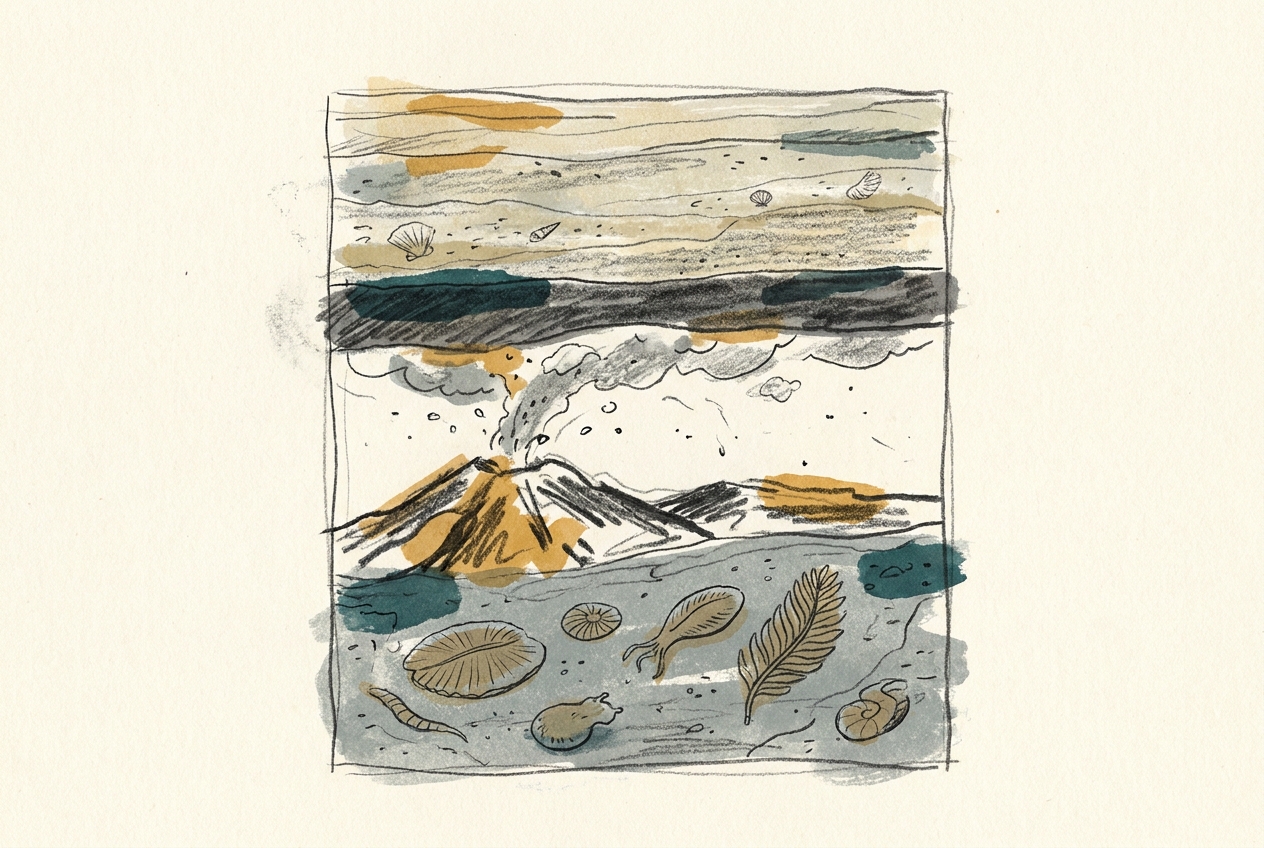
Thin beds of volcanic ash, altered to clay, punctuate the sequence. These ash layers came from distant volcanoes—likely along the margin of the ancient continent of Rodinia as it rifted apart. They provide precise radiometric dates, allowing geologists to pin the timing of ocean oxygenation to a narrow window around 570 million years ago.
The Brachina Formation's ash beds are time stamps, each one marking a moment when the atmosphere and oceans were being remade.
A Seafloor Preserved in Stone
The Brachina Formation was deposited in a deep marine basin that stretched across much of what is now South Australia. Sediment accumulated slowly, grain by grain, on a quiet seafloor far from land. Fine silt settled out of suspension; clay particles drifted down through the water column. The result is a sequence of exceptionally even, thin beds—millimetre-scale laminations that record seasonal or annual cycles.
Occasionally, a storm or turbidity current swept coarser sand into the basin, leaving a distinct layer. These event beds are visible in outcrop as lighter bands cutting through the darker siltstone. They give the formation its characteristic striped appearance.
The preservation is exquisite. Some beds show ripple marks, load casts, and other sedimentary structures that formed on the ancient seafloor. Others contain trace fossils—burrows and feeding trails left by early animals moving through the sediment. These are among the oldest known evidence of complex animal behaviour.
The First Burrowers
Before the Ediacaran, the seafloor was covered in microbial mats that bound the sediment together. Nothing disturbed them. In the Brachina Formation, something changed.
Trace fossils appear as small, sinuous tubes and horizontal trails, preserved as raised ridges on the bases of sandstone beds. They record the activities of bilaterian animals—organisms with a front and back, left and right, that could move deliberately through the sediment. These were not large animals; the burrows are only a few millimetres wide. But they represent a revolution in seafloor ecology.
The appearance of burrowing animals broke the microbial mats, oxygenated the sediment, and created new habitats. It was the beginning of the modern seafloor, where life churns and mixes the substrate. The Brachina Formation captures this transition in progress: lower beds are undisturbed, while higher beds are increasingly bioturbated.
A Window into a Changing World
The Brachina Formation is one of the few places on Earth where the Ediacaran oxygen rise is recorded in continuous sedimentary sequence. Most other Ediacaran successions are incomplete or altered by later tectonics. Here, the rocks are flat-lying and well exposed, accessible along the Parachilna Gorge road and in the hills around Brachina Gorge itself.
The ash beds that date the sequence are visible as pale clay partings, each one a few centimetres thick. They are unremarkable to look at. But they are the reason we know the timing of this transformation. Without them, the Brachina Formation would be just another stack of grey siltstone, its story locked away.
With them, it is a record of how the Earth became habitable for animals—and how, in a quiet basin off the coast of an ancient continent, the seafloor learned to breathe.
More like this
- The 5,000-Year-Old Volcanoes That Still Smoke in the SouthIn Victoria's Newer Volcanics Province, 400 volcanic vents erupted as recently as 5,000 years ago—the youngest volcanic field in mainland Australia, where craters still hold blue lakes and scoria cone
- The 560-Million-Year-Old Garden That Never Saw a PredatorIn South Australia's Flinders Ranges, 560-million-year-old Ediacara surfaces preserve entire seafloor communities of fronds, discs, and quilts — a garden of soft-bodied life that flourished before pre
- The 300-Million-Year-Old Forest That Died Standing UpIn New South Wales, a 300-million-year-old fossil forest preserves dozens of trees buried upright by a Permian volcanic eruption—an entire ecosystem frozen in ash.