22 May 2026 · 3 min read
The Ash That Buried a Reef: South Australia's Andamooka Opal
How 100-million-year-old opal in South Australia's Andamooka formed in the cavities of an ancient Cretaceous reef, preserving a vanished inland sea in gemstone.
A hundred million years ago, a shallow sea stretched across what is now the driest part of Australia. In that warm, lime-rich water, sponges and shellfish built a reef. Today, that reef is a ghost—preserved not in limestone but in opal.
South Australia's Andamooka field, 600 kilometres north of Adelaide, produces some of the world's finest precious opal. Unlike the famous black opal of Lightning Ridge, Andamooka opal is often pale, milky, or translucent, with flashes of blue and green that shift as you turn the stone. But the most remarkable thing about it is not the colour. It is the shape.
The Reef That Became a Gem
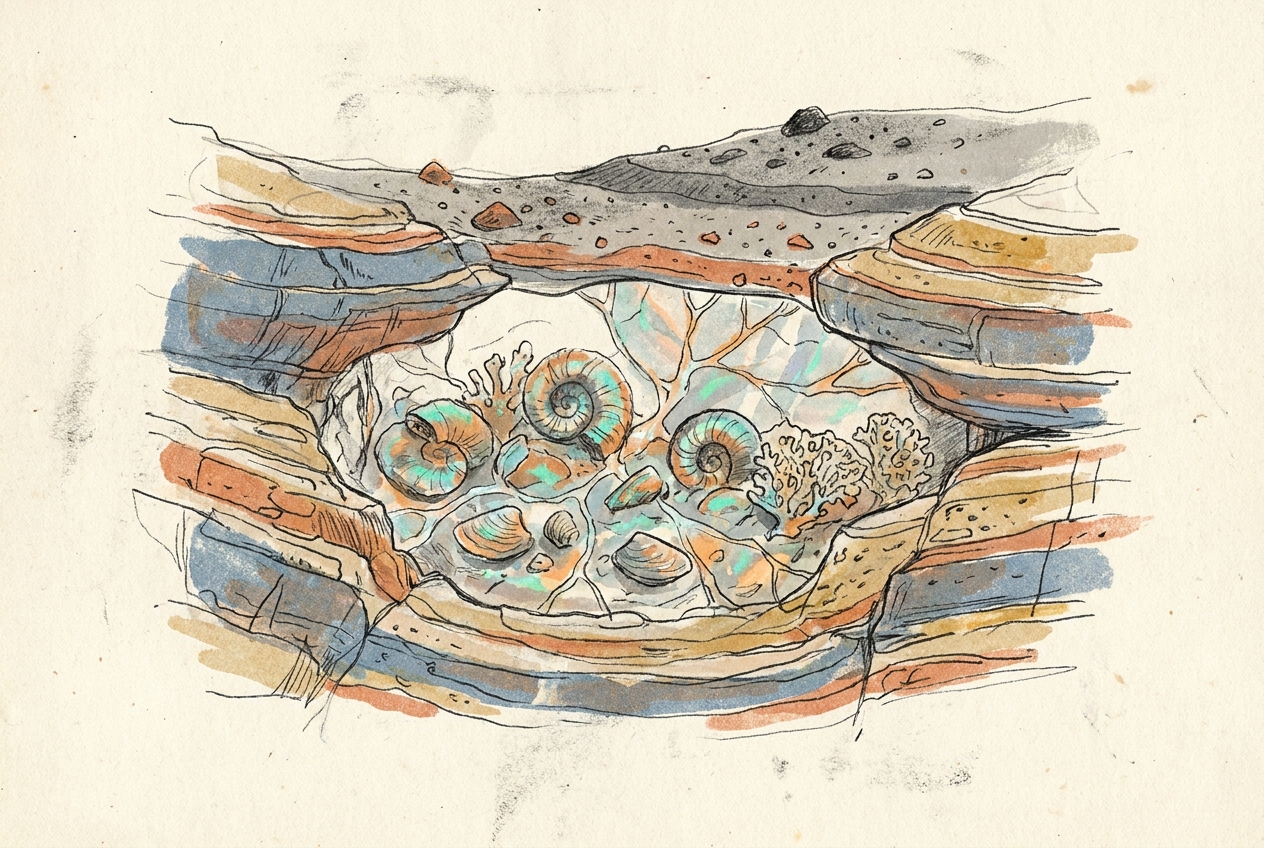
The opal at Andamooka formed inside a Cretaceous marine reef, part of the vast Great Artesian Basin that once lay under an inland sea. When the sea retreated, the reef was buried under layers of sediment. Over millions of years, silica-rich groundwater seeped through the porous limestone, filling cavities left by decayed shells, sponges, and coral.
Where silica filled a complete void, it preserved the original form of the organism. Opalised shells, belemnites, and even fragments of marine reptile bone have been found at Andamooka, their internal structures replaced atom by atom by hydrated silica. The result is a fossil made of gemstone.
The reef builders are gone, but their shapes remain—cast in opal, buried under red sand.
The process required unusual conditions. The silica came from the weathering of volcanic ash and feldspar-rich rocks in the surrounding landscape. Slow evaporation concentrated the solution. The presence of iron and other trace elements gave the opal its characteristic colours. Without that precise chemistry, the silica would have formed quartz or chalcedony instead.
A Landscape of Ghosts
Andamooka lies in the Stuart Shelf geological province, a region of flat, arid plains broken by low mesas and stony gibber. The opal-bearing layer, called the Andamooka Limestone, is a thin band of Cretaceous marine sediment that outcrops in scattered exposures across hundreds of square kilometres.
Miners dig shallow shafts and horizontal tunnels into the limestone, following the "opal dirt"—a layer of weathered, iron-stained rock where the gemstone accumulates. The work is hot, dusty, and uncertain. A single pocket of colour can be worth a year's wages. Most shafts yield nothing.
The fossils found in Andamooka opal are not as famous as those from Coober Pedy, 200 kilometres to the west, but they are older and more varied. Plesiosaur vertebrae, fish scales, and ammonites have all been recovered, their surfaces polished by the same silica that replaced them. Some specimens preserve fine detail: the texture of a sponge's surface, the curve of a belemnite's guard.
The Sea That Vanished
The Cretaceous inland sea that deposited the Andamooka Limestone was part of a global highstand of sea levels. Australia at that time was still attached to Antarctica, and the continent's interior was flooded by a shallow seaway that connected the Great Australian Bight to the Gulf of Carpentaria.
The reef at Andamooka grew on the eastern margin of this seaway, in water perhaps 50 metres deep. The organisms that built it—sponges, bryozoans, rudist bivalves—are typical of Cretaceous temperate reefs, which were less diverse than modern tropical reefs but still ecologically significant.
When the sea finally withdrew, around 80 million years ago, the reef was left exposed. Weathering and erosion stripped away the softer limestone, leaving the harder opalised pockets behind. The landscape dried out. The inland sea became a memory, recorded only in the rocks and the gemstones they contain.
Light, Water, Time
Opal is amorphous silica—not a mineral in the strict sense, but a hardened gel. It contains up to 20 percent water, trapped in microscopic spheres that diffract light to produce colour. The size and arrangement of those spheres determines which wavelengths are scattered: small spheres produce blue, larger spheres produce red.
Andamooka opal is known for its "potch"—common opal without colour—which often surrounds the precious material. Miners learn to read the subtle shifts in texture and moisture that signal the presence of colour. A dry shaft is a dead shaft.
The reef that gave birth to this opal has long since dissolved. What remains are the cavities it left behind, filled with light and water and time. When you hold a piece of Andamooka opal, you are holding the negative space of a vanished world—a reef that no longer exists, preserved in the one material that could capture its shape and still shine.
More like this
- The 560-Million-Year-Old Garden That Never Saw a PredatorIn South Australia's Flinders Ranges, 560-million-year-old Ediacara surfaces preserve entire seafloor communities of fronds, discs, and quilts — a garden of soft-bodied life that flourished before pre
- The 300-Million-Year-Old Forest That Died Standing UpIn New South Wales, a 300-million-year-old fossil forest preserves dozens of trees buried upright by a Permian volcanic eruption—an entire ecosystem frozen in ash.
- The 1.75-Billion-Year-Old Reef That Outranks the BarrierA 1.75-billion-year-old microbial reef in the Kimberley is the largest biological structure ever built by a single species, preserving a world without predators.