10 May 2026 · 3 min read
The Limestone Cathedral: The Naracoorte Cave Systems
Beneath South Australia's sheep pastures, the Naracoorte cave systems preserve a 500,000-year fossil record of Australia's vanished megafauna within layered sediment cones.
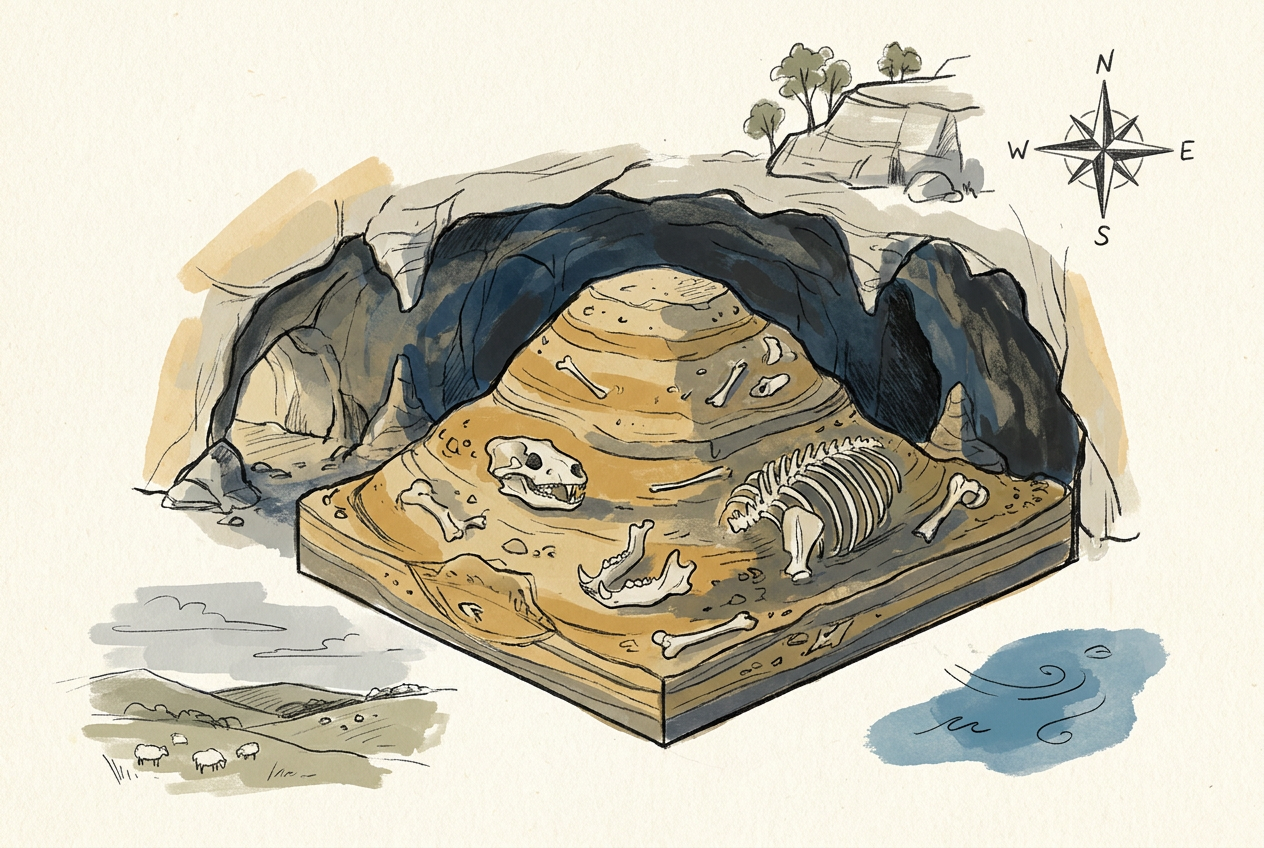
Beneath a sheep paddock in South Australia, a sinkhole opens into a limestone chamber where the bones of marsupial lions, giant wombats, and three-metre-tall kangaroos lie stacked like pages in a sedimentary book. The Naracoorte cave systems, 300 kilometres southeast of Adelaide, preserve half a million years of Australian mammal evolution in a single geological accident: a rising water table that repeatedly flooded and sealed the caves, trapping animals and their predators in a natural bone vault.
The Karst That Caught Everything
The caves formed in the Gambier Limestone, a marine sediment laid down 30 to 40 million years ago when the Southern Ocean covered what is now South Australia's sheep country. Rainwater, slightly acidic, dissolved the calcium carbonate along joints and bedding planes, carving a labyrinth of chambers and passages over millions of years. The result is a karst landscape—hollowed, porous, and unstable—where the roof of a cave can collapse without warning.
At Naracoorte, that instability became a fossil trap. When a cave ceiling fell, it opened a vertical shaft to the surface. Animals wandering across the pasture above—driven by drought, curiosity, or predators—fell through the hole and died on the chamber floor. Later, rising groundwater would flood the chamber, dissolving bone and redepositing calcite, sealing the remains in a flowstone crust. Then the water dropped, the sinkhole reopened, and the cycle repeated.
The Fossil Cones
The most productive chambers are not the broad caverns but the narrow vertical shafts that geologists call "fossil cones." At the Victoria Fossil Cave, a single cone of sediment—loam, bone, and calcite rubble—rises 20 metres from the chamber floor. It contains an estimated 4,000 individual skeletons, stacked in chronological order by layer.
The oldest layers, dated to roughly 500,000 years ago, contain the bones of Thylacoleo carnifex, the marsupial lion—a cat-sized predator with blade-like premolars and a thumb claw that could disembowel prey larger than itself. Above it lie the remains of Diprotodon optatum, the largest marsupial that ever lived: a wombat-like herbivore the size of a rhinoceros, weighing over two tonnes. Near the top, from 50,000 years ago, the bones thin out and shift: megafauna disappear, replaced by smaller species—wallabies, bandicoots, rodents—that survived the extinction event humans likely accelerated.
The sediment cone is a vertical timeline. You can walk up its slope and cross 450,000 years in twenty paces.
The Calcium Archive
What makes Naracoorte exceptional is not the fossils alone—other Australian sites preserve older or more complete specimens—but the preservation mechanism. The calcite-laden groundwater that periodically flooded the chambers also encased the bones in a protective mineral shell. Flowstone, stalagmites, and dripstone grew over the remains, shielding them from the acidic soils and seasonal wet-dry cycles that destroy bone elsewhere.
This process also allows precise dating. Uranium-thorium dating of the calcite layers bracketing the fossil beds gives geochronologists a tight constraint on when each animal lived and died. At the Blanche Cave, researchers dated a Thylacoleo skeleton to 280,000 years ago, with an error margin of only 4,000 years—remarkable precision for a fossil older than the Neanderthals.
The Vanished Menagerie
Naracoorte's fossil record tells a story of climate-driven extinction. During the glacial periods of the Pleistocene, when sea levels dropped and Australia's interior expanded into dry grassland and desert, the Naracoorte region remained a woodland refuge, fed by groundwater and winter rains. The megafauna concentrated here, and when the droughts worsened—or when humans arrived—they died here.
The youngest layers, from 40,000 to 50,000 years ago, show a sudden drop in bone density and diversity. The big animals vanish. The sediment continues accumulating, but the fossil cone records only small species. This pattern matches dozens of other Australian sites: the extinction of megafauna coincides with the arrival of the first humans, not with any single climate event.
The caves still trap animals today. Sinkholes that opened in the 1980s contain the skeletons of sheep, kangaroos, and foxes—a modern layer atop a half-million-year archive. In a few thousand years, if the water table rises again, those bones will be sealed in calcite, and some future geologist will dig them out, wondering what kind of creature kept sheep on this limestone plain.
More like this
- The 110-Million-Year-Old River That Runs Backwards UndergroundWestern Australia's 110-million-year-old dune system has been slowly dissolving into a labyrinth of caves where an ancient river still flows, carrying the taste of a Cretaceous desert.
- The 5,000-Year-Old Volcanoes That Still Smoke in the SouthIn Victoria's Newer Volcanics Province, 400 volcanic vents erupted as recently as 5,000 years ago—the youngest volcanic field in mainland Australia, where craters still hold blue lakes and scoria cone
- The 560-Million-Year-Old Garden That Never Saw a PredatorIn South Australia's Flinders Ranges, 560-million-year-old Ediacara surfaces preserve entire seafloor communities of fronds, discs, and quilts — a garden of soft-bodied life that flourished before pre