10 May 2026 · 3 min read
The Lava That Became a Mountain: The Glasshouse Mountains of Queensland
23-million-year-old volcanic plugs, the Glasshouse Mountains of southeast Queensland are the eroded cores of rhyolite and trachyte volcanoes that erupted through sandstone bedrock.
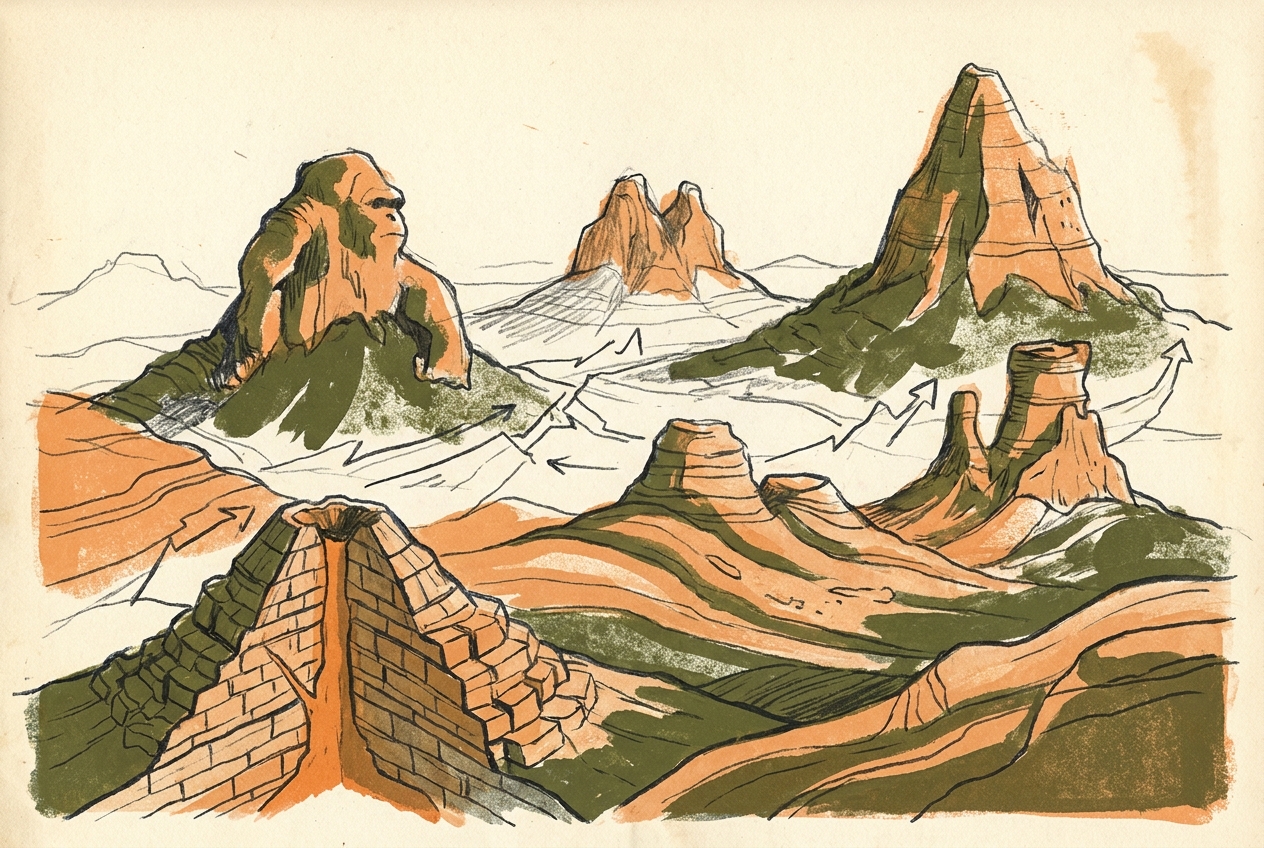
From the coastal plain north of Brisbane, the Glasshouse Mountains rise abruptly—thirteen steep-sided peaks of hard volcanic rock that once formed the throats of ancient volcanoes. The tallest, Mount Beerwah, stands 556 metres above the surrounding pineapple farms and bushland. They are not mountains in the usual sense. They are the plumbing.
The Eruptions
Twenty-three to twenty-seven million years ago, during the Oligocene, a series of volcanic eruptions punched through the sandstone and shale of the Nambour Basin. The magma that rose was not the runny basalt of Hawaii. It was rhyolite and trachyte—thick, silica-rich lava that moved sluggishly and cooled quickly near the surface.
Each eruption built a steep-sided volcanic cone, perhaps several hundred metres higher than the plugs we see today. The lava solidified inside the vents, forming hard, vertical columns of rock called plugs or necks. Then the softer surrounding sandstone and volcanic debris eroded away over millions of years, leaving the resistant cores standing alone.
The peaks are arranged along a north-south axis, roughly 25 kilometres long. This pattern reflects the northward movement of the Australian Plate over a stationary hotspot—the same deep mantle plume that later formed the volcanoes of eastern Australia as the continent drifted north.
The Rock
The plugs are composed mostly of comendite, a pale, silica-rich volcanic rock related to rhyolite. In cross-section, the rock shows flow banding—thin, wavy layers of dark and light minerals that record the movement of viscous lava as it squeezed upward through the vent.
At the base of some plugs, particularly Mount Tibrogargan, you can see columns of trachyte that cooled into rough hexagonal shapes, similar to the basalt columns of Tasmania but coarser and less regular. The rock is speckled with small crystals of sanidine feldspar and quartz, visible to the naked eye.
The surrounding landscape tells the opposite story. The low, rolling hills between the peaks are underlain by the same sandstone and shale that once buried the volcanic necks. These sedimentary rocks, deposited in the Triassic and Jurassic, are soft and easily weathered. They have been stripped away, leaving the harder volcanic rock in relief.
The Glasshouse Mountains are not mountains built upward. They are mountains exposed by the removal of everything that surrounded them.
The Naming
Captain James Cook named them in 1770, during his voyage along the eastern coast of Australia. He wrote that they "looked like glass houses"—a reference to the glass furnaces of his native Yorkshire. The name stuck, though the peaks have nothing to do with glass.
The Aboriginal names are older and more descriptive. Mount Beerwah means "place of the climbing possum." Mount Tibrogargan means "place of the two fingers." The local Kabi Kabi people tell stories of the peaks as a family of ancestral beings, frozen in place by a great flood.
The Present Shape
The mountains are still changing. Weathering works slowly on the hard volcanic rock, but it works. The distinctive pinnacle on top of Mount Beerwah is a narrow spine of rock that will eventually collapse. Several peaks have already lost their original shapes—landslides and rockfalls have scarred the faces of Mount Tibrogargan and Mount Coonowrin.
The surrounding plain continues to erode. In another million years, the plugs will stand even higher relative to the land around them, until they too crumble. The Glasshouse Mountains are a temporary exposure of a deeper process: the slow unearthing of what lies beneath.
More like this
- The 110-Million-Year-Old River That Runs Backwards UndergroundWestern Australia's 110-million-year-old dune system has been slowly dissolving into a labyrinth of caves where an ancient river still flows, carrying the taste of a Cretaceous desert.
- The 5,000-Year-Old Volcanoes That Still Smoke in the SouthIn Victoria's Newer Volcanics Province, 400 volcanic vents erupted as recently as 5,000 years ago—the youngest volcanic field in mainland Australia, where craters still hold blue lakes and scoria cone
- The 300-Million-Year-Old Forest That Died Standing UpIn New South Wales, a 300-million-year-old fossil forest preserves dozens of trees buried upright by a Permian volcanic eruption—an entire ecosystem frozen in ash.