10 May 2026 · 3 min read
The Inland Reef: The Stromatolites of Lake Clifton
In the shallow waters of a Western Australian lake, living microbial reefs—thrombolites and stromatolites—build layered limestone structures nearly identical to the earliest known fossils on Earth.
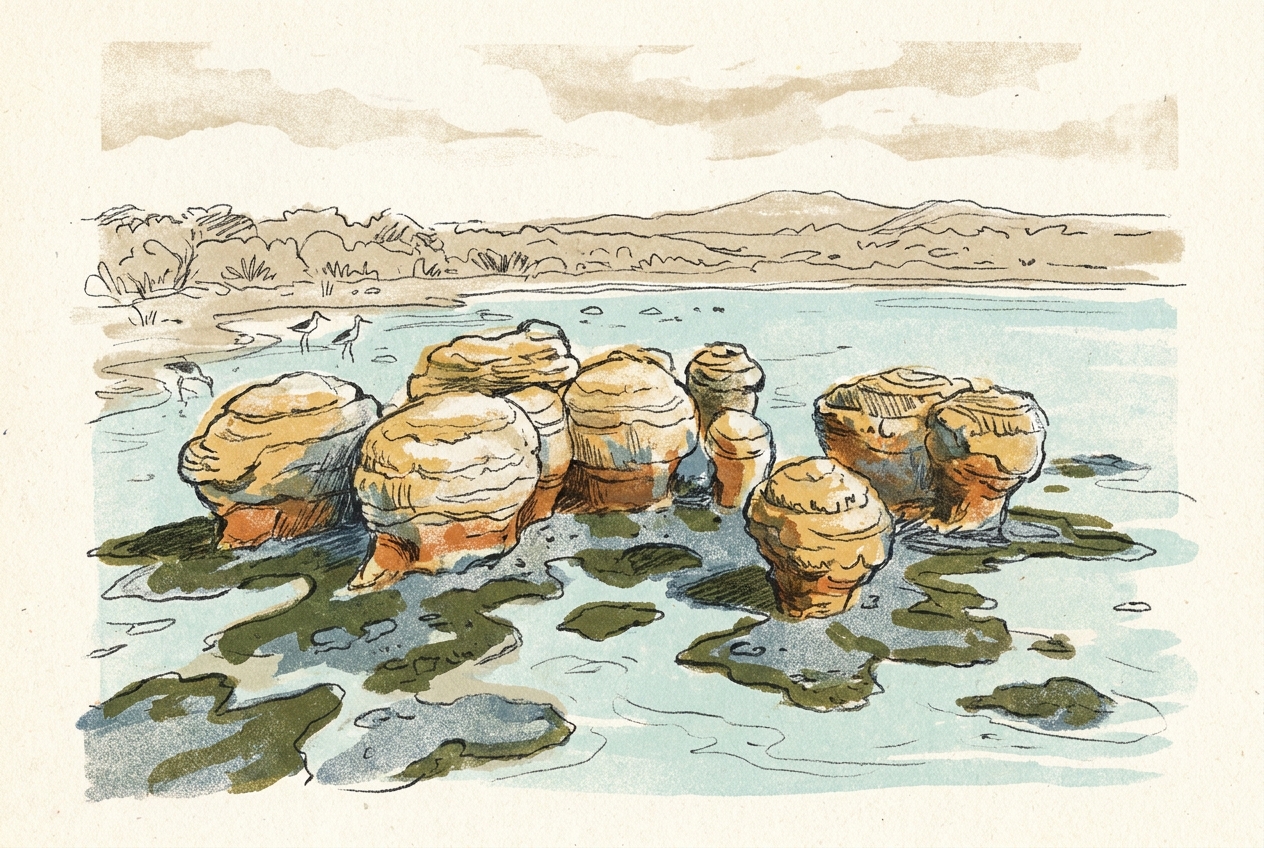
On the eastern shore of Lake Clifton, ninety kilometres south of Perth, the water is shallow enough to wade through. Beneath the surface, grey-green mounds rise from the lake bed like loaves of bread set out to cool. They are not rock, not quite. They are living microbial reefs—thrombolites—built by communities of cyanobacteria that have been building similar structures for 3.5 billion years.
The Builders
The mounds of Lake Clifton are not fossilised. They are alive. A consortium of microorganisms—predominantly cyanobacteria of the genus Scytonema—trap and bind carbonate minerals from the water, layer by layer, forming a crust that grows about one millimetre per year. The result is a thrombolite, a cousin of the better-known stromatolite. The difference is internal texture: stromatolites are finely laminated, like pages in a book; thrombolites are clotted, irregular, knobby. Both are microbialite—rock built by microbes.
Lake Clifton's thrombolites extend intermittently along six kilometres of shoreline. The largest mounds stand nearly two metres high and may be two thousand years old. They grow only in the shallows, where light penetrates to fuel photosynthesis and where the water chemistry allows carbonate to precipitate faster than it dissolves.
To touch a thrombolite is to touch the oldest method of building on Earth—a method that preceded animals, plants, even oxygen.
The Precedent
The earliest unambiguous evidence of life on Earth comes from the Pilbara region of Western Australia. In the 3.5-billion-year-old Dresser Formation, near North Pole (the town, not the pole), geologists have found wavy laminated structures interpreted as fossil stromatolites. The same microbial processes that build Lake Clifton's mounds today likely built those ancient reefs, back when the atmosphere was methane-rich and the oceans were warm, acidic, and devoid of animal life.
For most of Earth's history—roughly 80 percent of it—microbialites were the only reefs on the planet. They dominated the Archean and Proterozoic seas, building massive carbonate platforms that now form entire mountain ranges. Then, during the Cambrian explosion, grazing animals evolved—snails, worms, crustaceans—and the microbialites retreated. They could no longer survive where animals could scrape them away or burrow through them. Today, living microbial reefs persist only in environments too harsh for grazers: hypersaline lagoons, alkaline lakes, thermal springs.
Lake Clifton is one such refuge.
The Alkaline Shore
Lake Clifton is a coastal lagoon, separated from the Indian Ocean by a narrow limestone barrier. Its water is brackish, alkaline, and rich in calcium and bicarbonate. The lake is shallow—rarely more than two metres deep—and subject to seasonal evaporation that concentrates dissolved minerals. These conditions favour carbonate precipitation and discourage the snails and crustaceans that would otherwise graze the microbial mats.
The thrombolites grow in distinct zones. Near the shoreline, the mounds are smaller, younger, and often exposed to air during summer drawdown. Further out, the largest mounds sit in half a metre of water, their tops occasionally breaking the surface. The living microbial community is a dark green-brown crust, visible only when the water is clear and still. Below that crust, the interior is solid carbonate—calcite and aragonite—cemented into a porous rock that holds the shape of the mound long after the microbes have moved on.
The Vulnerability
Living microbialites are rare worldwide. They exist in Shark Bay (Western Australia), in the Bahamas, in a few Mexican lakes, and in Lake Clifton. But they are fragile. Changes in water chemistry, nutrient loading from agriculture, or altered groundwater flow can kill the microbial community within a single season. Lake Clifton's thrombolites declined noticeably in the 1990s and early 2000s as nearby farming increased nutrient runoff, promoting algal growth that smothered the mounds. Management efforts—including fencing, buffer zones, and monitoring—have since stabilised the population, but the threat remains.
The irony is sharp. These structures represent the most ancient continuous ecological process on the planet—life making rock, rock preserving life—and they persist only in a narrow band of chemical tolerance that human activity can disrupt in a generation.
The Archive
The thrombolites of Lake Clifton are not fossils. They are living examples of a process that spans nearly the entire history of life. When a geologist studies a 3.4-billion-year-old stromatolite from the Pilbara, they are looking at the same kind of structure—built by the same kind of organism, through the same biochemical pathway—that still grows in the shallows of a Western Australian lake.
The difference is age, not process. The difference is that the Pilbara examples are stone, and the Lake Clifton examples are still breathing.
More like this
- The 110-Million-Year-Old River That Runs Backwards UndergroundWestern Australia's 110-million-year-old dune system has been slowly dissolving into a labyrinth of caves where an ancient river still flows, carrying the taste of a Cretaceous desert.
- The 5,000-Year-Old Volcanoes That Still Smoke in the SouthIn Victoria's Newer Volcanics Province, 400 volcanic vents erupted as recently as 5,000 years ago—the youngest volcanic field in mainland Australia, where craters still hold blue lakes and scoria cone
- The 560-Million-Year-Old Garden That Never Saw a PredatorIn South Australia's Flinders Ranges, 560-million-year-old Ediacara surfaces preserve entire seafloor communities of fronds, discs, and quilts — a garden of soft-bodied life that flourished before pre