18 June 2026 · 3 min read
The Lava That Left a Diamond in the Sand: Western Australia's Argyle Lamproite Pipe
How a 1.2-billion-year-old lamproite pipe in Western Australia's East Kimberley produced Earth's richest source of rare pink diamonds, recording a continent's journey over a deep mantle hotspot.
In the remote East Kimberley of Western Australia, a single volcanic pipe has produced more than 90 percent of the world's pink diamonds. The Argyle lamproite pipe is not a classical kimberlite—the usual home of diamonds—but something rarer, stranger, and geologically younger than most of the continent's diamond-bearing rocks. Its story begins more than a billion years ago, deep beneath a continent that did not yet exist.
A Diamond's Unlikely Birthplace
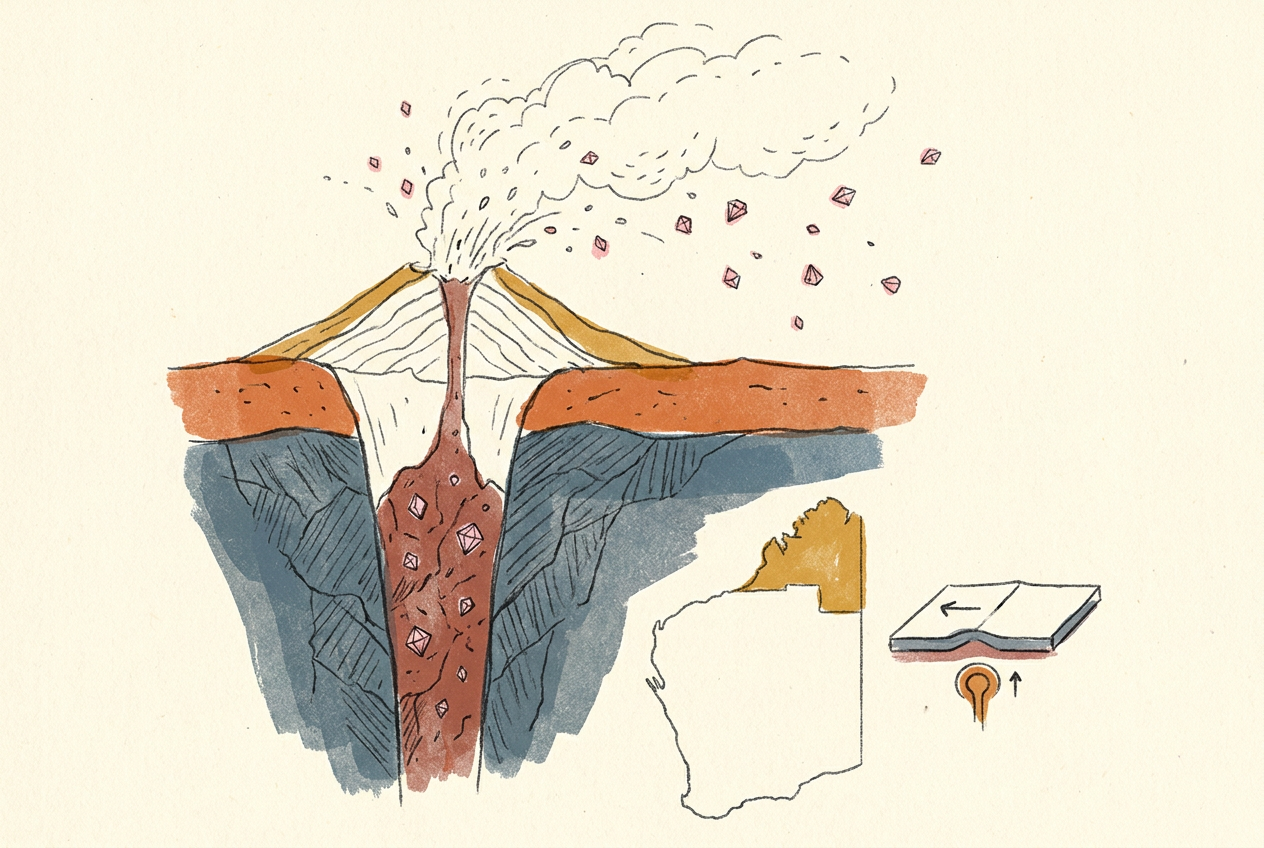
Diamonds form in the mantle, at depths of 150 to 200 kilometres, under pressures that crush carbon into its densest arrangement. Most Australian diamonds are ancient—more than two billion years old—and were brought to the surface by kimberlite pipes that erupted through the stable cratons of the north and west. But Argyle is different. Its host rock is lamproite, a potassium-rich volcanic rock that erupts at higher temperatures and with more violence than kimberlite. The pipe itself is only 1.2 billion years old, young by diamond standards, and sits not in the heart of an ancient craton but near its edge, where the Kimberley Block meets the Halls Creek Orogen—a zone of ancient continental collision.
The diamonds Argyle produced are mostly small, but a tiny fraction—about one in a million—carry a structural defect that turns them pink. The colour comes not from an impurity but from plastic deformation: the diamond's crystal lattice was bent and twisted under immense pressure during its journey to the surface, altering how it absorbs light. The result is a gem that ranges from pale rose to deep magenta, and whose value per carat far exceeds any other coloured diamond on Earth.
The Pipe and the Plume
Argyle's eruption was not a single event but a series of explosive bursts. The lamproite magma rose through a fracture system in the crust, picking up fragments of mantle rock and the diamonds they contained. When it reached the surface, it blasted a crater into the landscape—a depression that later filled with sediment and became a lake. Over time, the lake deposits preserved the volcanic breccia, sealing the diamonds in place.
The Argyle pipe is small—only about 200 metres across at its widest—but its diamond grade was among the highest ever discovered.
The trigger for this eruption was almost certainly a mantle plume: a column of hot rock rising from deep within the Earth. As the Indo-Australian Plate drifted northward over the plume, the hotspot punched through the lithosphere at what is now the East Kimberley. The same plume may have been responsible for other volcanic events across northern Australia, but only at Argyle did the chemistry align to produce lamproite instead of kimberlite. Why remains an open question.
A Billion-Year Journey to the Surface
To understand Argyle's diamonds, you must go deeper than the pipe itself. The diamonds crystallised in the mantle beneath the Kimberley Craton during the Proterozoic, when the craton was still part of a larger landmass called the North Australian Craton. For more than a billion years, they sat in the root of the continent, held in place by the cold, thick lithosphere that protects diamonds from being reabsorbed into the mantle. Then, around 1.2 billion years ago, the plume arrived. The diamonds were swept upward in a matter of hours, carried by magma that rose faster than sound in some estimates, and deposited in a crater that would remain undisturbed for eons.
The Mine and the End of an Era
Argyle was discovered in 1979, not by diamond indicator minerals but by a single pink diamond found in a stream bed. The mine opened in 1983 and operated for 37 years, producing more than 865 million carats of rough diamonds. Most were industrial grade, but the pink and red stones—less than 0.01 percent of the total—accounted for the bulk of the mine's value. When Argyle closed in 2020, the global supply of pink diamonds effectively ended.
The pipe itself is now a pit, visible from satellite imagery as a pale scar in the red earth. But the geology remains intact underground. The lamproite continues to hold diamonds at depth, and future miners may return when technology or prices shift. For now, the pink diamonds of Argyle are a finite inheritance from a billion-year-old plume, carried to the surface in a single violent hour and scattered across the world's jewellery boxes.
More like this
- The 5,000-Year-Old Volcanoes That Still Smoke in the SouthIn Victoria's Newer Volcanics Province, 400 volcanic vents erupted as recently as 5,000 years ago—the youngest volcanic field in mainland Australia, where craters still hold blue lakes and scoria cone
- The 300-Million-Year-Old Forest That Died Standing UpIn New South Wales, a 300-million-year-old fossil forest preserves dozens of trees buried upright by a Permian volcanic eruption—an entire ecosystem frozen in ash.
- The 1.85-Billion-Year-Old Caldera That Still Feeds the FurnaceIn South Australia's Middleback Ranges, a 1.85-billion-year-old volcanic caldera collapsed and later became one of the world's richest iron ore deposits.