18 June 2026 · 3 min read
The Heat That Turned a Coral Reef into Gemstone: Queensland's Sapphire Fields
How 300-million-year-old volcanic heat transformed a tropical reef in central Queensland into sapphire, ruby, and zircon deposits that still yield gemstones today.
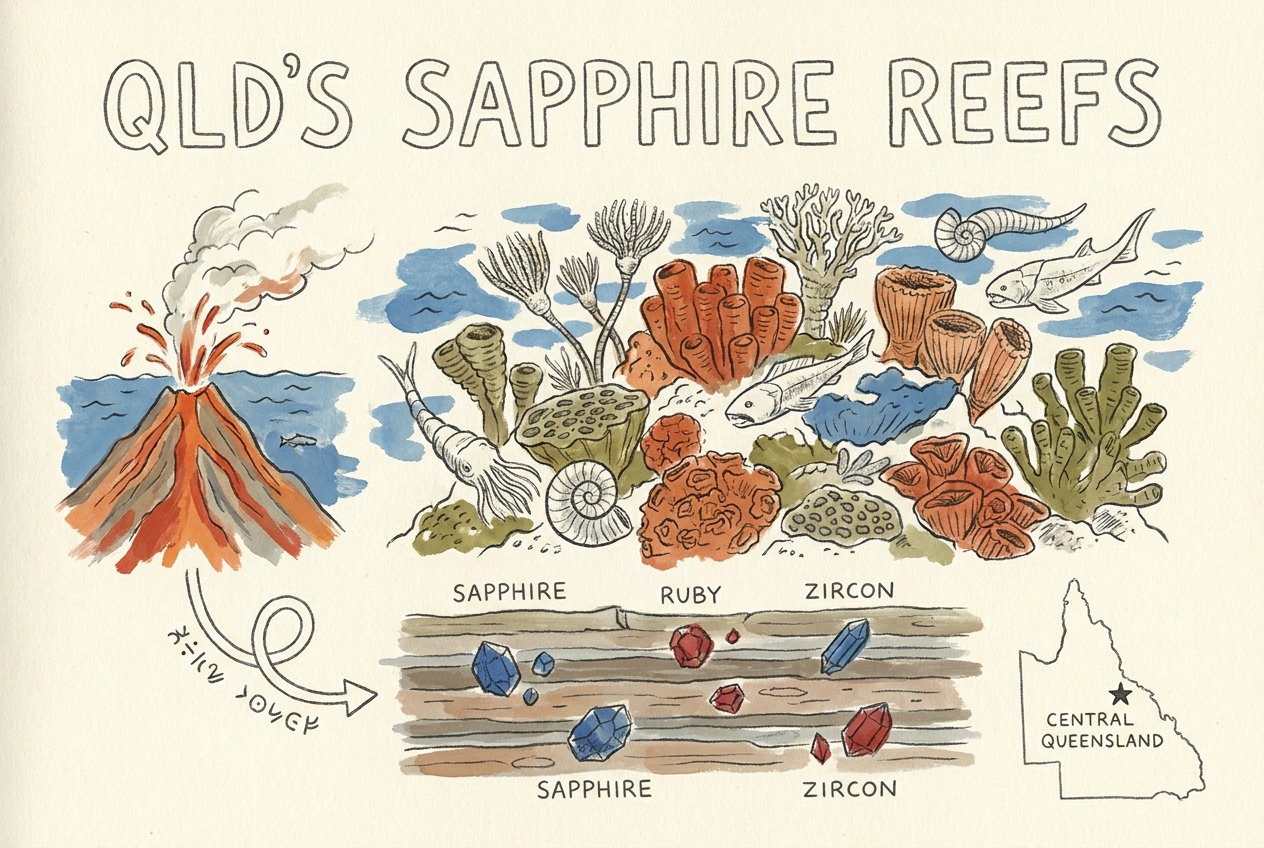
Roughly 300 million years ago, a shallow coral reef flourished in what is now central Queensland. Today, that reef is gone—cooked, compressed, and scattered across the gravel beds of the Anakie region as sapphires, rubies, and zircons. The gemfields near the town of Sapphire produce some of the world's most sought-after blue and parti-coloured sapphires, and the story of how a living reef became a gemstone deposit is a lesson in heat, pressure, and the slow violence of tectonic time.
A Reef Buried and Baked
The sapphires of central Queensland began as limestone—a thick sequence of marine carbonate laid down in the Devonian and Carboniferous periods, when much of eastern Australia lay beneath warm, shallow seas. Around 300 million years ago, as the New England Orogeny pushed volcanic arcs against the continental margin, the limestone was buried deep beneath younger sediments and intruded by bodies of molten granite. The heat and fluids from these intrusions metamorphosed the limestone into marble and, where the chemistry was right, crystallised corundum—the mineral that produces sapphire and ruby.
Corundum requires aluminium-rich, silica-poor conditions, which are rare in nature. The Anakie deposits likely formed when aluminium from the surrounding clay-rich sediments was mobilised by hot fluids and concentrated along fractures in the marble. Trace amounts of iron and titanium gave the crystals their blue colour; chromium would have produced ruby, though the Anakie fields are best known for their sapphires.
The Erosion That Freed the Gems
The sapphires did not stay locked in the marble. Over the following 200 million years, the region was uplifted, weathered, and eroded. The softer marble wore away, releasing the harder corundum crystals into ancient river systems. These rivers carried the sapphires downstream, where they were deposited in gravel beds alongside zircon, topaz, and other heavy minerals.
Today, the gemfields are worked by a mix of large-scale miners and hobbyists fossicking in the drainage systems around the town of Sapphire. The sapphires are found not in solid rock but in ancient alluvial deposits—layers of gravel and sand that once formed riverbeds. The largest sapphire ever found in Australia, a 1,157-carat crystal named the "Black Star of Queensland," came from these fields.
The sapphires of Anakie are not born in volcanic pipes like diamonds, nor in pegmatite veins like emeralds. They are the ghosts of a reef, recrystallised by heat and scattered by rivers.
A Spectrum of Colour
What makes the Anakie sapphires distinctive is their range of colour. They occur in blue, green, yellow, orange, brown, and the rare "parti-coloured" stones that show two or more colours in a single crystal. This variety reflects subtle differences in the trace elements present during crystallisation and the conditions of heat and pressure each crystal experienced.
The deposits also yield significant quantities of zircon, which formed in the same metamorphic environment. Zircon is denser than corundum, so it tends to concentrate in the same gravel layers. Many fossickers find more zircon than sapphire, though the zircon is often heat-treated to enhance its colour. The gemfields produce sapphire in every shade of blue, from pale cornflower to deep navy, and the parti-coloured stones are especially prized by collectors.
A Living Landscape of Fossicking
The Anakie gemfields are one of the few places in the world where amateur fossickers can dig for sapphires on public reserves. The town of Sapphire, population roughly 200, sits at the heart of the fields, surrounded by dry eucalypt woodland and red soil. Visitors can pay a small fee to sieve through gravel at designated fossicking areas, or buy a claim and work a patch of ground for a season.
The landscape bears the scars of a century of mining—mullock heaps, abandoned diggings, and tailings piles. But the gemfields remain productive. New sapphires are found every year, washed into the creeks by seasonal rains. The deposits are not finite in any human sense; the erosion that freed the first gems is still ongoing.
In the end, the sapphires of central Queensland are a reminder that gemstones are not rare because they are exotic. They are rare because the conditions required to form them are unlikely—a coral reef buried at the right depth, cooked by the right magma, weathered for the right length of time. The Anakie fields are the result of a chain of improbable events, each one necessary, each one written into the crystal lattice of every blue stone.
More like this
- The 5,000-Year-Old Volcanoes That Still Smoke in the SouthIn Victoria's Newer Volcanics Province, 400 volcanic vents erupted as recently as 5,000 years ago—the youngest volcanic field in mainland Australia, where craters still hold blue lakes and scoria cone
- The 560-Million-Year-Old Garden That Never Saw a PredatorIn South Australia's Flinders Ranges, 560-million-year-old Ediacara surfaces preserve entire seafloor communities of fronds, discs, and quilts — a garden of soft-bodied life that flourished before pre
- The 300-Million-Year-Old Forest That Died Standing UpIn New South Wales, a 300-million-year-old fossil forest preserves dozens of trees buried upright by a Permian volcanic eruption—an entire ecosystem frozen in ash.