18 June 2026 · 3 min read
The Ice That Carved a Cave of Crystals: Tasmania's Hastings Caves
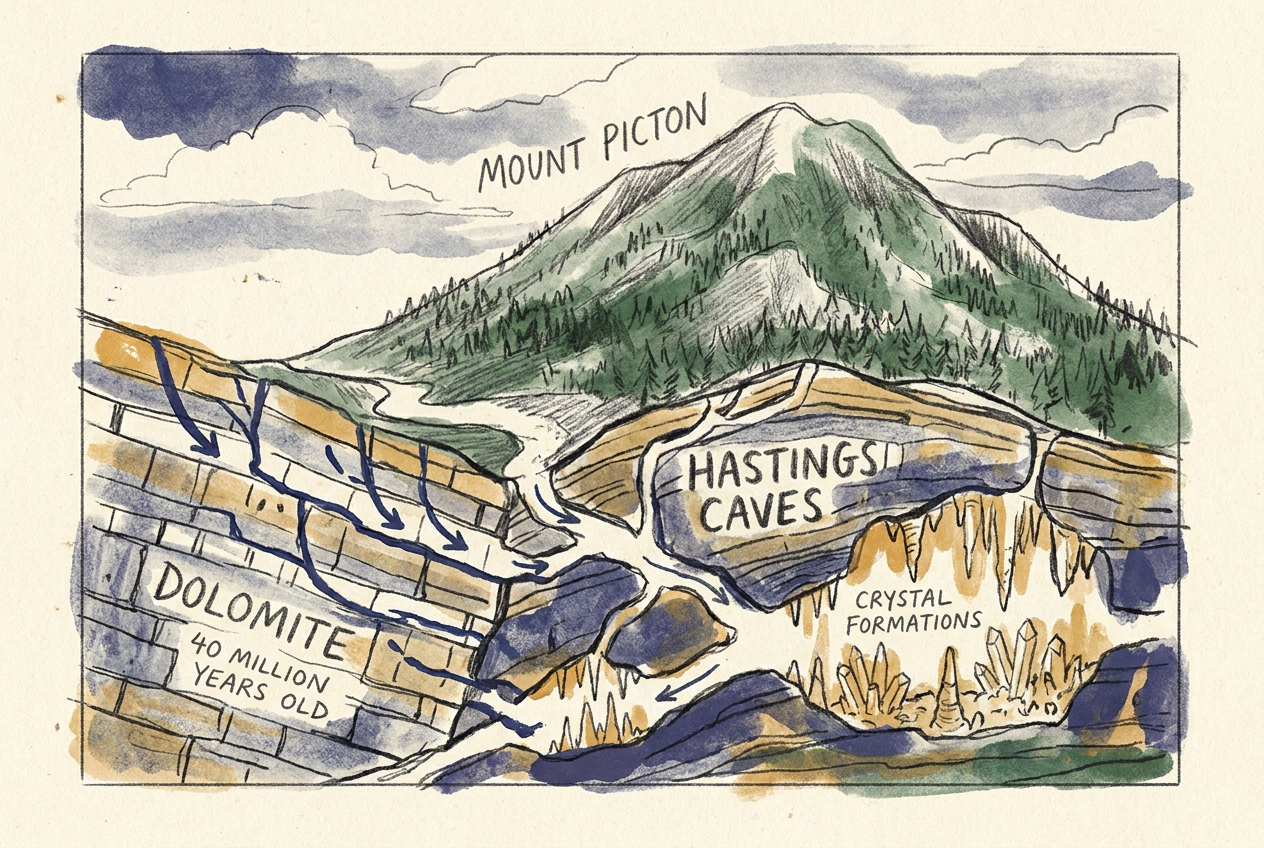
How 40-million-year-old dolomite in Tasmania's Hastings Caves, dissolved by acidic groundwater beneath Mount Picton, created one of Australia's largest and most ornate cave systems.
Forty million years ago, a shallow sea laid down a bed of dolomite on the floor of Tasmania. Today, that same rock hosts one of the most ornate cave systems in the Southern Hemisphere—a labyrinth of passages carved not by violent forces, but by the patient work of rainwater and time.
The Rock That Waited
The Hastings Caves lie 110 kilometres southwest of Hobart, buried within a ridge of dolomite that runs beneath Mount Picton. Dolomite is a sedimentary rock, similar to limestone but harder and less reactive. It formed during the Eocene epoch, when Tasmania sat at a different latitude and a warm sea covered what is now dry forest. Microscopic marine organisms built their shells from calcium and magnesium; when they died, their remains compacted into a rock that would wait millions of years before being hollowed out.
What makes dolomite special is its chemistry. Unlike pure limestone, which dissolves readily in weak acid, dolomite contains magnesium carbonate that slows the reaction. This means the caves that form in it tend to be fewer but larger, their chambers carved by water that had to work harder for longer.
The Water That Found a Way
Rain falling on Mount Picton absorbs carbon dioxide from the soil, turning into a weak carbonic acid. As it seeps through cracks in the dolomite, it slowly dissolves the rock, widening fissures into tunnels and tunnels into chambers. The process is extraordinarily slow—millimetres per century—but over 10 million years of sustained rainfall, it can hollow out a cathedral.
Newdegate Cave, the largest of the Hastings system and the only one open to the public, descends through a series of chambers connected by narrow passages. Its main gallery, the Cathedral Cave, rises 40 metres from floor to ceiling, studded with stalactites that have grown at a rate of one cubic centimetre per century. The largest column in the cave, known as the Organ Pipes, took half a million years to form.
The slowest sculpture on Earth: one cubic centimetre of calcite per century, built drop by drop from the ceiling of a Tasmanian hill.
The Crystals That Recorded a Climate
Every stalactite and flowstone in the Hastings system is a climate record. As water drips from the ceiling, it deposits a thin layer of calcite. The thickness and chemistry of each layer depend on the temperature and rainfall outside. By drilling cores from the stalagmites and analysing their trace elements, scientists can reconstruct the climate of Tasmania going back hundreds of thousands of years.
The data shows that Tasmania's southwest was wetter during glacial periods than it is today. When ice sheets covered much of the Northern Hemisphere, the westerly winds that bring rain to Tasmania strengthened, pushing moisture-laden air over Mount Picton and accelerating the growth of the caves. During interglacials like the present, the westerlies weakened and the caves grew more slowly.
The Forest That Keeps the System Alive
The Hastings Caves are not a fossil—they are still forming. The dolomite ridge is capped by a thick layer of temperate rainforest, dominated by myrtle beech, sassafras, and tree ferns. This forest is essential to the cave system's continued growth. Its deep root systems and thick leaf litter maintain a constant supply of organic acids that percolate into the rock. Without the forest, the chemical reaction that dissolves the dolomite would slow to a halt.
In 1996, a wildfire burned through the Hastings catchment, destroying large areas of the forest canopy. Scientists monitoring the caves afterward detected changes in drip-water chemistry, a reminder that these underground worlds are not sealed off from the surface. They breathe with the forest above them, and when the forest changes, the caves change too.
Tasmania's Hastings Caves are a quiet monument to the power of slow processes. A sea that vanished 40 million years ago left a rock that rainwater has been patiently carving ever since—a sculpture that is not yet finished.
More like this
- The 110-Million-Year-Old River That Runs Backwards UndergroundWestern Australia's 110-million-year-old dune system has been slowly dissolving into a labyrinth of caves where an ancient river still flows, carrying the taste of a Cretaceous desert.
- The 560-Million-Year-Old Garden That Never Saw a PredatorIn South Australia's Flinders Ranges, 560-million-year-old Ediacara surfaces preserve entire seafloor communities of fronds, discs, and quilts — a garden of soft-bodied life that flourished before pre
- The 1.75-Billion-Year-Old Reef That Outranks the BarrierA 1.75-billion-year-old microbial reef in the Kimberley is the largest biological structure ever built by a single species, preserving a world without predators.