22 May 2026 · 2 min read
The Lava That Built a Living Reef: Tasmania's Cenozoic Volcanoes and the Maria Island Fossil Forest
How 50-million-year-old volcanic eruptions in Tasmania buried a living temperate rainforest in ash, preserving leaves, cones, and pollen that record Australia's journey southward.
On Maria Island, off Tasmania's east coast, a cliff of white volcanic ash holds the ghosts of a forest that grew 50 million years ago. The leaves are still there—pressed into the rock like bookmarks, their veins and margins intact, fallen from trees that no longer exist anywhere on Earth.
The Ash That Fell on a Warm Forest
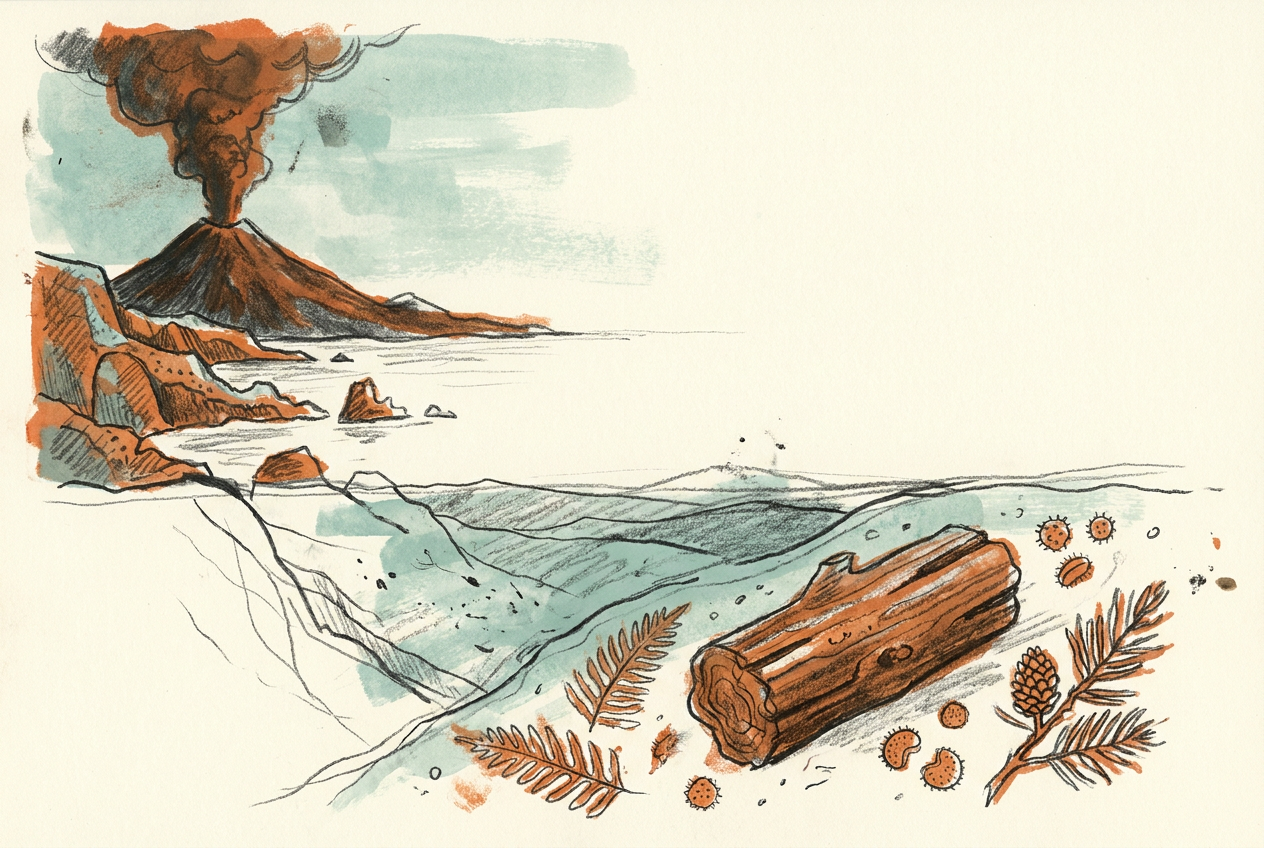
Fifty million years ago, Tasmania sat much farther north, at latitudes equivalent to present-day Melbourne or Sydney. The climate was warm-temperate, even subtropical. Rainforests of podocarps, araucarias, and southern beeches covered what is now the island's east coast. Then a series of small volcanic eruptions—part of the widespread Cenozoic volcanism that accompanied Australia's slow drift away from Antarctica—buried these forests in fine ash.
The eruptions were not catastrophic floods of lava. They were explosive but localised, sending columns of ash into the air that settled on standing trees and the forest floor. The ash fell softly enough to preserve the foliage intact. Leaves detached from branches and landed on ash layers; more ash fell and sealed them. Over millions of years, the ash compacted into a rock called tuff, and the organic material within it was replaced by silica and other minerals, leaving exact replicas in stone.
The Maria Island fossil forest is one of the most complete Cenozoic plant assemblages in Australia. It contains leaves, cones, seeds, flowers, and pollen grains, all preserved in the same fine-grained volcanic sediment that killed them.
A Continent's Drift Written in Leaves
What makes this site remarkable is not just the preservation—it is what the fossils reveal about Australia's journey. The leaf shapes and forest composition tell palaeobotanists that when these trees lived, Tasmania was warmer and wetter than today. The presence of certain genera, now restricted to South America and New Zealand, confirms that Australia was still connected to Antarctica, and through Antarctica to South America, in a remnant of Gondwana.
The fossils record the moment before isolation. Shortly after these ash falls, Australia separated completely from Antarctica and began its rapid northward drift. The climate cooled. The warm-temperate rainforests that covered Tasmania shrank and fragmented. Many of the species preserved at Maria Island went extinct on the Australian continent, surviving only in the wetter refuges of New Zealand and South America.
The ash that killed a forest became the archive of a lost world.
The Long Aftermath
The Maria Island deposits are part of a broader system of Cenozoic fossil sites across Tasmania. Similar leaf beds occur at Lea River, Balfour, and Regatta Point, all preserved by the same volcanic activity that punctuated Tasmania's landscape between 50 and 20 million years ago. Together, they document a continent's transition from a warm, connected landmass to a cool, isolated island.
Today, the cliffs on Maria Island erode slowly. Winter rains wash fragments of fossil leaves onto the beach below. The forest that grew there is gone. But the ash that buried it still holds the shape of every leaf that fell.
And that is the quiet miracle of volcanic preservation: what destroys also preserves. The same eruptions that ended a forest gave it a second life as stone, carrying its memory across 50 million years of continental drift.
More like this
- The 5,000-Year-Old Volcanoes That Still Smoke in the SouthIn Victoria's Newer Volcanics Province, 400 volcanic vents erupted as recently as 5,000 years ago—the youngest volcanic field in mainland Australia, where craters still hold blue lakes and scoria cone
- The 560-Million-Year-Old Garden That Never Saw a PredatorIn South Australia's Flinders Ranges, 560-million-year-old Ediacara surfaces preserve entire seafloor communities of fronds, discs, and quilts — a garden of soft-bodied life that flourished before pre
- The 300-Million-Year-Old Forest That Died Standing UpIn New South Wales, a 300-million-year-old fossil forest preserves dozens of trees buried upright by a Permian volcanic eruption—an entire ecosystem frozen in ash.