10 May 2026 · 3 min read
The Lava That Became Granite: The Moruya Batholith's Slow Cooling
How the Moruya Batholith on the New South Wales coast preserves a 390-million-year record of magma rising, cooling, and exhumation along the ancient Gondwanan margin.
Near the town of Moruya on the New South Wales south coast, the quarry walls of a working granite mine expose a face of stone that once glowed at 900 degrees Celsius. The rock is Devonian in age—roughly 390 million years old—and it records the slow crystallisation of a magma chamber that never erupted.
The Batholith Beneath
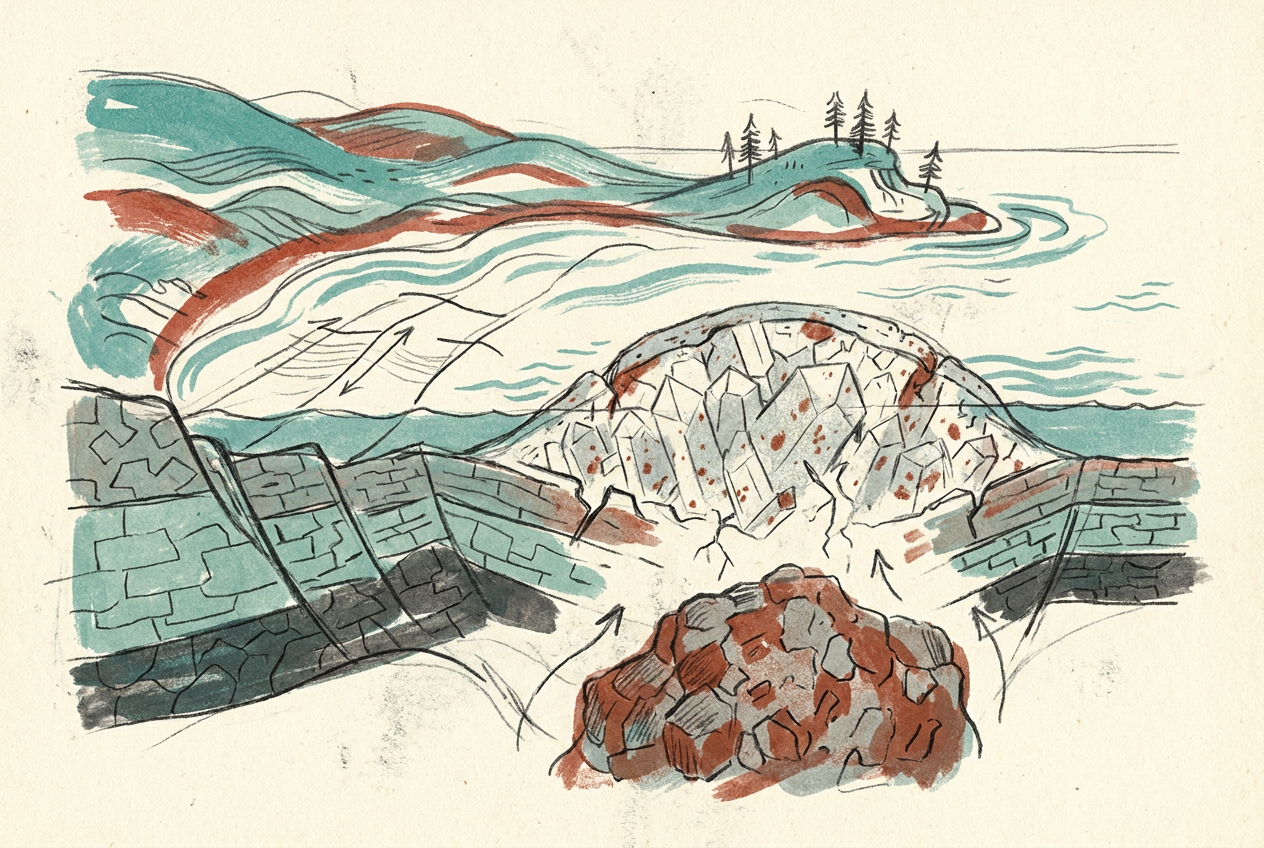
The Moruya Batholith is not a single body but a cluster of related plutons, each the frozen remnant of a pulse of molten rock. They intruded into the older Ordovician sediments of the Lachlan Fold Belt, a region of thickened crust that formed during the assembly of eastern Gondwana. The magma rose along deep fractures, stalling several kilometres below the surface, where it cooled at a rate of perhaps one degree per thousand years.
That slow cooling allowed crystals to grow large. The granite's visible grains—quartz, feldspar, biotite mica—are each the product of a specific temperature and pressure window. The feldspar crystals, some several centimetres long, record the order in which minerals nucleated and grew as the melt lost heat to the surrounding rock.
Quarrying has exposed these textures in three dimensions. The Budd's Ledge quarry, operated since the 1860s, has supplied dimension stone for buildings across the region, including the Sydney Harbour Bridge pylons. The stone's uniform grain and lack of internal fractures made it ideal for construction—a direct consequence of the slow, undisturbed crystallisation that occurred deep in the Devonian crust.
A Coastline of Granite
The batholith emerges along a 30-kilometre stretch of coastline between Moruya and Batemans Bay. At Bingie Bingie Point, wave erosion has planed the granite flat, creating a smooth rock platform where the mineral fabric of the pluton is laid bare. Dark enclaves of older metamorphic rock, torn from the walls of the magma chamber, float within the lighter granite like raisins in a loaf.
Further south, at Congo Point, the granite is cut by a swarm of vertical basalt dykes—evidence of later extension, probably Jurassic in age, when the Tasman Sea began to open. The dykes are black, fine-grained, and brittle; the granite around them is pale and crystalline. The contrast could hardly be sharper.
The coastline here is notched by small coves where the granite has been preferentially weathered along vertical joints. The pattern is geometric, rectangular, almost architectural. It is the same joint system that the quarrymen exploited.
Exhumation
For a pluton to be visible at the surface, the kilometres of rock that once covered it must be removed. The Moruya Batholith was exhumed over tens of millions of years, primarily by erosion during the Cretaceous and early Cenozoic. The rate was slow—perhaps 0.03 millimetres per year—but sustained. The sediment that once lay above the granite now lies offshore, in the basins of the Tasman Sea.
The exposure is not uniform. At the batholith's margins, the granite grades into the surrounding country rock through a zone of migmatite—partially melted sediment that was caught between the hot pluton and the cooler crust. These transition zones preserve the chemical exchange between magma and wall rock, the subtle contamination that gives each pluton a distinctive composition.
The quarrymen knew the stone by feel: its grain, its colour, its response to the chisel. They were reading the thermal history of a Devonian magma chamber.
The Modern Quarry
The Budd's Ledge quarry is still active, though operations have slowed. The working face is a clean vertical wall about 20 metres high, marked by drill holes and the scars of wire saws. The stone is cut into blocks, then split along natural fracture planes. Waste piles of broken granite—the quarry's debris—cover several hectares nearby, slowly weathering into soil.
The granite itself is a medium-grained biotite monzogranite, grey when fresh, weathering to a warm brown. Its feldspar crystals are white, not pink, which distinguishes it from the more famous granites of the New England region. The difference is chemical—a lower potassium content—and reflects the composition of the source rock that melted in the lower crust.
Geologists have dated the Moruya plutons using the uranium-lead system in zircon crystals. The ages cluster around 390 to 395 million years, placing the batholith firmly in the Middle Devonian. That was the time when the Lachlan Fold Belt was being compressed, thickened, and heated—a period of mountain building that shaped much of eastern Australia's basement.
The granite that emerges from the quarry today is the same rock that cooled beneath those mountains, exhumed not by catastrophe but by the patient work of water and wind, over an interval of time that dwarfs the entire history of our species.
More like this
- The 110-Million-Year-Old River That Runs Backwards UndergroundWestern Australia's 110-million-year-old dune system has been slowly dissolving into a labyrinth of caves where an ancient river still flows, carrying the taste of a Cretaceous desert.
- The 5,000-Year-Old Volcanoes That Still Smoke in the SouthIn Victoria's Newer Volcanics Province, 400 volcanic vents erupted as recently as 5,000 years ago—the youngest volcanic field in mainland Australia, where craters still hold blue lakes and scoria cone
- The 300-Million-Year-Old Forest That Died Standing UpIn New South Wales, a 300-million-year-old fossil forest preserves dozens of trees buried upright by a Permian volcanic eruption—an entire ecosystem frozen in ash.