12 May 2026 · 3 min read
The Iron That Fell: The Wolfe Creek Meteorite Crater
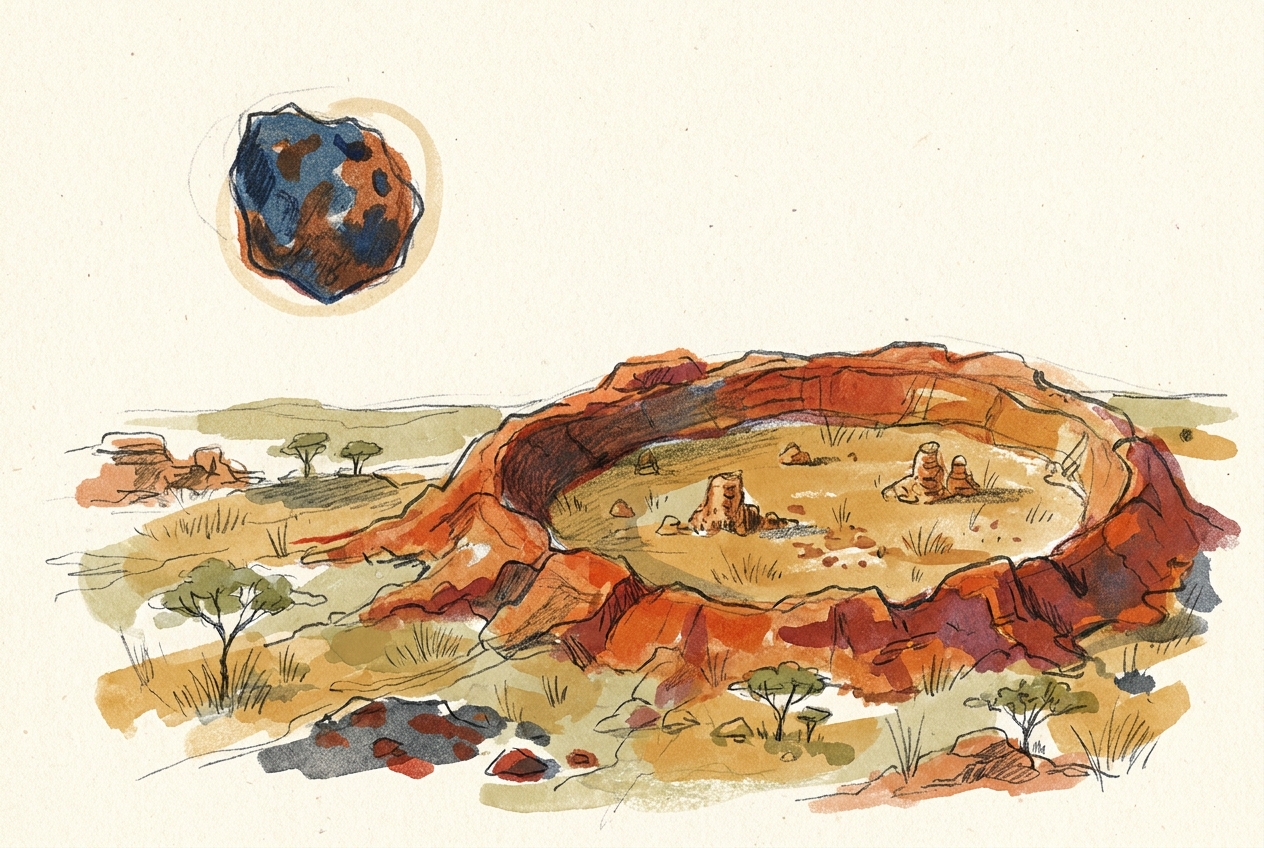
In Western Australia's Kimberley region, a 50-metre iron meteorite struck the desert around 120,000 years ago, leaving a 880-metre crater that remains one of Earth's best-preserved impact sites.
Around 120,000 years ago, a mass of iron roughly the size of a small car struck the red sandplain of Western Australia's Kimberley region at 15 kilometres per second. The impact excavated a crater 880 metres across and punched through layers of sandstone to expose the buried Proterozoic bedrock. The iron did not stay buried. Fragments of the meteorite—some weighing hundreds of kilograms—still litter the crater's rim, weathered but unmistakable.
The Traveller
The Wolfe Creek meteorite was an iron octahedrite, a fragment of a much larger body that broke apart in space or during atmospheric entry. Its composition is roughly 92% iron and 8% nickel, with traces of cobalt and phosphorus. When it struck, the impact released energy equivalent to several kilotons of TNT, instantly vaporising most of the projectile and hurling molten rock across the plain.
What makes Wolfe Creek exceptional is its youth and its preservation. Most meteorite craters on Earth are erased by erosion within a few hundred thousand years. Wolfe Creek has survived because the Australian continent is tectonically quiet and the Kimberley climate has remained arid throughout the late Pleistocene. The crater's rim rises 25 metres above the surrounding plain, still sharp enough to cast a shadow at sunrise.
The iron that fell here came from the asteroid belt, where it had orbited the Sun for 4.5 billion years before meeting the Australian desert.
The Scar
The crater sits within Paleozoic sandstone of the Canning Basin, sedimentary rock laid down when the Kimberley lay near the equator and was covered by shallow seas. The impact fractured and overturned these beds, raising a rim of shattered sandstone blocks that now host a sparse cover of spinifex and desert oaks.
The crater floor is flat, filled with fine sediment and salt-tolerant shrubs. Seasonal rainfall collects in a shallow pan that dries to a crust of gypsum and halite. Aerial surveys in the 1940s first identified the feature as a meteorite crater, though Aboriginal people in the region—the Djaru and Walmajarri—had known it for millennia. They called it Kandimalal, and their oral traditions describe a star that fell to earth.
The Fragments
Iron meteorites are rare among falls, comprising only about 5% of observed meteorites. But they survive terrestrial weathering better than stony types, and the dry Kimberley climate has preserved Wolfe Creek's fragments in exceptional condition. The largest recovered piece weighs nearly 200 kilograms and sits in a museum in Perth. Many smaller pieces remain scattered across the crater rim, their surfaces pitted with regmaglypts—thumbprint-like depressions formed by ablation during atmospheric passage.
The nickel content of the Wolfe Creek meteorite places it in a group known as IIIAB, the most common class of iron meteorites. These are thought to originate from the cores of differentiated asteroids that melted and separated into iron cores and stony mantles early in solar system history. When such an asteroid breaks apart in a collision, the core fragments become iron meteorites.
The Archive
Wolfe Creek is one of only about 190 confirmed impact craters on Earth. It is the second-largest meteorite crater in the world from which fragments have been recovered, after Meteor Crater in Arizona. But where the Arizona crater is heavily visited and its fragments mostly collected, Wolfe Creek remains remote and relatively undisturbed.
The crater also preserves a subtle record of climate change. The sediment layers on its floor contain pollen and charcoal that document shifts in vegetation over the past 100,000 years—from grassy woodlands during wetter interglacials to the spinifex desert of the present. The same iron that fell from space now holds a terrestrial archive.
For the geologist, Wolfe Creek is a clean experiment: a known projectile, a known target rock, a known age. For the traveller who walks its rim, it is a reminder that the Australian continent has been still long enough to keep the scars of what struck it. The iron arrived from somewhere else. The crater is what stayed.
More like this
- The 110-Million-Year-Old River That Runs Backwards UndergroundWestern Australia's 110-million-year-old dune system has been slowly dissolving into a labyrinth of caves where an ancient river still flows, carrying the taste of a Cretaceous desert.
- The 5,000-Year-Old Volcanoes That Still Smoke in the SouthIn Victoria's Newer Volcanics Province, 400 volcanic vents erupted as recently as 5,000 years ago—the youngest volcanic field in mainland Australia, where craters still hold blue lakes and scoria cone
- The 1.75-Billion-Year-Old Reef That Outranks the BarrierA 1.75-billion-year-old microbial reef in the Kimberley is the largest biological structure ever built by a single species, preserving a world without predators.