12 May 2026 · 3 min read
The Dinosaur That Walked Underwater: The Winton Trackways
In central Queensland, 95-million-year-old dinosaur footprints preserved on an ancient riverbed reveal how sauropods swam across a Cretaceous floodplain.
In central Queensland, near the town of Winton, a dinosaur left footprints on a riverbed 95 million years ago—and then kept walking. The tracks continue underwater.
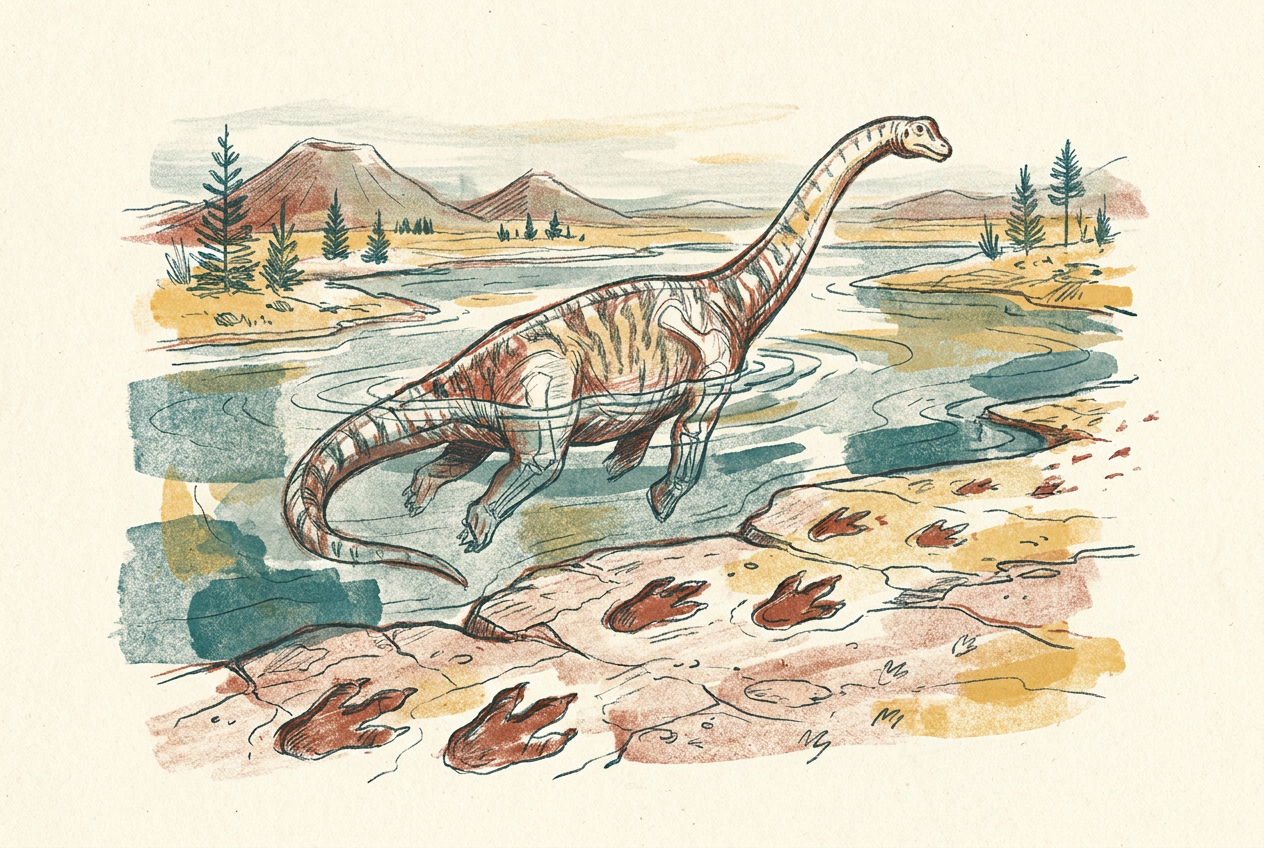
The Lark Quarry Conservation Park preserves what was once a broad, shallow river crossing on the edge of the Cretaceous Eromanga Sea. In 2015, palaeontologists from the Australian Age of Dinosaurs Museum identified a new set of tracks nearby that told an even stranger story: a long-necked sauropod, perhaps 15 metres from head to tail, had been swimming. Its back feet barely touched the bottom. Only the front feet left clear impressions, scuffing the mud as the animal pushed itself along in chest-deep water.
The Trackway That Changed a Narrative
Dinosaur footprints are not rare in Australia. The Winton Formation, a layer of sandstone and mudstone laid down between 95 and 98 million years ago, holds dozens of track sites. But the swimming sauropod tracks—formally described as ichnotaxon Sauropodopus—are something else. They show a large animal moving in a way that land-based footprints cannot capture.
The trackway runs for about 20 metres. The front footprints are deep and well-defined, with claw marks dragging through the sediment. The hind footprints appear only sporadically, shallow and smeared, as if the animal's hindquarters were buoyant. The spacing between steps is uneven, consistent with an animal pushing off the bottom rather than walking. This is the first clear evidence anywhere in the world of a sauropod swimming.
The hind feet touched the bottom only when the animal drifted into shallower water. The front feet never stopped working.
The Winton Formation was a different place then. The Eromanga Sea, a shallow inland ocean, covered much of what is now Queensland. Rivers carried sediment from the highlands to the east, building floodplains and deltas. Dinosaurs moved across this landscape in herds, following water and vegetation. When the sea rose, the floodplains became submerged. The sauropod tracks were buried by sand and silt, preserved until erosion exposed them again in the 21st century.
The Body Behind the Footprints
No bones have been found at Lark Quarry. The trackways are the only evidence of the animals that made them. But the footprints are detailed enough to identify the likely makers. The swimming sauropod was almost certainly a titanosauriform, a group of long-necked herbivores that included Diamantinasaurus matildae, whose bones have been found in the same formation 60 kilometres away.
Diamantinasaurus was a moderately sized sauropod, about 15 metres long, with a relatively short neck and robust limbs. It lived alongside the megaraptorid Australovenator wintonensis, a predator about six metres long whose claw marks appear in other tracks at the site. The Eromanga Sea ecosystem also included plesiosaurs, lungfish, and ancient crocodiles. The tracks suggest these animals moved between land and water regularly, adapting to seasonal floods and shifting shorelines.
A Window into Behaviour
Trackways are behavioural fossils. They record movement, speed, posture, and group dynamics in a way that bones cannot. The Lark Quarry sites include the world's largest known dinosaur stampede—3,300 footprints made by small ornithopods fleeing a predator. The swimming sauropod tracks add a different kind of moment: a large, slow animal using water to support its weight, perhaps to cross a channel or escape a threat.
The footprints are preserved in a layer of fine sandstone that once was river mud. The mud was soft enough to take an impression but firm enough to hold it. A subsequent influx of sand filled the tracks before they could be eroded, creating natural casts. Today those casts sit exposed on a low hillside in the Queensland outback, where the iron-rich sand has weathered to a deep red-brown.
The site is protected, but it remains vulnerable. Rain and wind wear the surface each year. Some tracks have already faded. The museum staff at Winton have cast and photographed every impression, building a digital archive in case the originals disappear.
What the tracks preserve is a moment of ordinary behaviour—a dinosaur swimming across a river, probably on a route it had used many times before. That ordinariness is what makes it valuable. The sauropod was not dying, not fighting, not being preserved for posterity. It was simply moving through its world, and the mud held the record.
More like this
- The 560-Million-Year-Old Garden That Never Saw a PredatorIn South Australia's Flinders Ranges, 560-million-year-old Ediacara surfaces preserve entire seafloor communities of fronds, discs, and quilts — a garden of soft-bodied life that flourished before pre
- The 300-Million-Year-Old Forest That Died Standing UpIn New South Wales, a 300-million-year-old fossil forest preserves dozens of trees buried upright by a Permian volcanic eruption—an entire ecosystem frozen in ash.
- The 1.75-Billion-Year-Old Reef That Outranks the BarrierA 1.75-billion-year-old microbial reef in the Kimberley is the largest biological structure ever built by a single species, preserving a world without predators.