12 May 2026 · 3 min read
The Gneiss That Remembers: The Proterozoic Basement of the Gawler Craton
Beneath South Australia's Gawler Craton lies 1.7-billion-year-old gneiss—rock once buried 25 kilometres deep, now exposed by tectonic uplift and erosion, that records the assembly of Proterozoic Austr
Some rocks have been through hell and kept the receipts. On the Eyre Peninsula of South Australia, outcrops of banded grey and pink gneiss—the Sleaford Complex—record a journey from the deep crust to the sunlit surface, a trip that took nearly two billion years.
The Deepest Crust
The Gawler Craton is one of Australia's ancient continental nuclei, a block of Archaean and Proterozoic crust that stabilised around 1.5 billion years ago. At its core lies the Sleaford Complex, a sequence of gneisses and migmatites that originally formed as sedimentary and volcanic rocks between 2.5 and 2.0 billion years ago.
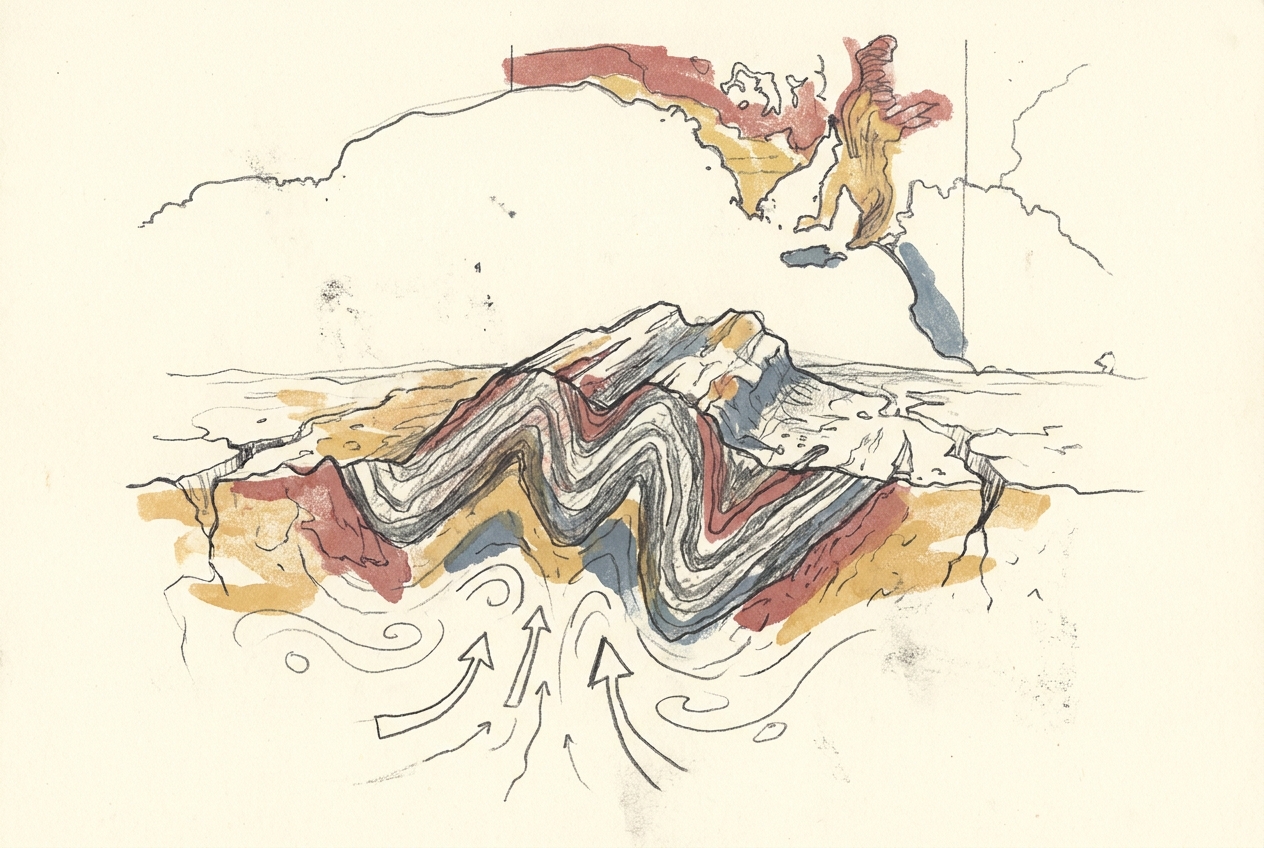
During the Kimban Orogeny, roughly 1.7 billion years ago, these rocks were buried to depths of 20 to 25 kilometres. There, at temperatures exceeding 700 degrees Celsius and pressures of 6 to 8 kilobars, the original minerals recrystallised into the banded gneiss we see today. Dark bands of biotite and hornblende alternate with pale bands of quartz and feldspar, the rock's fabric stretched and folded by the same forces that thickened the continental crust.
What makes the Sleaford Complex remarkable is not its age alone, but the clarity of its record. The mineral assemblages—garnet, sillimanite, cordierite—allow geologists to calculate precise pressure-temperature paths, mapping the rock's descent and eventual rise with unusual confidence.
The rock carries its history in its minerals. Each crystal is a data point, a witness to a specific depth and temperature at a specific moment in time.
The Exhumation
Burial is only half the story. For the gneiss to be visible today, the overlying 20 kilometres of rock had to be removed. This happened through a combination of tectonic uplift and erosion, a slow unroofing that took most of the Proterozoic Eon.
By 1.45 billion years ago, the Gawler Craton had been uplifted enough that the Sleaford Complex was exposed at the surface. The eroded material fed sedimentary basins to the east and north, including the sediments that would later host the Olympic Dam deposit. The craton has remained largely stable since then, a high-standing block of ancient crust that resisted further burial.
The exposure is not uniform. Along the coast near Streaky Bay and Ceduna, the gneiss forms low, wave-washed platforms—smooth, striated surfaces where the Southern Ocean has planed the rock flat. Inland, tors of gneiss rise above the scrub, their rounded forms a testament to deep weathering under the Cretaceous and Tertiary climates that once covered much of Australia.
The Craton's Legacy
The Gawler Craton is not just a geological curiosity. It is the basement that hosts some of Australia's richest mineral deposits. The Olympic Dam copper-uranium-gold deposit, the Prominent Hill copper-gold deposit, and the Challenger gold mine all lie within or above the craton's margins.
The connection is not coincidental. The same orogenic processes that metamorphosed the Sleaford Complex also created pathways for hydrothermal fluids to circulate, concentrating metals into economic deposits. The craton's long-term stability preserved these deposits from erosion and burial, keeping them accessible to mining.
The gneiss itself, however, has little economic value. Its worth is scientific: a rare window into the deep crust, exposed by time and erosion, that tells the story of how Australia's ancient core was built. Walking across the wave-cut platforms of the Eyre Peninsula, you step on rock that once sat 25 kilometres beneath your feet—rock that has flow, folded, and recrystallised under pressures that would crush any surface material into dust.
The Quiet Witness
The Sleaford Complex is not spectacular. It does not form towering cliffs or brilliant colours. It is grey and pink, banded and folded, worn smooth by wind and water. But it is honest. It records exactly what happened to it, and it hides nothing.
In a continent where the most famous geology is often the most dramatic—Uluru's monolith, the Hamersley's banded iron formations, the Kimberley's ancient reefs—the gneiss of the Gawler Craton offers something quieter: the deep time perspective of a rock that has been everywhere a rock can go and come back to tell the tale.
More like this
- The 110-Million-Year-Old River That Runs Backwards UndergroundWestern Australia's 110-million-year-old dune system has been slowly dissolving into a labyrinth of caves where an ancient river still flows, carrying the taste of a Cretaceous desert.
- The 5,000-Year-Old Volcanoes That Still Smoke in the SouthIn Victoria's Newer Volcanics Province, 400 volcanic vents erupted as recently as 5,000 years ago—the youngest volcanic field in mainland Australia, where craters still hold blue lakes and scoria cone
- The 1.75-Billion-Year-Old Reef That Outranks the BarrierA 1.75-billion-year-old microbial reef in the Kimberley is the largest biological structure ever built by a single species, preserving a world without predators.