12 May 2026 · 3 min read
The Bone Bed of the Nullarbor: Koala Cave's Fossil Marsupials
In a 1.5-million-year-old cave on the Nullarbor Plain, a fossil deposit preserves the remains of giant marsupials—including a 3-metre-tall wombat relative—trapped when the plain was a lush woodland.
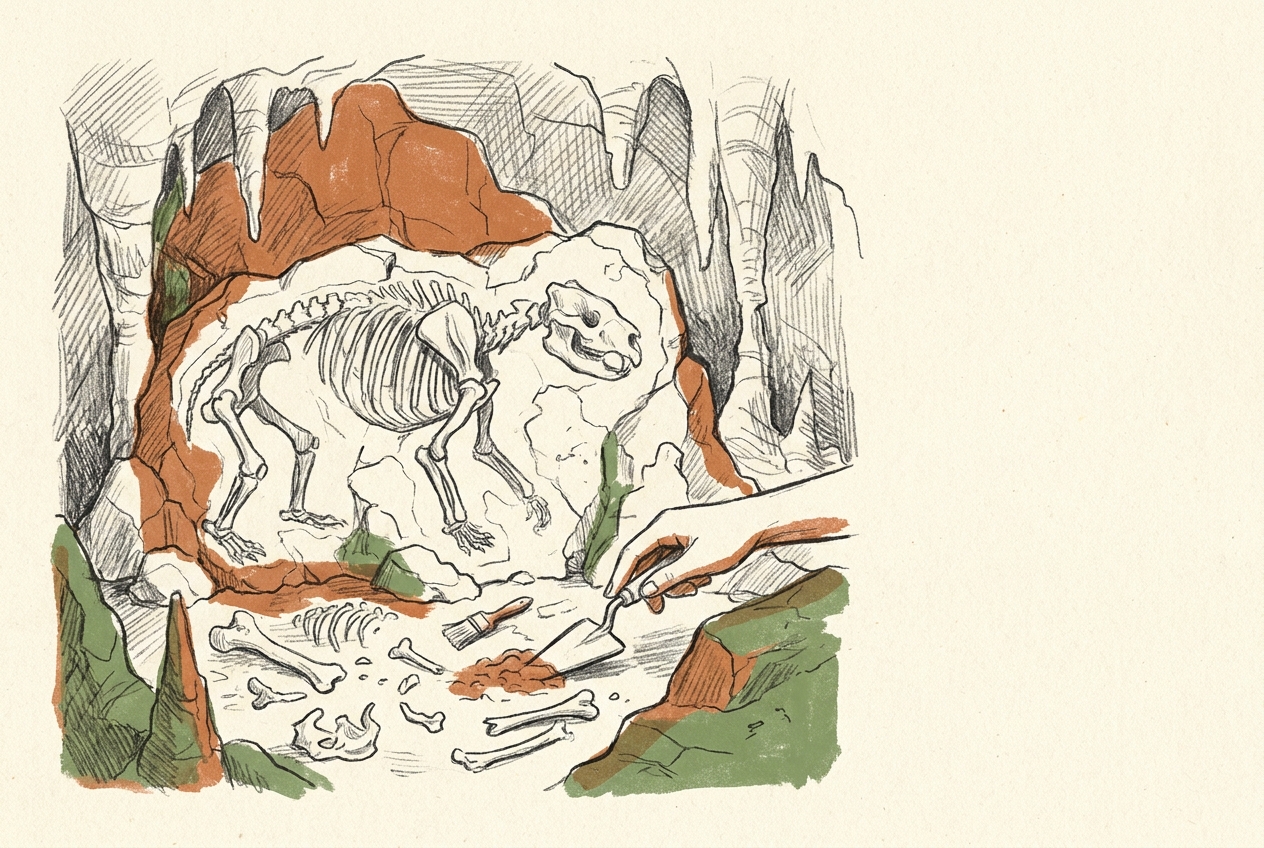
A wombat the size of a rhinoceros fell into a hole on the Nullarbor Plain about 500,000 years ago. It died there, and its bones lay undisturbed in a limestone cave for half a million years—until a bulldozer operator found them in 1968.
The cave is called Koala Cave, though it holds no koalas. It sits on the edge of the Nullarbor, that vast limestone plateau spanning 200,000 square kilometres of South and Western Australia. Today the plain is a treeless, waterless desert. Half a million years ago, it was woodland.
The Accidental Trap
The Nullarbor is honeycombed with caves. The plateau is a thick slab of Eocene limestone—deposited 40 to 50 million years ago when this part of Australia lay under a shallow tropical sea. Over millions of years, rainwater dissolved the limestone, creating a labyrinth of tunnels, chambers, and vertical shafts.
These shafts became death traps. Animals wandering through the woodland would step on a thin crust of limestone and fall ten or fifteen metres into a chamber below. They could not climb out. They died of thirst or injury, and their bones accumulated on the cave floor.
Koala Cave preserves one such accumulation. The deposit is about 1.5 million years old, spanning the early Pleistocene. In that single chamber, palaeontologists have recovered over 3,000 identifiable bones representing at least 50 species.
The Giants of the Pleistocene
The most spectacular specimen from Koala Cave is Phascolonus gigas, the giant wombat. This animal weighed about two tonnes and stood three metres long—roughly the size of a black rhinoceros. Its teeth were broad, flat, and ever-growing, adapted for grinding tough vegetation.
A wombat the size of a rhinoceros fell into a hole and lay undiscovered for half a million years.
The cave also held Procoptodon goliah, the short-faced kangaroo, which stood nearly three metres tall. Unlike modern kangaroos, it had a single large toe on each foot and a face like a horse. It could not hop fast—it was built for browsing, not sprinting.
Other fossils include Thylacoleo carnifex, the marsupial lion—a carnivore with blade-like premolars and a powerful thumb claw. Thylacoleo was not a lion; it was a diprotodontid marsupial that converged on big-cat form. It weighed about 130 kilograms and could climb trees.
The deposit also contains Sthenurus, a giant kangaroo with a short face and heavy limbs; Diprotodon optatum, the largest marsupial ever to live, a three-tonne herbivore resembling a giant wombat; and Zygomaturus, a diprotodontid with flaring cheekbones.
What the Bones Reveal
The Koala Cave assemblage tells a story about climate. The presence of browsing kangaroos and diprotodontids indicates that the Nullarbor was once covered by open woodland and shrubland, not desert. The bones are not abraded by transport—they fell directly into the chamber and were buried by sediment washed in during rain events.
The cave also preserves smaller animals: bandicoots, possums, rodents, and reptiles. These give a finer picture of the Pleistocene ecosystem. There were goannas, pythons, and a species of giant tortoise that disappeared from Australia around 50,000 years ago.
The timing of the megafaunal extinctions in Australia is debated. Most species in Koala Cave—including Phascolonus, Procoptodon, and Thylacoleo—disappeared between 50,000 and 40,000 years ago. That coincides with the arrival of humans on the continent. Whether climate change, hunting, or landscape burning drove the extinctions remains unresolved.
The Cave That Preserved a World
Koala Cave is not the only fossil deposit on the Nullarbor. The plain contains dozens of caves with Pleistocene bone beds. But Koala Cave is among the richest, partly because the entrance collapsed soon after the fossils accumulated, sealing the chamber from further disturbance.
The bones were discovered in 1968 during limestone quarrying for the Trans-Australian Railway. The bulldozer operator noticed white fragments in the rubble and reported them to the South Australian Museum. Excavations over the following decades recovered the full assemblage.
Today, the cave is protected. The fossils are held in museum collections, studied for what they reveal about Australia's lost Pleistocene fauna. The Nullarbor itself remains dry and flat, its caves holding a record of a greener continent—one where wombats grew as large as rhinos and kangaroos stood taller than any human.
More like this
- The 110-Million-Year-Old River That Runs Backwards UndergroundWestern Australia's 110-million-year-old dune system has been slowly dissolving into a labyrinth of caves where an ancient river still flows, carrying the taste of a Cretaceous desert.
- The 560-Million-Year-Old Garden That Never Saw a PredatorIn South Australia's Flinders Ranges, 560-million-year-old Ediacara surfaces preserve entire seafloor communities of fronds, discs, and quilts — a garden of soft-bodied life that flourished before pre
- The 300-Million-Year-Old Forest That Died Standing UpIn New South Wales, a 300-million-year-old fossil forest preserves dozens of trees buried upright by a Permian volcanic eruption—an entire ecosystem frozen in ash.