9 May 2026 · 3 min read
The Inverted Mountain: The Woodleigh Impact Structure
Beneath the flat wheatlands of Western Australia, a 360-million-year-old impact crater preserves a record of Devonian catastrophe and the slow healing of a continent.
Drive east from Perth for four hours, through the wheatbelt towns of Moora and Watheroo, and you cross something invisible. The land lies flat, cropped to stubble, the horizon a straight line of pale blue. But beneath the paddocks, buried under three hundred metres of sediment, there is a ring of shattered rock twenty kilometres wide—a scar left by a mountain-sized object that struck the continent 360 million years ago and nearly ended the Devonian world.
The Buried Crater
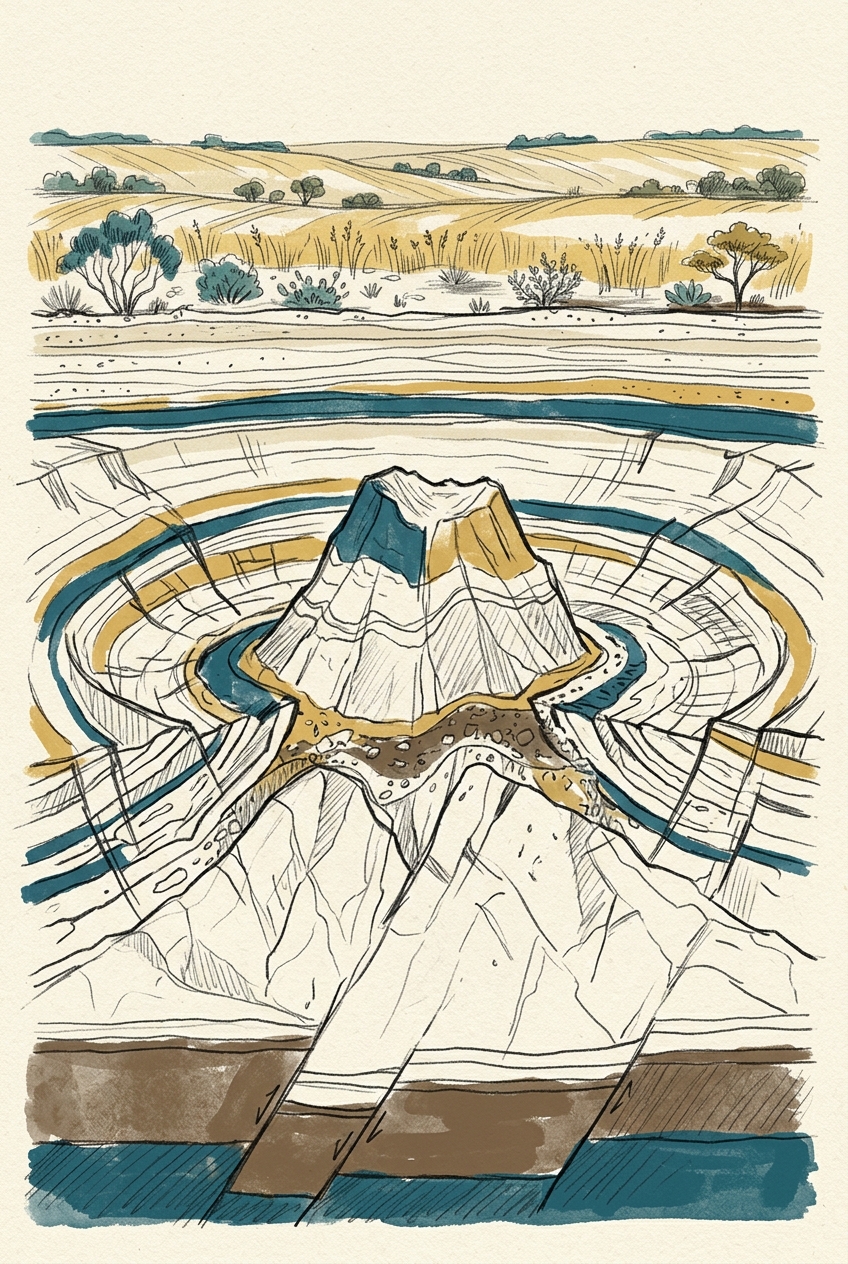
The Woodleigh impact structure was discovered in 1979, not from the surface but from below. Geologists drilling for groundwater in the Carnarvon Basin noticed something strange: the drill cores brought up fractured quartz, shocked feldspar, and breccias—rocks that had been pulverised by forces no earthquake could produce. It took another two decades before seismic imaging revealed the crater's true shape: a central uplifted dome ringed by a collapsed trough, the signature of a complex impact structure.
At the moment of impact, the object—estimated at one to two kilometres across—punched through the crust. The rock beneath rebounded like a struck bell, forming a central peak that later collapsed into a ring of concentric fractures. What remains is an inverted mountain, its summit pointing downward, its roots reaching toward the mantle.
Woodleigh is one of the largest known impact structures in Australia, comparable in size to the better-known Acraman impact in South Australia. But while Acraman left its ejecta scattered across the Flinders Ranges, Woodleigh left almost no surface trace. The crater was filled, buried, and forgotten.
The Devonian Catastrophe
The timing of the Woodleigh impact coincides with a mass extinction at the end of the Devonian period, roughly 372 million years ago. The Frasnian-Famennian extinction event wiped out 70 to 80 percent of marine species, including many reef-building organisms. The cause has long been debated—volcanism, anoxia, climate change—but a growing body of evidence points to multiple impacts.
Woodleigh's age is not perfectly constrained. Current estimates place it between 360 and 370 million years old, making it a plausible contributor to the late Devonian crisis. If the impacting body was large enough, it would have thrown vapourised rock and sulphur into the stratosphere, blocking sunlight for months or years, chilling the climate, and acidifying the oceans. The reefs of the Kimberley, which flourished in warm Devonian seas, would have been among the first to collapse.
The rock record of catastrophe is rarely dramatic. More often it is a thin layer of shocked quartz, a bed of broken shell fragments, a sudden absence of species.
The Healing Crust
What makes Woodleigh remarkable is not the violence of its formation but the quietness of its aftermath. The crater filled with sediment over tens of millions of years—first with marine shales, then with sandstones, then with the alluvial gravels of a drying continent. The central uplift, composed of granite and gneiss from the deep crust, now sits 300 metres below the surface, invisible to anyone walking above.
Drill cores from the site reveal a remarkable sequence. At the base, impact breccia—fragments of granite, quartzite, and schist fused into a chaotic matrix. Above it, a layer of shattered rock that grades upward into fractured but recognisable basement. Then the sedimentary infill: fine-grained marine sediments that record the slow recovery of the seaway that once covered this part of Western Australia.
The crater also preserved a small hydrothermal system. Groundwater heated by the impact circulated through the fractured rock, depositing veins of quartz and calcite. For a few thousand years after the strike, the crater floor was a warm oasis in a devastated landscape—a place where hot springs bubbled through the rubble of the impact.
A Quiet Archive
Today the Woodleigh structure is known only to geologists and a few curious farmers. There is no visitor centre, no walking trail, no sign marking the spot where a city-sized object struck the Earth. The wheat grows as it always has, and the sheep graze across the buried ring as though nothing happened.
But the crater remains, a fossil of catastrophe preserved in the crust. It reminds us that the Australian continent, for all its ancient stability, has been struck repeatedly over its long history. Each impact left a mark—some visible from space, others buried so deep that only a drill core can reveal them.
The Woodleigh impact structure is not a monument. It is a scar that healed, a wound that became geology. And beneath the flat paddocks of the wheatbelt, it waits for someone to ask the right questions.
More like this
- The 110-Million-Year-Old River That Runs Backwards UndergroundWestern Australia's 110-million-year-old dune system has been slowly dissolving into a labyrinth of caves where an ancient river still flows, carrying the taste of a Cretaceous desert.
- The 5,000-Year-Old Volcanoes That Still Smoke in the SouthIn Victoria's Newer Volcanics Province, 400 volcanic vents erupted as recently as 5,000 years ago—the youngest volcanic field in mainland Australia, where craters still hold blue lakes and scoria cone
- The 560-Million-Year-Old Garden That Never Saw a PredatorIn South Australia's Flinders Ranges, 560-million-year-old Ediacara surfaces preserve entire seafloor communities of fronds, discs, and quilts — a garden of soft-bodied life that flourished before pre