9 May 2026 · 3 min read
The Blood Wood: The Redgum Forests of the Murray River
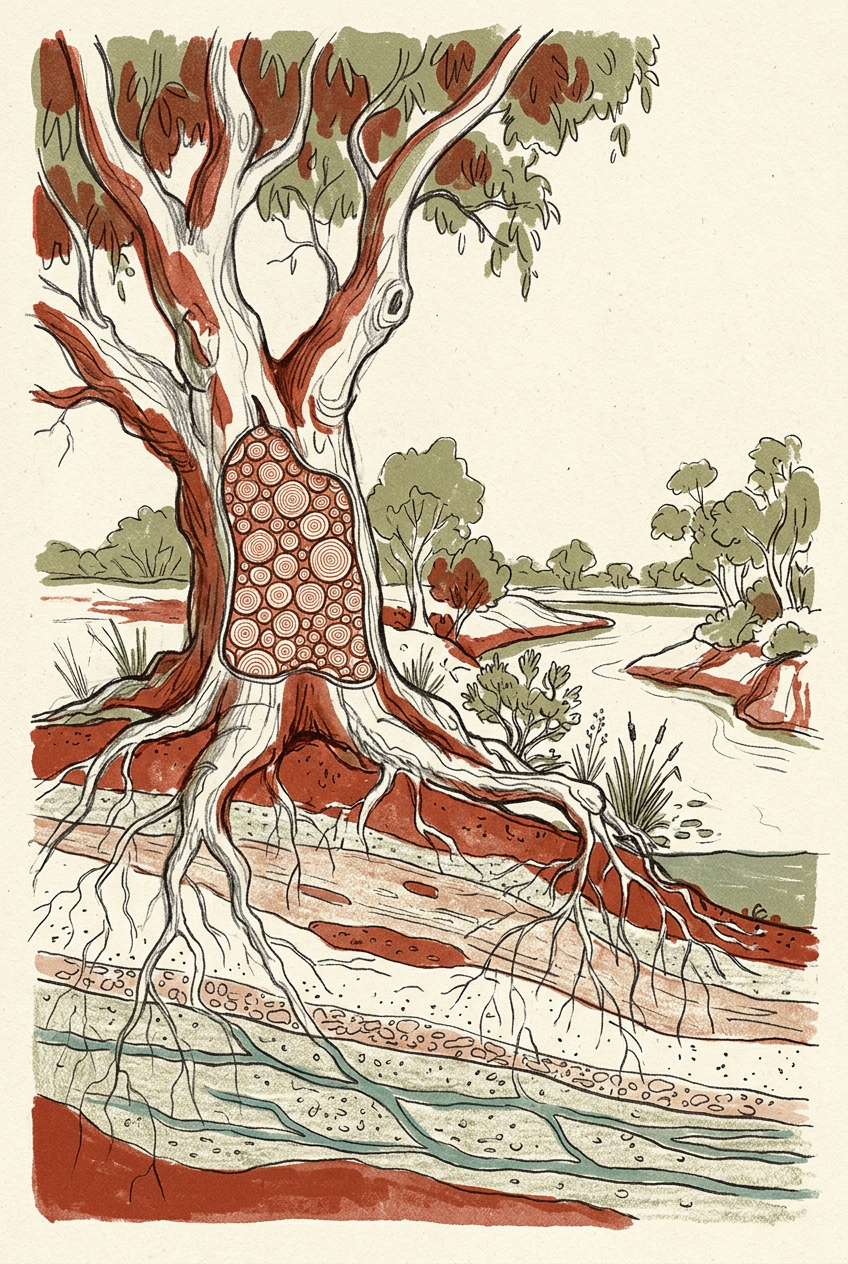
Along the Murray River floodplains, ancient river red gums anchor a living geology—roots drinking from buried aquifers, trunks recording drought and flood in seasonal growth rings spanning a thousand
Along the Murray River, from the Snowy Mountains to the Coorong, the river red gum (Eucalyptus camaldulensis) grows in groves so vast and old they seem less like trees than geological features. The largest specimens exceed forty metres in height and carry a thousand years of flood and drought in their gnarled trunks. They are not merely plants. They are living sediment cores, recording the pulse of Australia's longest river system.
The Floodplain Archive
River red gums depend on floods. Their roots reach down fifteen metres or more, tapping the shallow aquifers that underlie the Murray's floodplains. When the river rises, the trees absorb the water and lay down a wide growth ring. When the river retreats, the ring narrows. A cross-section of an old red gum reveals the hydrological history of the Murray in striated detail: wet decades, dry decades, the arrival of European water management.
Dendrochronologists have cross-matched living trees with preserved stumps and fallen logs to build a continuous record stretching back more than seven hundred years. The data show that the Murray's flow has always been variable, but the variability has intensified. The Federation Drought of 1895–1902, the Millennium Drought of 1997–2010—these events appear as narrow bands of compressed cells, the tree's quiet testimony to water stress.
A thousand-year-old red gum holds more information about the Murray than any gauge installed by the state.
The River That Builds Itself
The red gum does not simply inhabit the floodplain. It constructs it. Each tree traps sediment during overbank flows, slowing the water with its buttressed trunk and dense root mat. Over centuries, the trapped alluvium builds up around the base, forming raised benches that raise the tree above the floodplain. As the bench grows, the tree sends out new roots from higher on the trunk, climbing its own debris pile.
This process creates the distinctive form of the mature river red gum: a thick, fluted base, often hollow with age, and a crown of branches that spreads like a fractured delta. The Barmah-Millewa Forest, straddling the Murray in northern Victoria, contains the largest stand of these trees on the continent. Here the river meanders through a floodplain of grey cracking clays, and the red gums stand in dense ranks, their roots interlocking beneath the surface like the foundations of a buried city.
The Wood That Will Not Rot
The heartwood of the river red gum is dense, oily, and resistant to decay. Its specific gravity approaches 1.2—denser than water. Aboriginal peoples of the Murray-Darling Basin used the wood for shields, coolamons, and canoes, carving single logs into vessels that could carry several people across the river. The hollow trunks served as shelters, burial sites, and markers along seasonal travel routes.
When European settlers arrived, they felled the red gums with a zeal that bordered on mania. The wood was used for railway sleepers, bridge pilings, fence posts, and wharves. In South Australia, the paddle steamers that hauled wool and wheat down the Murray burned red gum in their boilers. The logging was so intense that entire forests disappeared within decades. At the Murray Mouth, the Coorong's red gum woodlands were cut for charcoal to fuel Adelaide's gasworks.
The Living Stones
The river red gum persists where it persists because it cannot be killed by water. A tree can survive complete submersion for months during a flood, its bark shedding oxygen into the waterlogged tissues. It can also survive fire, drought, and salt. But it cannot survive the regulation of the river.
Since the construction of locks, weirs, and dams along the Murray, the natural flood regime has been suppressed. The red gums that once flooded every two to three years now may wait a decade or more for a high flow. Seedlings cannot establish without spring floods to wash away the salt and moisten the seedbed. The old trees are dying without replacement.
In the Barmah-Millewa Forest, the Murray's largest red gum forest, more than half the trees show signs of stress: thinning canopies, dead branches, reduced seed production. Environmental water releases attempt to mimic the old floods, but the volumes are insufficient. The river has been tamed, and the trees are recording the cost.
Stand beneath a thousand-year-old red gum on the Murray's bank. The trunk is fissured, grey at the base, reddish higher up where the bark flakes away. The roots grip the alluvium like stone fingers. The tree does not move. It does not speak. It simply grows another ring, thinner than the last, and waits for the river to rise again.
More like this
- The 110-Million-Year-Old River That Runs Backwards UndergroundWestern Australia's 110-million-year-old dune system has been slowly dissolving into a labyrinth of caves where an ancient river still flows, carrying the taste of a Cretaceous desert.
- The 5,000-Year-Old Volcanoes That Still Smoke in the SouthIn Victoria's Newer Volcanics Province, 400 volcanic vents erupted as recently as 5,000 years ago—the youngest volcanic field in mainland Australia, where craters still hold blue lakes and scoria cone
- The 560-Million-Year-Old Garden That Never Saw a PredatorIn South Australia's Flinders Ranges, 560-million-year-old Ediacara surfaces preserve entire seafloor communities of fronds, discs, and quilts — a garden of soft-bodied life that flourished before pre