9 May 2026 · 3 min read
The Gold That Walked: The Witwatersrand Clues of the Pilbara
In Western Australia's Pilbara, 3.4-billion-year-old conglomerates preserve the earliest known placer gold deposits—river sediments that predate all life on land.
Some of the world's oldest gold never came from veins or magma. It came from a river.
In the Pilbara region of Western Australia, a sequence of metamorphosed conglomerates known as the Whim Creek Group and the Mosquito Creek Formation contains gold that was panned, washed, and concentrated by liquid water roughly 3.4 billion years ago. These are the oldest known placer gold deposits on Earth—river gravels laid down before the continents had stabilised, before the atmosphere held free oxygen, and before any living thing had crawled onto land.
The Oldest River
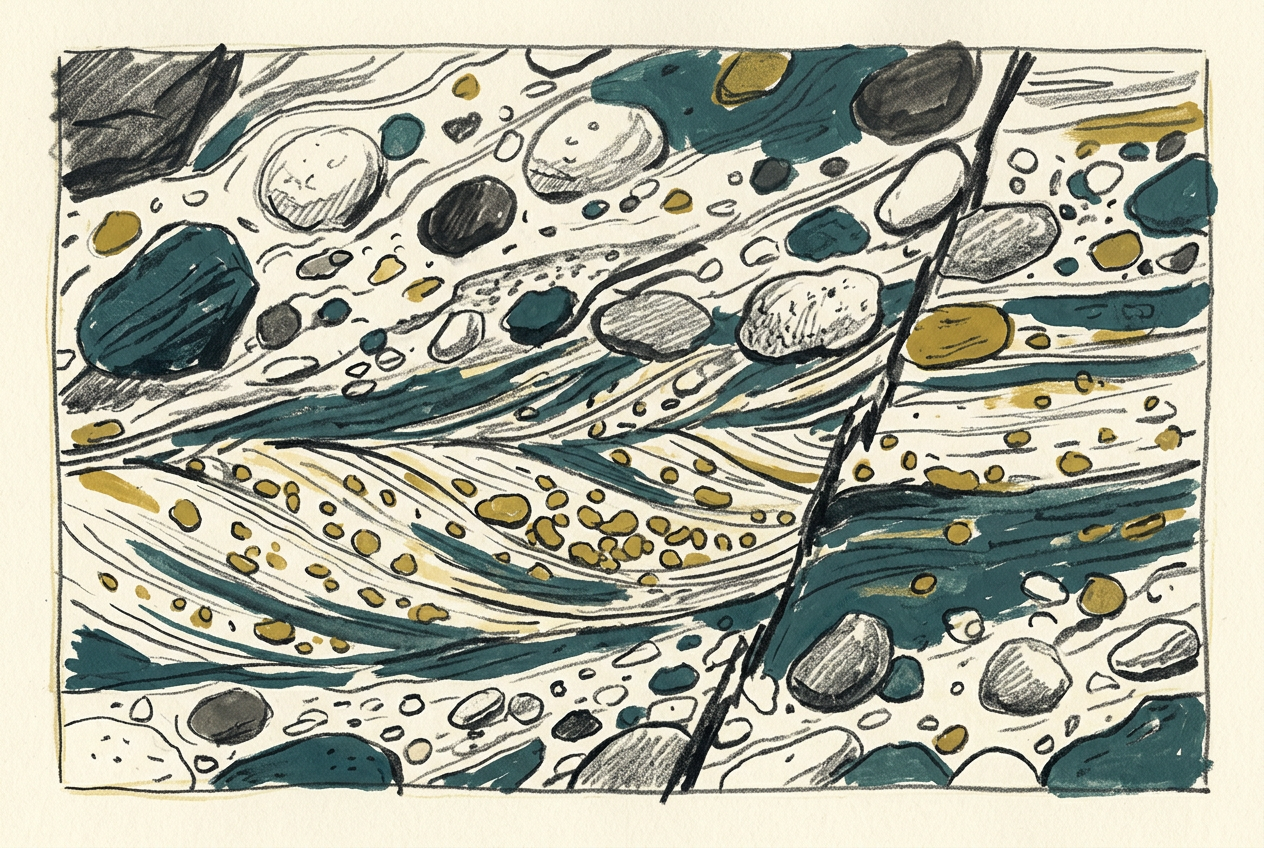
The gold-bearing conglomerates of the Pilbara are not easy to read. They have been metamorphosed—heated and squeezed—multiple times over three billion years. But their original character remains legible in the shape of the pebbles and the chemistry of the rock.
The deposits sit within the Mosquito Creek Basin, a narrow, deformed belt of sedimentary and volcanic rocks sandwiched between the older granite-greenstone terranes of the East Pilbara Craton. The basin formed as a rift, a crack in the ancient crust where rivers drained into a shallow sea. Those rivers carried debris eroded from gold-bearing greenstone belts—veins of quartz laced with native gold that had formed even earlier, in hydrothermal systems driven by Archean volcanism.
As the rivers slowed upon reaching the basin, they dropped their heaviest load first. Gold, with a density roughly six times that of quartz, settled into the gravel bars and channel lags. Sand and silt later buried these rich horizons. The process was identical to the one that would later concentrate gold in the Witwatersrand Basin of South Africa—except the Pilbara deposits are at least 400 million years older.
A Window into Archean Weathering
Before these deposits were recognised, geologists had little direct evidence of how Archean landscapes weathered and eroded. The Pilbara conglomerates preserve something rare: a sedimentary record of the Earth's surface before life had colonised the continents.
There were no soils as we know them—no root systems to bind sediment, no organic acids to accelerate chemical weathering. The land was a sterile terrain of volcanic rock and exposed granite, worn down by rainfall and carbon dioxide alone.
The gold itself tells a story about atmospheric chemistry. In the Archean, gold could be transported in solution by thiosulfate complexes—compounds that form in low-oxygen, sulfur-rich waters. Some of the gold in the Mosquito Creek deposits may have been dissolved, moved, and reprecipitated before being mechanically concentrated by the rivers. This dual mobility—chemical and physical—is rarely preserved in younger deposits.
The Ghost of a Continent
The Pilbara placer gold is not mined at scale today. The grades are modest, the geology complex, and the deposits deeply weathered. But they matter for a different reason: they are clues to a vanished continent.
The Pilbara Craton, stabilised by about 3.2 billion years ago, is one of only two surviving fragments of early Archean crust that retain their original character (the other being the Kaapvaal Craton in southern Africa). The Mosquito Creek conglomerates record the first stirrings of plate tectonics—the rifting, erosion, and sediment transport that would come to define continental geology. In their pebbles and gold grains, we see the infancy of the rock cycle itself.
The rivers that laid down these deposits have long since vanished. The basin has been folded, faulted, and intruded by younger granites. But the gold remains, scattered through three-billion-year-old gravels that once shifted under an Archean sun—a record of the first landscapes to hold moving water, and the first sediments to carry the weight of a mineral that humans would one day cross oceans to find.
More like this
- The 560-Million-Year-Old Garden That Never Saw a PredatorIn South Australia's Flinders Ranges, 560-million-year-old Ediacara surfaces preserve entire seafloor communities of fronds, discs, and quilts — a garden of soft-bodied life that flourished before pre
- The 1.75-Billion-Year-Old Reef That Outranks the BarrierA 1.75-billion-year-old microbial reef in the Kimberley is the largest biological structure ever built by a single species, preserving a world without predators.
- The 3.5-Billion-Year-Old Cones That Still Catch LightIn the Pilbara's Dresser Formation, 3.5-billion-year-old stromatolites preserve the oldest direct evidence of life on Earth—microbial mats that built layered domes in a volcanic caldera.