26 June 2026 · 3 min read
The Hill of Pure Silver Chloride
A 60-metre hill of silver chloride at Broken Hill formed when 1.7-billion-year-old ore was enriched by a billion years of chemical weathering.
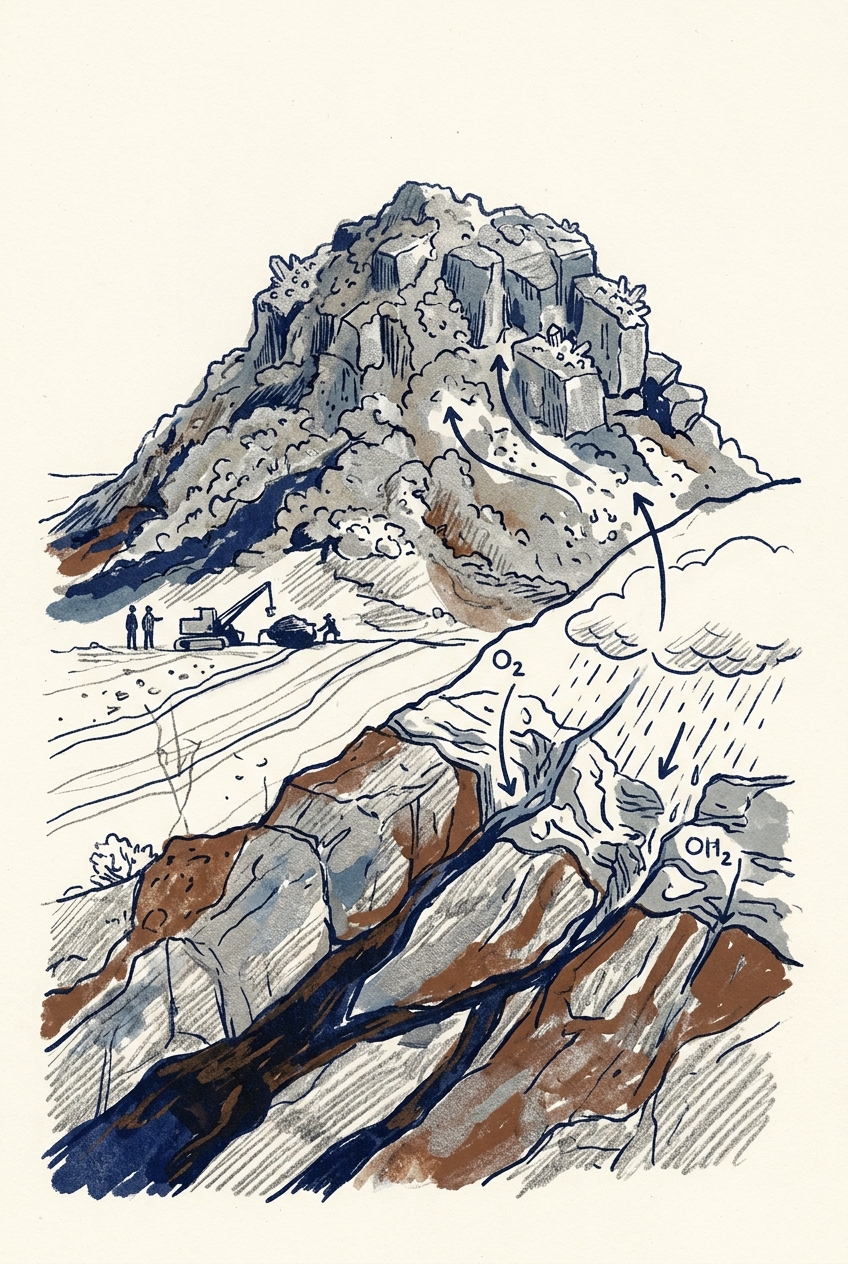
Just north of Broken Hill, on the New South Wales side of the border, a hill called The Pinnacle rises from the flat red plain. It is not a hill of rock. It is a hill of silver chloride — a 60-metre mound of pure, weathered silver ore that men once dug with their hands.
The Line of Lode
Broken Hill sits above a single orebody: a 7-kilometre-long lens of lead, zinc, and silver that bends through the earth like a sleeping serpent. Prospector Charles Rasp pegged the first claim in 1883, mistaking the dark gossan for tin. What he had found was one of the richest silver-lead-zinc deposits ever discovered — a body that would yield more than 300 million tonnes of ore over 140 years.
The orebody formed 1.7 billion years ago on an ancient seafloor. Hot brines rose through volcanic sediments, dumping metals into layers of mud. Later, the rocks were folded, metamorphosed, and thrust upward. What had been a flat stratiform deposit became a vertical sheet, tilted almost 90 degrees, its top eroded to reveal the silver-stained cap.
The Weathering Engine
Above the primary sulfide ore, a process of oxidation and enrichment had been running for millions of years. Rainwater, charged with oxygen and carbon dioxide, percolated down through the exposed lead-zinc mass. It dissolved the sulfides and reprecipitated them as carbonates, sulfates, and chlorides — minerals far richer in silver than the original ore.
The result was a supergene zone up to 100 metres deep, with silver grades sometimes exceeding 5,000 grams per tonne. In places, the silver chloride formed thick crusts on the surface, so pure that early miners could cut it with a knife. The black gossan that Rasp had dismissed as worthless actually held the richest silver ever found on the continent.
The hill was not the source but the residue — the chemical ghost of a billion years of weathering.
The Ghost Reef
Geologists now recognise that Broken Hill is a massive sulfide deposit of the "broken hill-type," a class named after this single mine. But the silver cap tells a subtler story. The primary ore contained only modest silver — perhaps 100 grams per tonne. The supergene enrichment concentrated that silver more than fiftyfold, creating zones so rich they would have been impossible to discover by drilling alone.
The Pinnacle itself is almost entirely secondary. It is the insoluble residue of a billion-year chemical reaction: rain on metal, oxygen on sulfide, time on stone. The miners who dug it out in the 1880s found nuggets of wire silver coiled in the clay like roots. In one pocket, they recovered 4 tonnes of almost pure silver chloride from a single excavation.
The Unmined Mystery
Broken Hill still produces silver today, but the supergene cap is long gone — carved into ingots, minted into coins, sold to finance empires. What remains is the primary sulfide orebody, the engine that fed the enrichment zone for millennia.
The hill of silver chloride was a transient feature, a chemical accident of climate and time. It formed because the Australian interior stayed dry enough to prevent complete dissolution, and tectonically quiet enough to preserve the weathered profile. A different rainfall regime would have washed the silver into the water table. A different uplift rate would have eroded it away.
For a few thousand years of geological history — an eyeblink — the silver sat on the surface, waiting. When men finally arrived, they found a hill that was not rock, but wealth.
More like this
- The 110-Million-Year-Old River That Runs Backwards UndergroundWestern Australia's 110-million-year-old dune system has been slowly dissolving into a labyrinth of caves where an ancient river still flows, carrying the taste of a Cretaceous desert.
- The 5-Million-Year-Old Cave Archive Beneath a Treeless PlainBeneath the treeless Nullarbor Plain, a labyrinth of limestone caves preserves five million years of Australian climate in sediment layers, fossil bones, and ancient air bubbles.
- The 2.5-Billion-Year-Old Volcano That Still Holds 3,000 Tonnes of CopperIn South Australia's Olympic Dam, a 2.5-billion-year-old volcanic-hydrothermal system created the largest uranium deposit on Earth and a copper resource so vast it reshaped an industry.