26 June 2026 · 3 min read
The 1.7-Billion-Year-Old Mound That Makes Opal
How 1.7-billion-year-old stromatolite mounds in central Australia's Great Artesian Basin became the silica-rich ghost that produces the continent's precious opal.
The world's finest black opal forms inside a 1.7-billion-year-old bacterial mat that never turned to stone.
The Living Scaffold
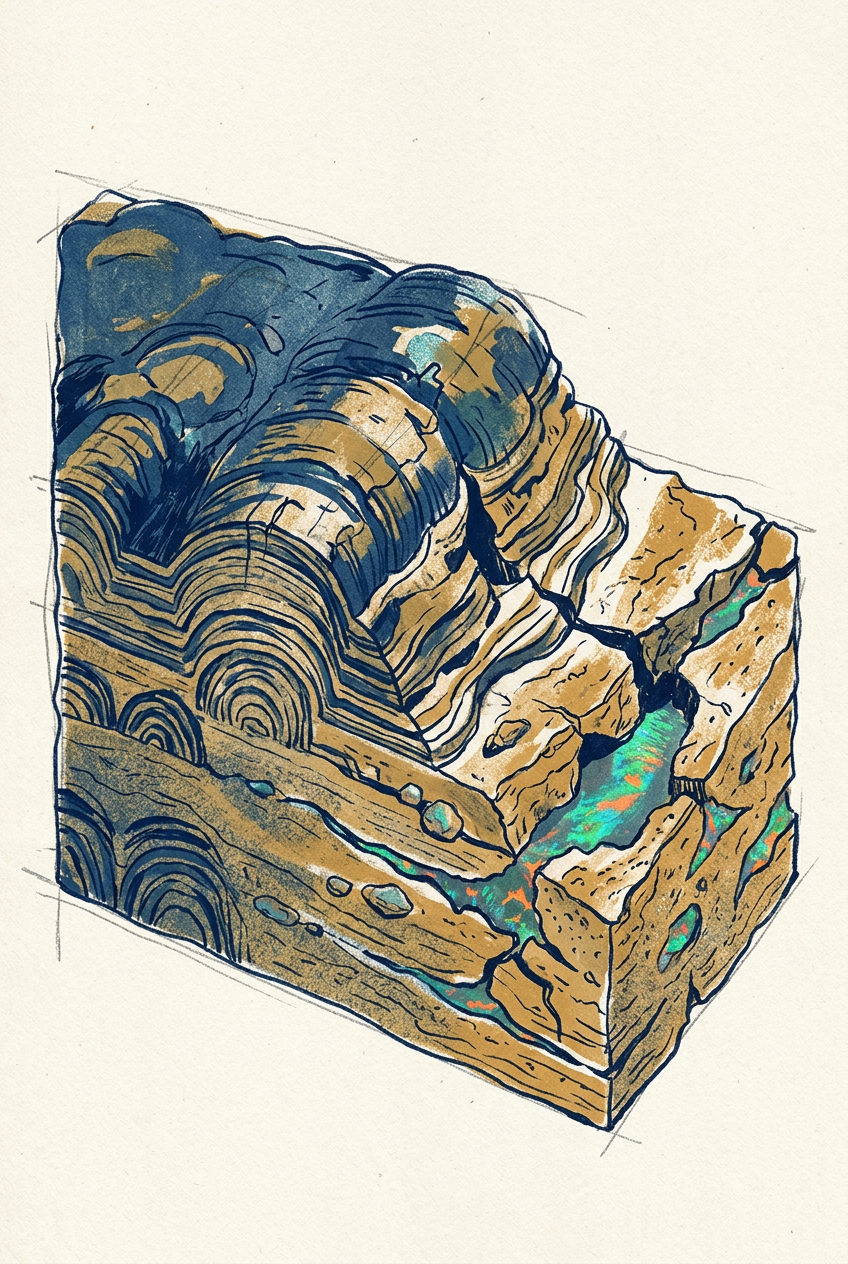
In the Cretaceous period, 100 million years ago, a shallow inland sea spread across what is now the Great Artesian Basin. Its floor was not the usual sand and mud. Beneath the water lay a landscape of low, domed mounds—fossilised stromatolites built by photosynthetic bacteria 1.7 billion years earlier, during the Proterozoic.
Those ancient microbial colonies had layered themselves into structures that survived burial, compaction, and the long squeeze of geological time. When the Cretaceous sea arrived, the old stromatolite beds lay buried under sediment, but they remained porous—a buried reef of silica-rich bacterial architecture.
Groundwater rich in dissolved silica seeped through these buried mounds. Where the stromatolite framework created cavities and fractures, the silica precipitated out, filling the spaces with a gel that over millions of years hardened into opal.
The opal is not the fossil. The fossil is the mould that shaped the gem.
The Ghost of a Microbe
Opal forms where silica-saturated water fills a void and then dries out, layer by minuscule layer. The stromatolite mounds provided the voids: irregular cavities where bacterial mats had decayed unevenly, leaving pockets and channels.
What makes Australian opal so vivid is the regularity of those drying layers. The silica spheres that stack together in the gel pack themselves at just the right size—about 150 to 300 nanometres across—to diffract visible light. Red, green, blue: the colour depends on the spacing. The stromatolite cavities, with their gentle, irregular curves, encouraged this slow, even deposition.
Coober Pedy, Lightning Ridge, Andamooka—all sit on the same geological inheritance. The opal fields of inland Australia trace the buried shoreline of that Cretaceous sea, where the old stromatolite beds lay closest to the surface.
The Colour of Deep Time
Not all opal comes from stromatolites. But the most prized—the black opal of Lightning Ridge, the crystal opal of Coober Pedy—owes its existence to these Proterozoic mounds. The dark carbonaceous traces of the original bacteria give black opal its deep body tone, against which the colours flare like fire in ink.
The opal itself is young by geological standards: perhaps 20 to 30 million years old, deposited long after the dinosaurs were gone. But the mould it filled was already ancient when the first trilobite crawled. A gemstone shaped by bacteria that lived a billion and a half years before the opal formed.
Miners in Lightning Ridge speak of "findings"—the trace of colour that tells them a seam is near. What they are really reading is the ghost of a 1.7-billion-year-old microbial colony, still directing the way water moves through stone.
The Slowest Craft
Opal mining is intimate work. A miner lies on his side in a narrow tunnel, picking at clay with a screwdriver, following a coloured seam by headlamp. The stone he seeks was made by the slowest craftsman imaginable: a bacterial mat that built a scaffold, waited a billion years for seawater, and then held still while silica filled its bones.
Australia produces 95 percent of the world's precious opal. Every piece of it carries, somewhere in its structure, the fingerprint of those Proterozoic mounds—the oldest living things on the continent, still shaping what we find valuable.
More like this
- The 110-Million-Year-Old River That Runs Backwards UndergroundWestern Australia's 110-million-year-old dune system has been slowly dissolving into a labyrinth of caves where an ancient river still flows, carrying the taste of a Cretaceous desert.
- The 560-Million-Year-Old Garden That Never Saw a PredatorIn South Australia's Flinders Ranges, 560-million-year-old Ediacara surfaces preserve entire seafloor communities of fronds, discs, and quilts — a garden of soft-bodied life that flourished before pre
- The 1.75-Billion-Year-Old Reef That Outranks the BarrierA 1.75-billion-year-old microbial reef in the Kimberley is the largest biological structure ever built by a single species, preserving a world without predators.