10 July 2026 · 3 min read
The 2.5-Billion-Year-Old Volcano That Still Holds 3,000 Tonnes of Copper
In South Australia's Olympic Dam, a 2.5-billion-year-old volcanic-hydrothermal system created the largest uranium deposit on Earth and a copper resource so vast it reshaped an industry.
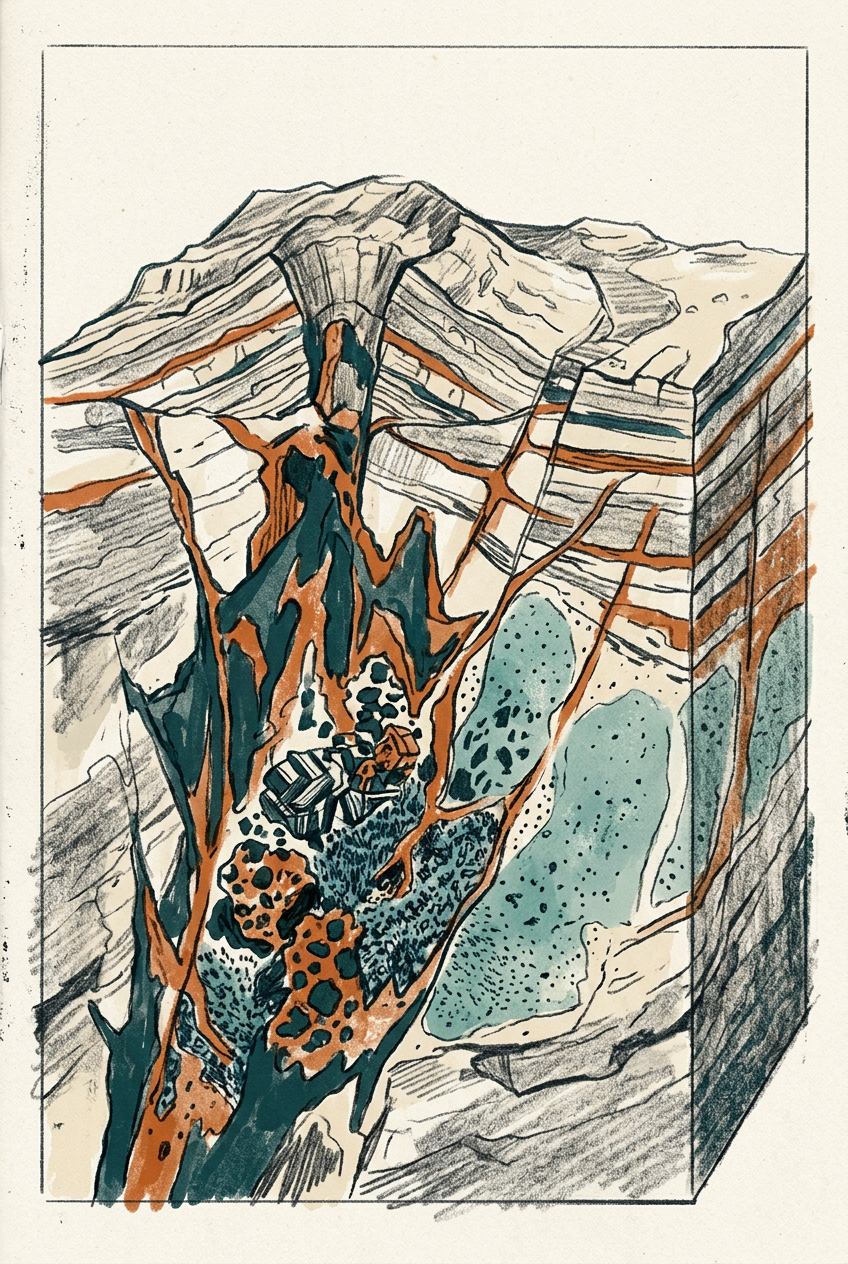
Beneath the arid stony plains of South Australia, 550 kilometres north of Adelaide, a 2.5-billion-year-old volcanic system still pulses with metal. The Olympic Dam deposit holds 3,000 million tonnes of copper — enough at current consumption rates to supply the entire world for nearly two years — along with the largest known uranium resource on the planet, significant gold, and silver. It is not a seam or a vein. It is a breccia: a kilometres-wide body of shattered rock, cemented by minerals that precipitated from hot fluids moving through the crust long after the volcano itself had died.
A Volcano That Never Erupted
The Gawler Range Volcanics, which cover nearly 25,000 square kilometres of South Australia, are the remnants of a massive 1.59-billion-year-old eruption — one of the largest volcanic events Earth has ever known. But Olympic Dam is older. The ore body sits within a 2.5-billion-year-old rhyolite volcanic complex that never reached the surface. Instead, magma stalled in the upper crust, fracturing the surrounding rock as it cooled and released pressure. Into those fractures, mineral-rich hydrothermal fluids rose, depositing copper sulphides, uranium oxides, and iron oxides in a chaotic jumble of broken fragments.
The result is a breccia pipe: a vertical column of shattered rock that extends more than a kilometre deep. Unlike the neat layered ores of sedimentary copper deposits, Olympic Dam's mineralisation is messy, irregular, and immense. Geologists still debate exactly how the fluids moved and what triggered the precipitation, but the broad strokes are clear: a deep magma chamber heated groundwater, which leached metals from the surrounding volcanic rock and then dumped them as the fluids cooled and chemically reacted with the breccia.
No one was looking for a copper mine. They were looking for uranium to fuel nuclear power, and they found something far larger.
Discovered by Accident
Olympic Dam was discovered in 1975, not by geologists hunting copper, but by Western Mining Corporation searching for uranium. The company had been following a regional geophysical anomaly — a magnetic high in the otherwise flat Gawler Craton. The first drill hole intersected 35 metres of copper mineralisation at a grade far higher than anything in Australia at the time. The second hole hit 170 metres of similar ore. It took another decade of drilling to understand the scale: a mineralised system measuring roughly 7 kilometres by 4 kilometres, with a vertical extent of at least 1.5 kilometres.
The deposit is still being drilled today, and the boundaries keep expanding. In 2023, BHP, the current operator, reported that the resource had grown by another 60 million tonnes of copper equivalent, pushing Olympic Dam into the ranks of the largest metal accumulations ever discovered on Earth.
Why It Matters
Olympic Dam is not just big. It is geologically unusual. Most copper deposits on Earth are porphyry systems — disseminated grains in large igneous intrusions — or sedimentary layers like those in Zambia's Copperbelt. Olympic Dam belongs to a rare class called iron-oxide-copper-gold (IOCG) deposits, of which it is the type example and by far the largest. The same processes that formed it may operate beneath other ancient volcanic terrains, but no comparable deposit has yet been found anywhere else.
The mine itself is a feat of engineering. Because the ore body lies 300 to 600 metres below the surface, extraction happens entirely underground — a network of tunnels and declines that form one of the largest underground mines on Earth. The rock is crushed, ground, and processed in a surface plant that draws water from the Great Artesian Basin, a source of ongoing environmental concern in a region that receives less than 200 millimetres of rain per year.
For all its scale, Olympic Dam exposes a humbling fact. The volcano that built this treasure chamber erupted and collapsed 2.5 billion years ago. The fluids moved, the metals precipitated, and then the entire system sat buried and undisturbed for two billion years — until a drill bit happened to find it. There are almost certainly other Olympic Dams waiting beneath the cover, but the crust does not give up its secrets easily. That is what makes exploration a gamble, and what makes a discovery like this one a piece of geological luck that a country can live on for a century.
More like this
- The 5,000-Year-Old Volcanoes That Still Smoke in the SouthIn Victoria's Newer Volcanics Province, 400 volcanic vents erupted as recently as 5,000 years ago—the youngest volcanic field in mainland Australia, where craters still hold blue lakes and scoria cone
- The 300-Million-Year-Old Forest That Died Standing UpIn New South Wales, a 300-million-year-old fossil forest preserves dozens of trees buried upright by a Permian volcanic eruption—an entire ecosystem frozen in ash.
- The 1.85-Billion-Year-Old Caldera That Still Feeds the FurnaceIn South Australia's Middleback Ranges, a 1.85-billion-year-old volcanic caldera collapsed and later became one of the world's richest iron ore deposits.