27 June 2026 · 3 min read
The 110-Million-Year-Old Ash That Buried a Dinosaur Dawn
How 110-million-year-old volcanic ash in Victoria's Otway and Strzelecki Ranges preserved the only polar dinosaur fauna from the Cretaceous—a cold-adapted ecosystem that thrived within the Antarctic C
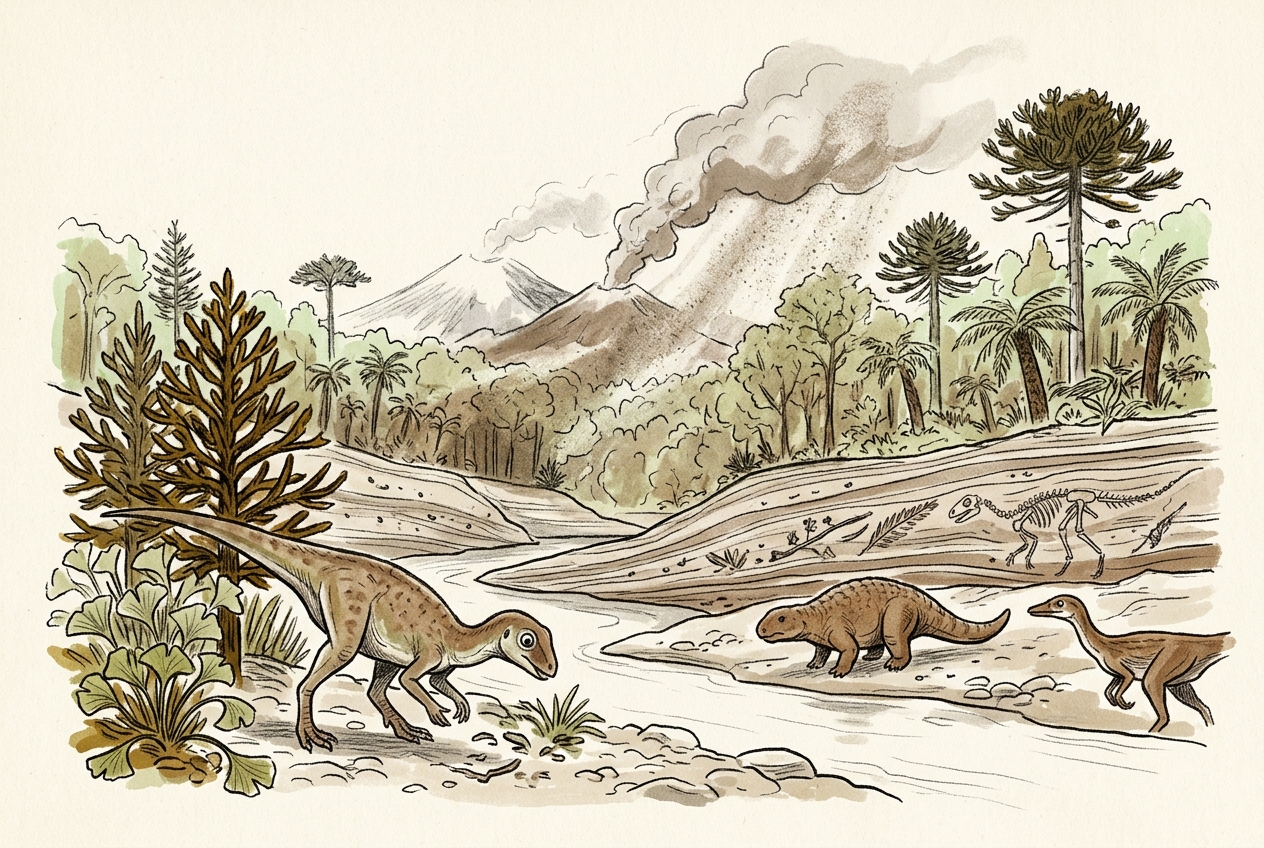
On the coast of Victoria, where the Southern Ocean slams against sandstone cliffs, a 110-million-year-old ashfall has preserved something no other deposit on Earth holds: a dinosaur fauna that lived inside the Antarctic Circle. These were not the giants of the northern continents. They were small, feathered, cold-adapted animals that spent months in darkness, and they died in a sudden volcanic winter that buried them in ash.
The Ash That Killed and Preserved
In the Early Cretaceous, Australia was still attached to Antarctica. The Otway and Strzelecki Ranges of Victoria sat at about 75 degrees south latitude—well within the polar circle. The climate was not the ice sheet we imagine today. It was cool-temperate, with forests of conifers, cycads, and ferns, and a mean annual temperature around 10°C.
But the light was polar. Four months of winter darkness, followed by a summer of constant sun.
Then a volcanic eruption in what is now the Whitsunday volcanic province—one of the largest continental volcanic systems ever known—sent a plume of ash across southeastern Australia. The ash fell into river systems and lakes, smothering everything. It was not a gentle burial. The bones show no scavenger damage, no weathering. These animals were killed and covered in days.
The Polar Dwarf Ecosystem
The Dinosaur Cove and Flat Rocks sites near Cape Otway have yielded a fauna unlike any other. The dominant predator was a small theropod, Timimus, about the size of a turkey. There were ornithopods the size of dogs, ankylosaurs no larger than a cow, and the oldest known monotreme teeth—early relatives of the platypus and echidna.
These were not stragglers at the edge of the world. They were a stable, diverse ecosystem that had adapted to polar life over millions of years.
The bones are preserved in volcaniclastic sandstone—ash that settled in river channels and was reworked by water. The preservation is so fine that some bones still show microscopic blood vessel channels. The ash acted as a chemical seal, preventing dissolution by groundwater.
What the Ash Tells Us
Radiometric dating of zircon crystals in the ash beds pins the age at 110 to 115 million years old. That places these dinosaurs in the middle of the Cretaceous thermal maximum, when global temperatures were the highest in the last 250 million years. There were no polar ice caps. The Antarctic forests stretched to the coast.
But even in a warm world, the light cycle was the same. These animals had to survive four months of winter darkness. Some may have hibernated. Others, like the small theropods, may have remained active, hunting by starlight and aurora. The eye sockets of Timimus are large—an adaptation for low-light vision.
The ash preserved not just bones, but also the environment. Pollen grains in the same layers show a flora dominated by podocarp conifers and southern beech, with understorey ferns and lycophytes. The forest floor was soft, wet, and dark.
The Only Record of Its Kind
No other continent has produced a polar dinosaur fauna of this age and completeness. The Alaskan and Siberian sites are younger—from the latest Cretaceous, when the world was already cooling. The Victorian sites capture the peak of Cretaceous warmth, when polar life was at its most diverse.
The ash that killed them also made them immortal. Without that eruption, the bones would have been scattered by rivers, crushed by sediment, or dissolved by acid groundwater. Instead, they were sealed in volcanic siltstone, waiting 100 million years for a few fossil hunters with hammers and chisels.
Today, the sites are eroding into the sea at about 10 centimetres per year. The same ocean that exposes the bones is also destroying them. Each storm season claims another piece of the only window we have into the dinosaurs of the Antarctic dawn.
More like this
- The 5,000-Year-Old Volcanoes That Still Smoke in the SouthIn Victoria's Newer Volcanics Province, 400 volcanic vents erupted as recently as 5,000 years ago—the youngest volcanic field in mainland Australia, where craters still hold blue lakes and scoria cone
- The 560-Million-Year-Old Garden That Never Saw a PredatorIn South Australia's Flinders Ranges, 560-million-year-old Ediacara surfaces preserve entire seafloor communities of fronds, discs, and quilts — a garden of soft-bodied life that flourished before pre
- The 300-Million-Year-Old Forest That Died Standing UpIn New South Wales, a 300-million-year-old fossil forest preserves dozens of trees buried upright by a Permian volcanic eruption—an entire ecosystem frozen in ash.