10 July 2026 · 3 min read
The 5-Million-Year-Old Cave Archive Beneath a Treeless Plain
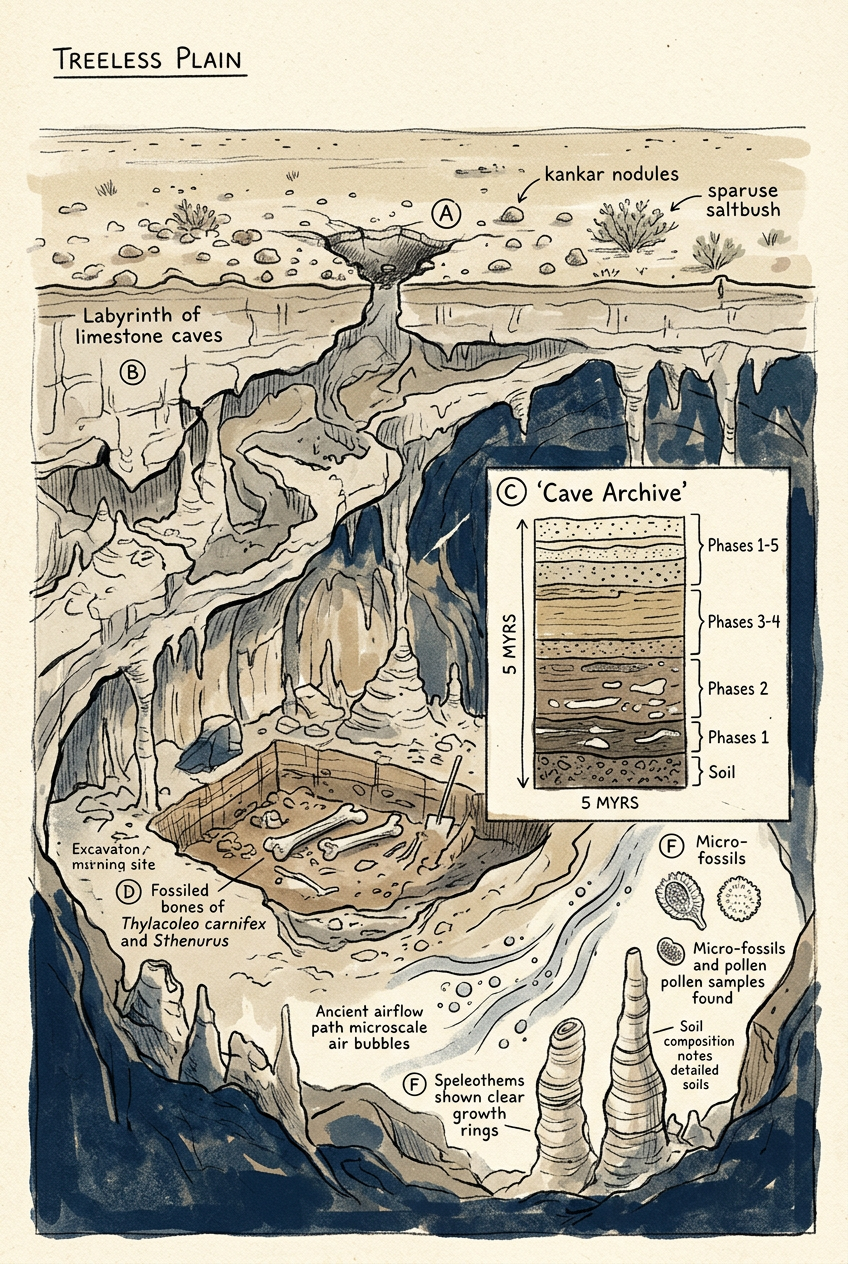
Beneath the treeless Nullarbor Plain, a labyrinth of limestone caves preserves five million years of Australian climate in sediment layers, fossil bones, and ancient air bubbles.
Nullarbor — Latin for "no tree." But the Nullarbor Plain hides something stranger than treelessness: a labyrinth of limestone caves whose walls are buried time capsules of the last five million years of Australian climate.
The Roof That Fell Slowly
The Nullarbor is a giant limestone platform, a former seafloor that rose above the waves about 15 million years ago when Australia drifted north over a sinking Pacific plate. Rain, slightly acidic from carbon dioxide, dissolved the limestone along joints and fractures. Over millions of years, these hairline cracks widened into chambers, tunnels, and shafts. The roof eventually collapsed in places, creating "blowholes" — entrance pits that drop 20 metres straight down into darkness.
More than 1,200 caves have been mapped beneath the Nullarbor. Some extend for kilometres. Others are vertical shafts that never saw sunlight until cavers dropped into them.
A Five-Million-Year-Old Weather Report
What makes the Nullarbor caves extraordinary is that they remained dry. Other caves around the world were flushed by groundwater or buried by glaciers. Here, on a remote limestone plain that never saw ice, the debris that fell into the caves stayed where it landed.
In one cave, a 230-centimetre core through the sediment showed alternating layers of coarse sand and fine silt — wet periods and dry periods, written in stone.
Scientists extracted sediment cores from several caves. They found fossil pollen from eucalypts and chenopods, charcoal from ancient bushfires, and the bones of extinct kangaroos and wombats. Each layer records a pulse of climate: the onset of aridity around 2.5 million years ago, the intensification of El Niño cycles, the megafaunal extinctions.
The Bones That Fell Through the Roof
Some Nullarbor caves are death traps. Animals blunder into the blowholes and cannot climb out. Their bones accumulate below, sometimes building up into metre-thick bone beds. In Thylacoleo Cave — named for Australia's extinct marsupial lion — excavators found the complete skeleton of a Thylacoleo carnifex, preserved in pristine condition because it never moved after falling.
The bones are young by geological standards — 50,000 to 800,000 years old — but they tell an old story: a landscape that was once richer, wetter, and more forested than the treeless plain of today.
The Oldest Air in the World
The deepest Nullarbor caves contain something even rarer: ancient air. In Weebubbie Cave, speleothems (stalactites and stalagmites) grew in layers like tree rings. Tiny air bubbles trapped within them preserve samples of the atmosphere from hundreds of thousands of years ago. Analysis of these bubbles shows that carbon dioxide levels during interglacial periods varied more than previously thought.
The same caves also preserve the oldest known continuous record of fire in Australia — charcoal fragments that reveal how Aboriginal people managed the landscape with fire for at least 100,000 years.
A Window That Keeps Closing
Today, the Nullarbor caves face a slow threat. Groundwater levels are dropping as the arid climate deepens. Without moisture, the speleothems stop growing. The sediment layers stop accumulating. The windows are closing, one by one.
But what they have already revealed is clear: the Nullarbor Plain, so empty above ground, holds one of the world's richest records of how the Australian continent dried out, burned, and reshaped itself around its animals — including the one that keeps trying to find water in a treeless land.
More like this
- The 560-Million-Year-Old Garden That Never Saw a PredatorIn South Australia's Flinders Ranges, 560-million-year-old Ediacara surfaces preserve entire seafloor communities of fronds, discs, and quilts — a garden of soft-bodied life that flourished before pre
- The 300-Million-Year-Old Forest That Died Standing UpIn New South Wales, a 300-million-year-old fossil forest preserves dozens of trees buried upright by a Permian volcanic eruption—an entire ecosystem frozen in ash.
- The 1.75-Billion-Year-Old Reef That Outranks the BarrierA 1.75-billion-year-old microbial reef in the Kimberley is the largest biological structure ever built by a single species, preserving a world without predators.