10 May 2026 · 3 min read
The Copper Cauldron: The Porphyry Deposits of the Mount Isa Inlier
In northwest Queensland, the Mount Isa Inlier holds one of the world's great copper and lead-zinc provinces, forged 1.65 billion years ago by hydrothermal fluids rising through fractured Proterozoic c
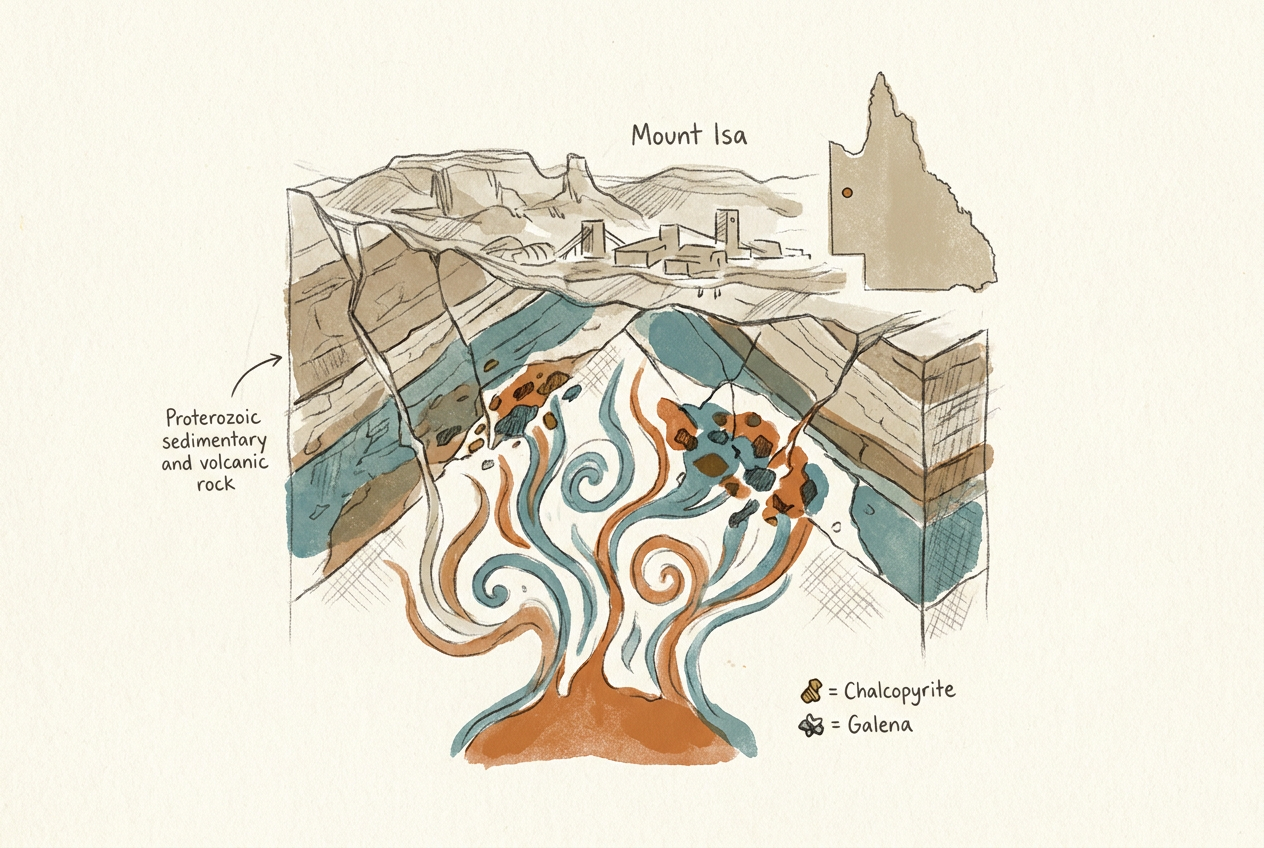
Beneath the red plains of northwest Queensland, a 1.65-billion-year-old plumbing system still holds its heat. The Mount Isa Inlier is not a mountain range but a shield of ancient rock where copper, lead, zinc, and silver were deposited by hydrothermal fluids moving through fractured crust. For a century, miners have followed the veins.
The Proterozoic Foundry
The Mount Isa Inlier formed between 1.8 and 1.5 billion years ago, when what is now Queensland sat near the centre of the supercontinent Nuna. A series of sedimentary basins filled with dolomite, shale, and sandstone as shallow seas advanced and retreated. Then, around 1.65 billion years ago, the crust began to stretch.
Extension created deep faults—pathways for hot, mineral-rich brines. These fluids, heated by the Earth's geothermal gradient, leached metals from the surrounding rock as they rose. When they hit chemical traps—carbonate layers, organic-rich shales, or abrupt changes in pressure—they precipitated their load.
The result is a mineral province of staggering concentration. The Mount Isa mine alone has produced over 8 million tonnes of copper and 30 million tonnes of lead-zinc-silver ore since operations began in 1923. Nearby, the Cannington mine holds one of the world's richest silver deposits.
The fluids that built these deposits moved through the crust at walking pace—centimetres per year—over hundreds of thousands of years.
The Silica Caps
What makes the Mount Isa deposits unusual is their preservation. Most Proterozoic hydrothermal systems have been eroded away or metamorphosed beyond recognition. Here, a cap of impermeable silica and dolomite sealed the system, trapping the mineralising fluids beneath.
At the George Fisher deposit, the ore sits within carbonaceous shales that once lay at the bottom of a stagnant basin. The organic matter in those shales helped precipitate lead and zinc sulphides, acting as a chemical sponge. The result is a bed of ore that can be followed laterally for kilometres.
The copper orebodies are different. They occupy steep faults and fractures, where hot brines mixed with cooler groundwater. The sudden drop in temperature forced copper out of solution, forming veins of chalcopyrite that cut across the sedimentary layers like dark stitching.
The City That Ore Built
Mount Isa is a company town in the oldest sense. The mine's smokestack—270 metres tall, visible from kilometres away—burns off sulphur dioxide 24 hours a day. The city of 20,000 people sits on the edge of the open pit, a settlement shaped entirely by the geology beneath it.
The Kalkadoon people knew the copper-stained rocks long before European arrival. They collected malachite and azurite—bright green and blue copper carbonates—for pigment and trade. When John Campbell Miles stumbled on the outcrops in 1923 while searching for gold, he recognised the weathered copper stains from his mining experience in Broken Hill.
The mine has been in continuous operation ever since. It has outlasted booms and busts, strikes and takeovers, and the collapse of metal prices that killed smaller operations. The reason is simple geometry: the orebody is large enough and rich enough to absorb the costs of depth.
The Deep Future
The Mount Isa mines now extend 1.8 kilometres below the surface. At those depths, rock temperatures exceed 50 degrees Celsius, requiring industrial-scale air conditioning. The copper grade has fallen from 4.5 percent in the early years to around 2.5 percent today, but the volume remains immense.
Geologists estimate that the Mount Isa Inlier still holds 50 million tonnes of copper and 100 million tonnes of lead-zinc-silver ore at depth. The deposits continue downward, following the same faults that channelled fluids 1.65 billion years ago. The plumbing system is still intact.
What made Mount Isa—the coincidence of extension, chemistry, and sealing—has not been repeated on Earth in quite the same way. The Proterozoic was a unique window: oxygen levels were rising, continents were stabilising, and the crust was still warm enough to drive large-scale hydrothermal circulation. No younger deposit on the planet matches the combination of scale, grade, and diversity found in this one corner of Queensland.
More like this
- The 560-Million-Year-Old Garden That Never Saw a PredatorIn South Australia's Flinders Ranges, 560-million-year-old Ediacara surfaces preserve entire seafloor communities of fronds, discs, and quilts — a garden of soft-bodied life that flourished before pre
- The 1.75-Billion-Year-Old Reef That Outranks the BarrierA 1.75-billion-year-old microbial reef in the Kimberley is the largest biological structure ever built by a single species, preserving a world without predators.
- The 3.5-Billion-Year-Old Cones That Still Catch LightIn the Pilbara's Dresser Formation, 3.5-billion-year-old stromatolites preserve the oldest direct evidence of life on Earth—microbial mats that built layered domes in a volcanic caldera.