9 May 2026 · 4 min read
The Gold That Rained From Space: The Witwatersrand Conglomerates and the Bendigo Connection
How the Witwatersrand-style gold deposits of Western Australia's Yilgarn Craton preserve a 2.7-billion-year record of ancient rivers, meteorite bombardment, and the richest gold province on Earth.
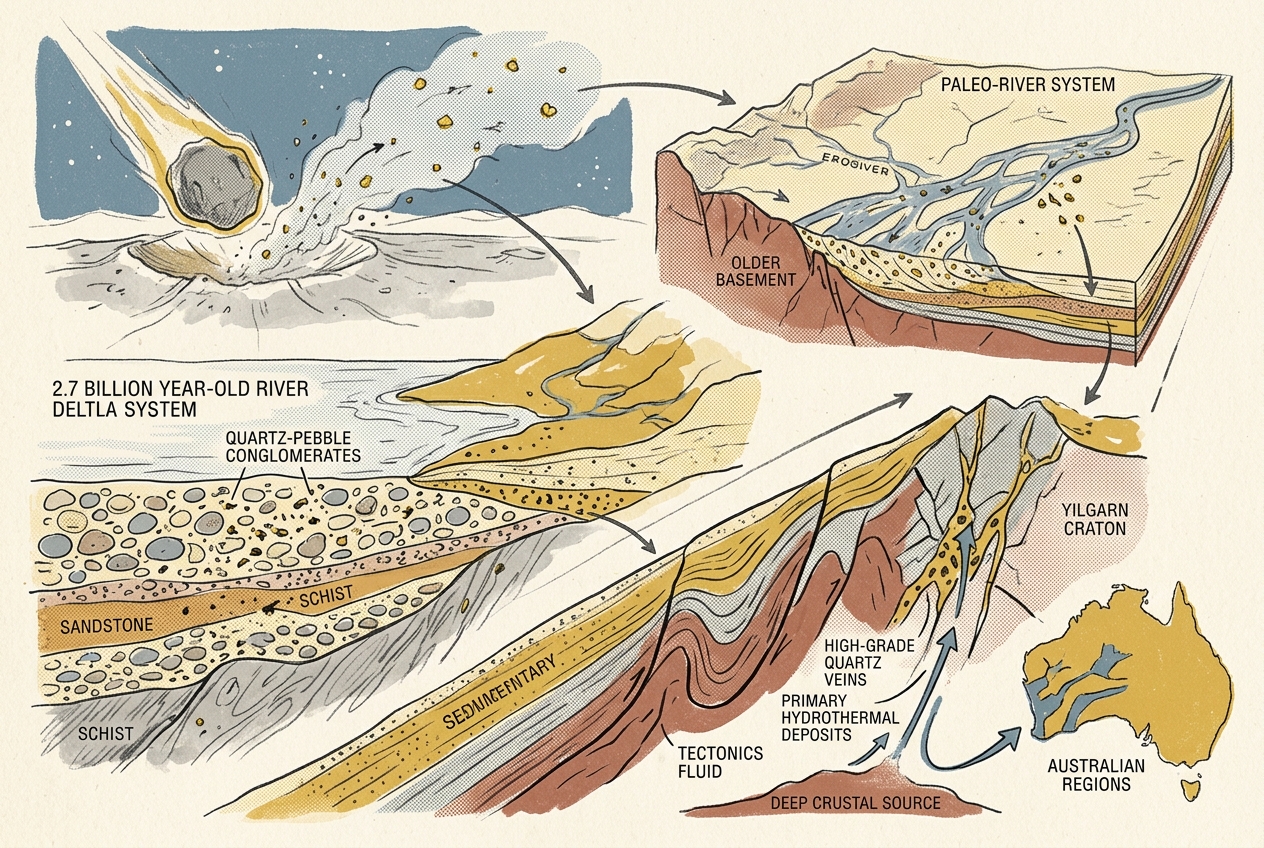
In the eastern Goldfields of Western Australia, a 2.7-billion-year-old river system once carried gold that fell from space. The metal arrived as micrometeorites and impact debris during the Late Archean, when the young Earth was still being pummelled by asteroids. Today, that gold—concentrated by ancient streams and buried under kilometres of younger rock—forms one of the richest gold provinces on the planet.
The Cosmic Source
The gold in the Witwatersrand-style deposits of the Yilgarn Craton did not originate in the mantle or from hydrothermal fluids, at least not directly. Geochemical fingerprinting tells a stranger story. The gold grains contain high levels of iridium and osmium, elements more common in meteorites than in Earth's crust. The ratio of these isotopes matches those found in chondritic meteorites, the primitive building blocks of the solar system.
During the Late Archean, between 2.8 and 2.7 billion years ago, Earth experienced a period of intense bombardment. Thousands of meteorites struck the surface each year, many of them carrying trace amounts of gold. Rain and rivers washed this debris into alluvial fans and braided stream channels, where the dense gold grains settled among quartz pebbles in conglomerate beds.
The same process operated in what is now South Africa's Witwatersrand Basin, source of nearly half the gold ever mined. In Western Australia, the equivalent deposits lie buried beneath the red dirt of the Yilgarn Craton, preserved in narrow, sinuous paleochannels that geologists call "reefs."
The Ancient Rivers
The Kalgoorlie-Kambalda region sits atop one of these ancient drainage systems. The gold reefs here are not veins or lodes but fossilised riverbeds—layers of rounded quartz pebbles bound by a matrix of pyrite and carbon, with visible gold flakes scattered through the rock. The pebbles themselves are water-worn remnants of older granite-greenstone terranes, carried downstream by rivers that flowed across a landscape without plants.
No vegetation meant no soil to hold the banks. The Archean rivers were broad, braided systems that shifted course frequently, spreading their gravel loads across floodplains hundreds of kilometres wide. When the rivers changed direction, they abandoned their gravel beds, which were then buried by sand and silt. Over millions of years, the weight of overlying sediments compressed these gravels into conglomerate.
Later, hydrothermal fluids—hot, mineral-rich waters driven by regional metamorphism—percolated through the conglomerates. The fluids dissolved some of the gold and reprecipitated it, coarsening the grains and concentrating the metal into richer zones. But the primary source remained the same: cosmic dust and impact debris, collected by Archean rivers and locked in stone.
The Golden Province
The Eastern Goldfields of Western Australia have produced over 3,500 tonnes of gold since mining began in the 1890s. The Super Pit at Kalgoorlie, a single open-cut mine two kilometres wide, has yielded more than 1,400 tonnes. The gold occurs in two main forms: the ancient conglomerate reefs, which are mined on a massive scale, and younger quartz veins that cut through the surrounding greenstone belts.
The conglomerate reefs are harder to find. They are often buried under hundreds of metres of younger rock, and the paleochannels that contain them are narrow and sinuous, rarely more than a few hundred metres wide. Modern exploration uses magnetic surveys and seismic imaging to map the buried river systems, tracing the ancient channels through the craton.
The gold in these deposits did not rise from the deep Earth. It fell from the sky, grain by grain, over millions of years.
When the channels are located, the drilling targets the basal conglomerate—the first layer of gravel deposited when the river began to flow. This layer is typically the richest, because the heaviest gold grains settled first, trapped among the largest pebbles.
The Bendigo Parallel
The Victorian Goldfields, mined during the 1850s rushes, tell a different story. There, the gold was hydrothermal in origin, deposited by hot fluids that rose along faults during the Devonian period, about 400 million years ago. The gold formed in quartz veins within folded sedimentary rocks, not in conglomerate beds.
Yet the two provinces share a deeper connection. Both were formed by processes that concentrated gold over vast timescales. In Victoria, the gold was leached from older rocks by circulating fluids and redeposited in structural traps. In Western Australia, the gold was delivered by meteorites and concentrated by rivers. Both systems required millions of years of tectonic stability, during which the gold could accumulate without being dispersed.
The Yilgarn Craton has remained largely undisturbed since the Archean. Unlike younger terranes that have been repeatedly deformed and eroded, the craton's ancient landscapes are preserved beneath a veneer of younger sediments. The gold reefs that formed 2.7 billion years ago are still where the rivers left them, waiting for geologists to read the buried geography.
When you hold a gold nugget from Kalgoorlie, you are holding a piece of the Archean sky. The atoms in that gold were forged in a supernova billions of years before Earth existed, then incorporated into a meteorite that struck the young planet, then washed downstream by a river that flowed across a world without grass or trees. The gold did not come from the Earth. It came from the universe, and Australia's ancient cratons have kept it safe.
More like this
- The 560-Million-Year-Old Garden That Never Saw a PredatorIn South Australia's Flinders Ranges, 560-million-year-old Ediacara surfaces preserve entire seafloor communities of fronds, discs, and quilts — a garden of soft-bodied life that flourished before pre
- The 1.75-Billion-Year-Old Reef That Outranks the BarrierA 1.75-billion-year-old microbial reef in the Kimberley is the largest biological structure ever built by a single species, preserving a world without predators.
- The 3.5-Billion-Year-Old Cones That Still Catch LightIn the Pilbara's Dresser Formation, 3.5-billion-year-old stromatolites preserve the oldest direct evidence of life on Earth—microbial mats that built layered domes in a volcanic caldera.