16 May 2026 · 3 min read
The Gold That Rode a River: Victoria's Deep Leads
Beneath Victoria's basalt plains, ancient river channels buried by lava flows preserve some of the richest alluvial gold deposits ever found.
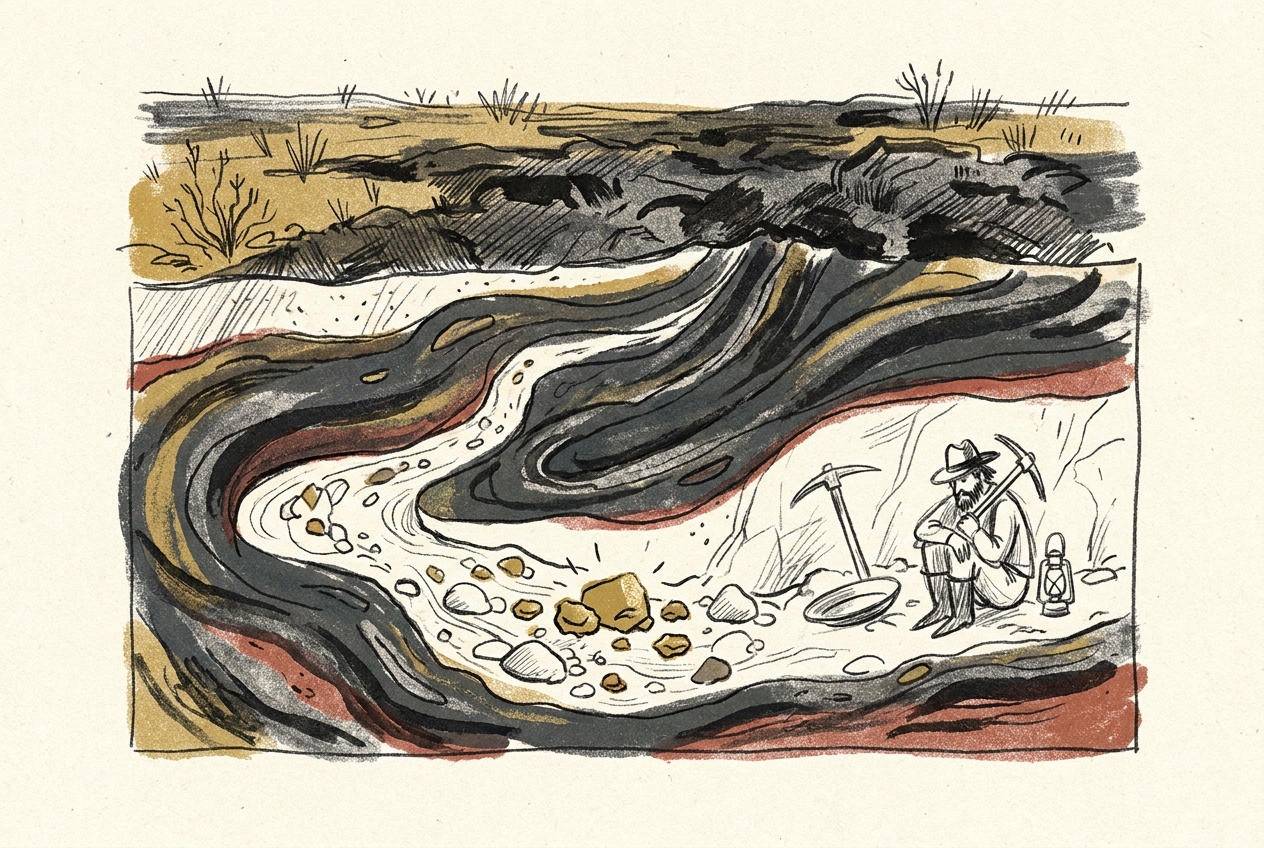
Before the basalt came, there were rivers. Between about 60 and 15 million years ago, streams draining the Victorian goldfields carried heavy gold downstream and lodged it in gravel beds: ancient river channels that later vanished under lava. Those buried channels, called deep leads, became one of the richest alluvial gold discoveries in Australian history.
The Rivers That Disappeared
During the early Cenozoic, Victoria's landscape looked nothing like today. The land was older, flatter, and drained by rivers that ran courses now entirely invisible from the surface. Erosion of the Palaeozoic gold-bearing reefs in central Victoria—the same rocks that fed the 1850s gold rushes—had released vast quantities of gold into these streams.
The gold settled where heavy particles always settle: at the bottom of gravel bars, in the lee of boulders, on the inside bends of ancient river curves. Over millions of years, the gravel beds accumulated gold in concentrations that would later astonish miners. One deep lead near Ballarat yielded over 50 tonnes of gold.
Then the volcanoes began.
The Lava That Sealed the Treasure
Between 4.5 million and about 10,000 years ago, eruptions from the Newer Volcanic Province spread basalt lava across western Victoria. Flow after flow poured over the landscape, filling valleys, burying creek beds, and flooding the plains. The lava did not destroy the old river channels. It sealed them.
The basalt flows, in some places over 30 metres thick, acted as a perfect cap. They preserved the gravel beds from erosion, locked the gold in place, and created a geological puzzle: the richest gold deposits in Victoria now lay hidden beneath a volcanic plain that showed no sign of the rivers below.
Miners discovered this only by accident. Sinking shafts through basalt in the 1860s, they broke into buried gravels heavy with gold. The deep leads had been found.
"The basalt is the miner's greatest enemy and his greatest friend. It hides the gold and it preserves the gold."
The Search Beneath the Stone
Finding deep leads required more than luck. The buried channels followed the logic of old topography: they wound along valley floors, converged at junctions, and snaked around hills that had long since been buried. Mining companies drilled through basalt to map the ancient river courses, then sank shafts to follow them.
The mining was dangerous. Deep lead shafts could reach 100 metres down through fractured basalt that let in water. Pumps ran day and night. Cave-ins were common. But the rewards could be extraordinary. At the Birthday Lead near Ararat, a single 800-metre stretch of buried channel produced over 14 tonnes of gold.
The deep leads were not all rich. Many petered out into barren gravel. But the pattern was consistent: where an old river had cut through gold-bearing country, the heaviest gold lay in the lowest few feet of gravel, just above the bedrock.
What the Deep Leads Tell Us
The deep leads offer a rare record of how landscapes evolve. They preserve not just gold but the shape of an entire drainage system that predates the volcanic plains—a ghost river network etched into the bedrock beneath the basalt. Geologists have mapped over 2,000 kilometres of these buried channels across western Victoria.
The deposits also reveal something about gold itself. The nuggets and grains in the deep leads are often larger and purer than those found in the surface alluvial deposits nearby. Sealed beneath basalt, protected from weathering and chemical alteration, the gold survived millions of years almost unchanged.
Today, most deep leads are exhausted. The shafts have been filled, the poppet heads dismantled, the old river courses mined out. But the story remains: a landscape where rivers flowed, volcanoes buried them, and the gold waited beneath the stone for someone to dig through the basalt and find what the old streams had left behind.
More like this
- The 5,000-Year-Old Volcanoes That Still Smoke in the SouthIn Victoria's Newer Volcanics Province, 400 volcanic vents erupted as recently as 5,000 years ago—the youngest volcanic field in mainland Australia, where craters still hold blue lakes and scoria cone
- The 560-Million-Year-Old Garden That Never Saw a PredatorIn South Australia's Flinders Ranges, 560-million-year-old Ediacara surfaces preserve entire seafloor communities of fronds, discs, and quilts — a garden of soft-bodied life that flourished before pre
- The 300-Million-Year-Old Forest That Died Standing UpIn New South Wales, a 300-million-year-old fossil forest preserves dozens of trees buried upright by a Permian volcanic eruption—an entire ecosystem frozen in ash.