15 May 2026 · 3 min read
The Glass That Remembers the Sea: South Australia's Acraman Impact
South Australia's Acraman structure records a 580-million-year-old impact that scattered glass across the continent and may have triggered the Ediacaran biota's first radiation.
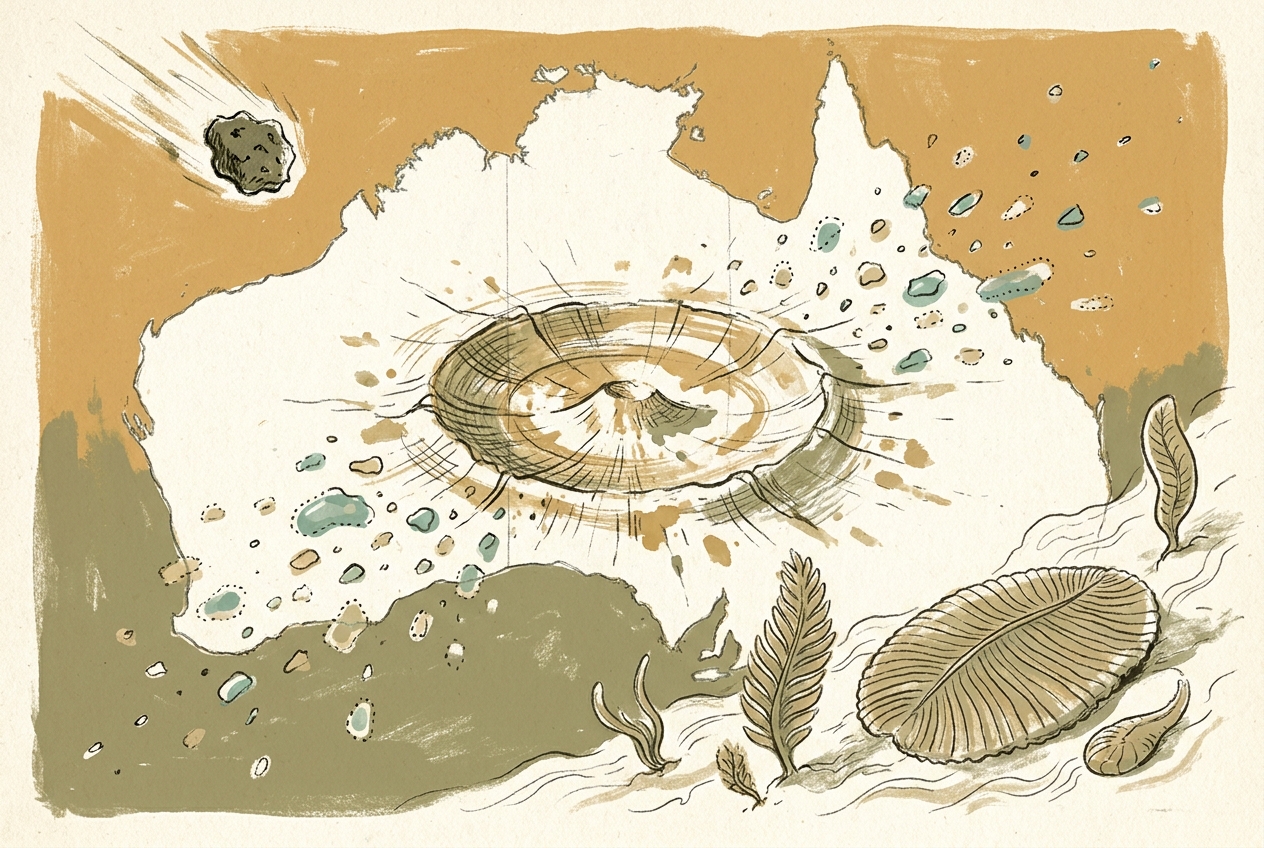
Deep in the Gawler Ranges of South Australia, a circular depression 30 kilometres wide marks where a 4.7-kilometre asteroid struck the continent 580 million years ago. The impact threw molten rock across the landscape, and some of that glass—shocked and shattered—travelled more than 300 kilometres before settling into ancient seafloor sediments. Those glass shards, called accretionary lapilli, were discovered in the Flinders Ranges in the 1980s. They proved that the Acraman impact was one of the largest known to have struck Australia.
The Ejected Sky
When the Acraman asteroid hit, it excavated a crater at least 40 kilometres deep in the continental crust. The energy released was equivalent to several million nuclear bombs. Rock at the impact site melted instantly, forming a distinctive pink glass known as impactite—breccia containing shocked quartz grains and shatter cones that still record the pressure wave.
What makes Acraman remarkable is not the crater itself, which has been deeply eroded over half a billion years, but the debris it scattered. Geologists found a thin layer of impact glass preserved in the Bunyeroo Formation of the Flinders Ranges, 300 kilometres east of the crater. The glass contains elevated levels of iridium, a metal rare in Earth's crust but common in asteroids. This horizon—no thicker than a few centimetres—marks a precise geological moment: the instant of impact.
The Seafloor That Caught the Rain
At the time of the Acraman impact, the Gawler Craton was a dry landscape, but the Flinders Ranges region lay beneath a shallow sea. The glass shards fell into quiet marine waters and settled onto the seabed, where fine muds gradually buried them. Over millions of years, those muds hardened into shale, preserving the impact layer like a page in a book.
The Bunyeroo Formation shale is now exposed in the Flinders Ranges, where it weathers into red and grey banded outcrops. Within those bands, the impact layer appears as a distinct sandy horizon, littered with tiny glass beads and mineral fragments that bear the unmistakable signs of shock metamorphism. The layer has been traced across more than 50,000 square kilometres of South Australia.
The Acraman impact scattered glass across a third of a continent—and may have scattered the seeds of animal life along with it.
The Pulse That Stirred Evolution
The Acraman impact struck Earth during the Ediacaran Period, between 635 and 541 million years ago. This was when the first complex multicellular life appeared—the enigmatic Ediacaran biota preserved in the Flinders Ranges themselves. The timing has led some scientists to ask whether the impact triggered an evolutionary pulse.
The impact layer in the Bunyeroo Formation sits just below the first appearance of Ediacaran fossils in the same sequence. After the impact, the fossil record shows a diversification of the soft-bodied organisms that defined this era. The connection remains speculative, but the evidence is suggestive: a mass extinction followed by a radiation of new forms, much as the later K-Pg impact cleared the way for mammals.
The Acraman event may have injected nutrients into the shallow seas—iron, phosphorus, and other elements—that fertilised microbial communities and allowed new ecological niches to open. The Ediacaran biota that followed included the first frond-like organisms, the first mobile animals, and the first reef-builders. Whether the impact was a catalyst or a coincidence, the glass shards in a South Australian shale bed mark the closest link between a planetary catastrophe and the dawn of animal life on Earth. The crater that remains, a faint ring in the Gawler Ranges, is a scar from a moment when the sky fell—and the seas answered.
More like this
- The 560-Million-Year-Old Garden That Never Saw a PredatorIn South Australia's Flinders Ranges, 560-million-year-old Ediacara surfaces preserve entire seafloor communities of fronds, discs, and quilts — a garden of soft-bodied life that flourished before pre
- The 550-Million-Year-Old Frond That Died on PurposeA 550-million-year-old frond in the Flinders Ranges preserves the oldest known evidence of programmed cell death, recorded in the symmetrical decay pattern of Dickinsonia.
- The 825-Million-Year-Old Rift That Failed But Built a WorldA failed 825-million-year-old rift left a 650-kilometre volcanic chain and sedimentary basin in South Australia that preserved the Ediacaran fossils and still shapes the landscape today.