15 May 2026 · 3 min read
The Reef That Grew Before Animals: South Australia's Ediacaran Mounds
In the Flinders Ranges, 550-million-year-old microbial reef mounds built by biofilms—not animals—record Earth's transition from microbial to complex life.
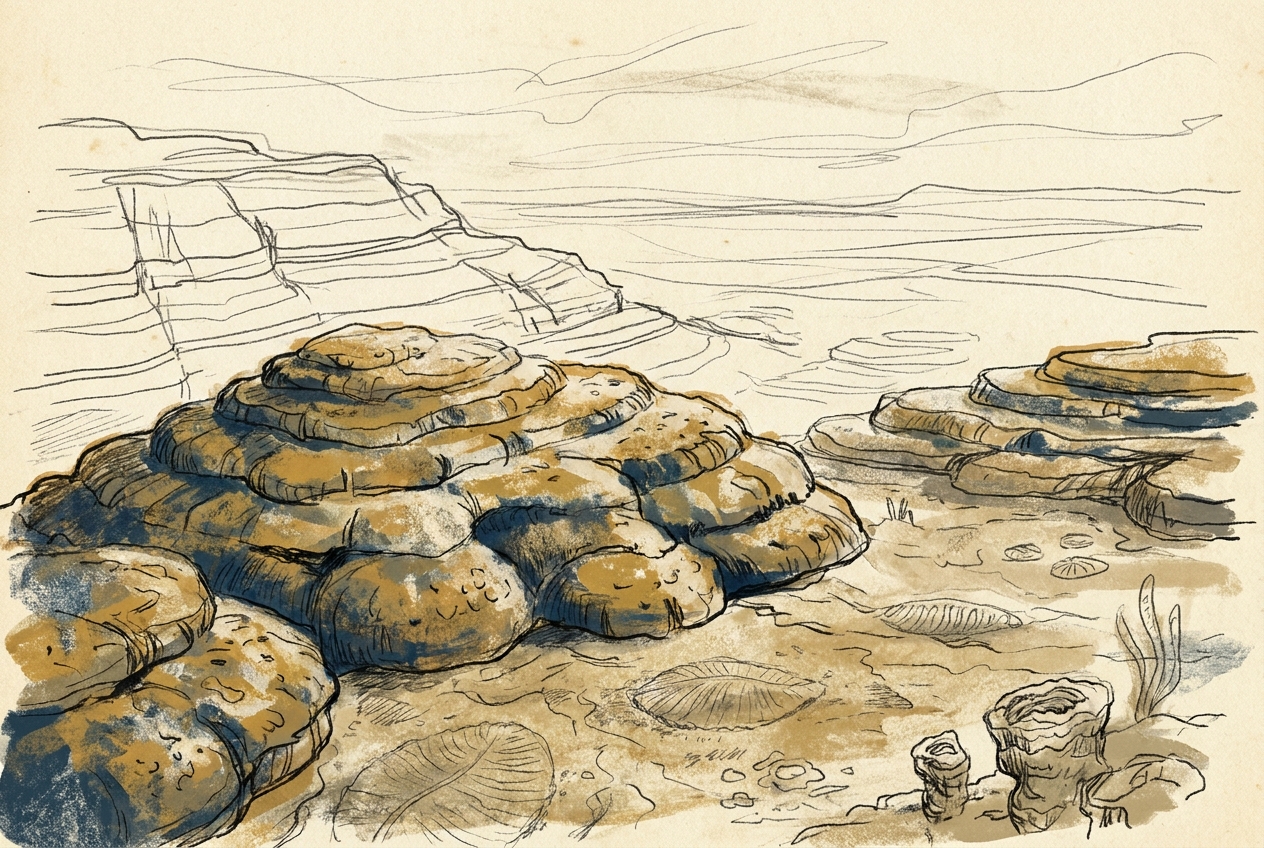
In the Flinders Ranges of South Australia, a ridge of limestone rises from the red dirt like a buried spine. It is not a coral reef. It was built by microbes, 550 million years ago, before any animal had evolved a skeleton or a shell.
These are the Ediacaran thrombolite mounds of the Parachilna Formation—reef-like structures built not by polyps but by biofilms. They grew during a period when Earth's oceans were transitioning from a world ruled by microbial mats to one where complex animals were just beginning to stir.
The Reef Builders That Left No Bones
The mounds are called thrombolites—clotted-textured microbialites that form when cyanobacteria and other microbes trap and bind sediment into layered structures. Unlike stromatolites, which stack in neat laminations, thrombolites have a chaotic, curdled internal fabric that records a more complex microbial ecosystem.
At Parachilna Gorge, these mounds reach several metres in diameter and stand as low domes and irregular pillars in the limestone. They grew on a shallow marine shelf, in waters rich in dissolved calcium carbonate, where microbial mats could precipitate minerals and build upward toward the sunlight.
The mounds flourished for millions of years before the first shelled organisms appeared. When the Cambrian explosion began, around 541 million years ago, animals with hard parts would graze on and burrow through these microbial structures, permanently altering the seafloor.
These mounds are the last great reefs built entirely by microbes—the final expression of a billion-year-old way of building rock.
A Seafloor Frozen in Time
The Parachilna Formation sits directly above the Ediacara Member, the same rock unit that preserves the famous Ediacaran soft-bodied fossils at Nilpena. But where Nilpena captures impressions of the first large complex organisms—Dickinsonia, Spriggina, and their kin—the Parachilna records the world those organisms lived on.
The limestone of the mounds contains no animal fossils. Instead, it preserves the texture of microbial mats: wavy laminations, wrinkled surfaces, and the clotted fabric of the thrombolites themselves. These structures were the seafloor of the Ediacaran world—the living skin that covered vast areas of the shallow ocean bottom.
Geochemical analysis of the limestone reveals conditions unlike modern seas. The water was warmer, richer in dissolved minerals, and lower in oxygen. The microbes that built these mounds were not just reef builders; they were ecosystem engineers, stabilising sediment and producing oxygen for the simple animals that lived among them.
What the Mounds Tell Us
The thrombolite mounds of the Parachilna Formation represent the end of an era. For nearly three billion years, microbial mats were the dominant life form on Earth, building structures from stromatolites to these clotted mounds. Then, in a geological instant, animals evolved grazing and burrowing behaviours that shredded the mats and transformed the seafloor.
The mounds survived because they were lithified—turned to stone—before animals could destroy them. They stand today as a snapshot of a world on the cusp of change, when the seafloor was still a living microbial carpet and the first complex animals had only just begun to move across it.
Walking along the Parachilna Gorge ridge, you step on a reef that never saw a coral, a sponge, or a shell. It was built by slime—organised, patient, mineral-precipitating slime that stacked limestone grain by grain for millions of years. The animals that would eventually inherit the seafloor were already evolving in the waters above, but these mounds belong to the world before.
More like this
- The 560-Million-Year-Old Garden That Never Saw a PredatorIn South Australia's Flinders Ranges, 560-million-year-old Ediacara surfaces preserve entire seafloor communities of fronds, discs, and quilts — a garden of soft-bodied life that flourished before pre
- The 300-Million-Year-Old Forest That Died Standing UpIn New South Wales, a 300-million-year-old fossil forest preserves dozens of trees buried upright by a Permian volcanic eruption—an entire ecosystem frozen in ash.
- The 1.75-Billion-Year-Old Reef That Outranks the BarrierA 1.75-billion-year-old microbial reef in the Kimberley is the largest biological structure ever built by a single species, preserving a world without predators.