15 May 2026 · 3 min read
The Ash That Turned to Coal: Sydney's Permian Forest
Beneath Sydney lies a 250-million-year-old fossil forest preserved in the Hawkesbury Sandstone, where volcanic ash buried an entire Permian ecosystem and later became the coal that fuelled Australia's
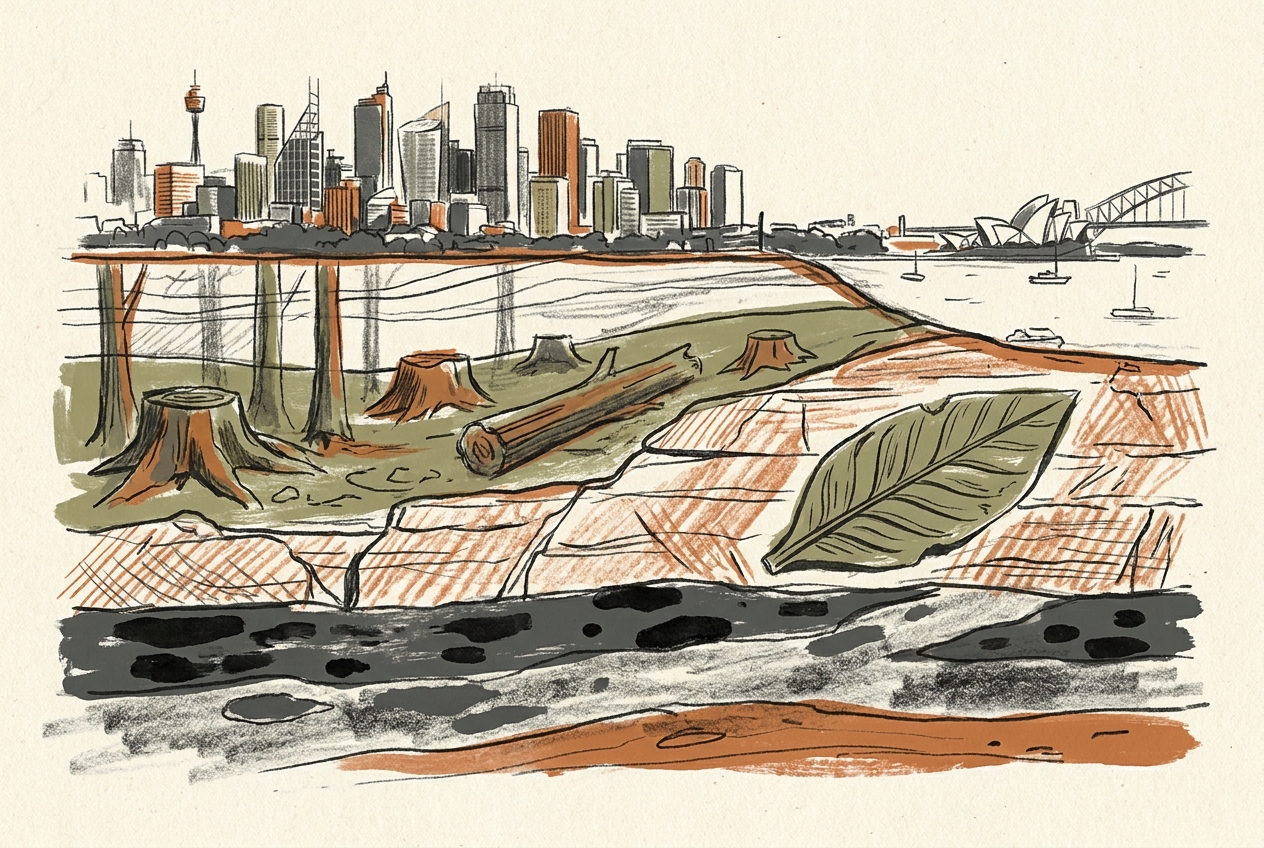
Walk anywhere in central Sydney and you are standing on a forest floor. Two hundred and fifty million years ago, a river delta spread across what is now the city's sandstone bedrock, carrying the debris of a Permian world. The trees that grew there—glossopterids, seed ferns unlike any alive today—fell into swampy channels and were buried by volcanic ash. That ash became clay. The trees became coal. The whole thing hardened into the Hawkesbury Sandstone, the pale rock that gives Sydney Harbour its cliffs.
The Forest Beneath the City
The Hawkesbury Sandstone is not a single formation but a layer cake of ancient environments. It was laid down between 250 and 240 million years ago, during the mid-Triassic, when Australia sat much closer to the South Pole. The climate was cool and wet, with strong seasonal rainfall. Rivers carried sediment from the eroding New England Fold Belt to the north-east, spreading it across a broad coastal plain.
Within that plain, forests of glossopterids—the dominant trees of the Permian—grew in dense stands along riverbanks and swamp margins. When they fell, they accumulated in anaerobic water, where decay slowed. Over time, the plant matter compressed into coal seams that today run beneath the city's suburbs. The seams are thin by global standards—rarely more than a few metres thick—but they are remarkably pure, and they powered Sydney's growth through the 19th and 20th centuries.
The first coal mine in Australia opened at Coalcliff, south of Sydney, in 1797. Miners followed the seams inland, digging beneath what would become the city's streets. At Balmain, at Newcastle, at Wollongong, the same fossil forest yielded its energy. The trees that had photosynthesised under a Triassic sun now burned in boilers and furnaces, driving trains, ships, and factories.
The Ash That Preserved a Moment
What makes the Sydney Basin exceptional is not just the coal but the preservation of the forest itself. In several locations—notably at the Gosford fossil site on the Central Coast—the Hawkesbury Sandstone contains upright tree trunks, still in growth position, entombed by volcanic ash falls. These are not petrified in the usual sense; they are preserved as casts and moulds within the sandstone, the original wood long since decayed and replaced by sediment.
The ash came from volcanoes to the east, along the margin of the Gondwanan continent. The same volcanic arc that produced the ash also supplied the silica that cemented the sand into hard quartz sandstone. Without that ash, the trees would have rotted away completely. Instead, their shapes were captured: the ribbed bark of glossopterid trunks, the branching patterns of their crowns, the litter of leaves and cones on the forest floor.
At one site near Terrigal, a single tree trunk stands three metres tall within the cliff face, its base still rooted in the coal seam below. Geologists have counted more than forty growth rings in its cross-section, recording the seasonal rhythms of a Triassic year.
The coal beneath Sydney is a forest that never decayed—a moment of falling, drowning, and burial that lasted 250 million years.
The Weight of Time
The transformation from living tree to black coal required more than burial. It required pressure. Over the long Triassic and Jurassic, the Sydney Basin accumulated several kilometres of sediment on top of the coal seams. The weight compressed the plant matter, driving off water and volatile compounds, concentrating carbon. At greater depths, the coal became harder, shinier, more energy-dense.
The same process that created the coal also created the sandstone that encloses it. The Hawkesbury Sandstone is remarkably uniform—a massive, cross-bedded quartz arenite that forms the iconic yellow-grey cliffs of the harbour. It is porous enough to hold groundwater, which is why Sydney's early settlers found springs and wells in the sandstone. It is also soft enough to carve: the tunnels of the city's rail network, the cuttings for its roads, the foundations of its skyscrapers, all excavated through the remains of that ancient forest.
Today, the coal seams are largely worked out beneath the inner city. The mines have closed; the entrances are sealed or built over. But the forest itself remains visible wherever the sandstone is exposed—in the sea cliffs of the Royal National Park, in the road cuttings of the M1 motorway, in the rock platforms of Bondi. Look closely at the sandstone and you can see the carbonised fragments of leaves, the impressions of stems, the occasional log-shaped void where a tree once lay.
The forest that built Sydney is still there, just not as trees. It is the city itself.
More like this
- The 560-Million-Year-Old Garden That Never Saw a PredatorIn South Australia's Flinders Ranges, 560-million-year-old Ediacara surfaces preserve entire seafloor communities of fronds, discs, and quilts — a garden of soft-bodied life that flourished before pre
- The 300-Million-Year-Old Forest That Died Standing UpIn New South Wales, a 300-million-year-old fossil forest preserves dozens of trees buried upright by a Permian volcanic eruption—an entire ecosystem frozen in ash.
- The 1.75-Billion-Year-Old Reef That Outranks the BarrierA 1.75-billion-year-old microbial reef in the Kimberley is the largest biological structure ever built by a single species, preserving a world without predators.