15 May 2026 · 3 min read
The Sandstone That Painted Itself: Australia's Rainbow Valley
Northern Territory's Rainbow Valley preserves 80-million-year-old sandstone whose iron bands record ancient water tables and paint the desert in colour.
A hundred kilometres south of Alice Springs, a low escarpment burns orange at sunset. The locals call it Rainbow Valley, and for once the name is not hyperbole.
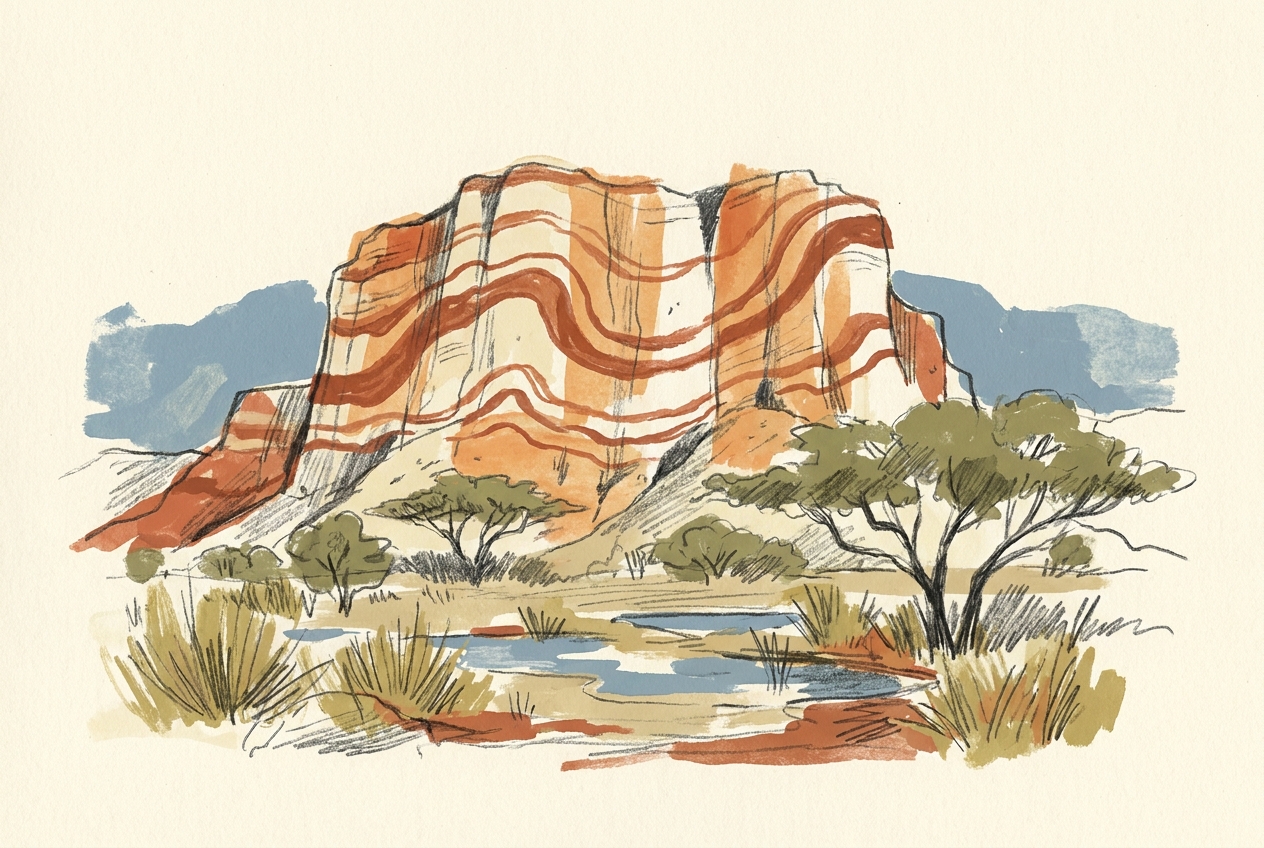
The cliffs run for about a kilometre, layered in bands of white, ochre, red, purple, and deep chocolate brown. They look painted, but the palette is geological: 80 million years of groundwater chemistry, written in iron.
The Sandstone That Holds a Sea
The rock itself is the Mulloy Sandstone, part of the Eromanga Basin that once lay beneath a vast Cretaceous inland sea. Between about 100 and 80 million years ago, this sea stretched from what is now the Gulf of Carpentaria down to the southern coast, covering much of central Australia in shallow, warm water.
Sand and silt accumulated on the seafloor for millions of years, compacting into sandstone. After the sea retreated, the basin was buried under younger sediments, then slowly exhumed by erosion over the past 20 million years. What remains is a 30-metre-high cliff of remarkably pure quartz sand, cemented by silica into a rock hard enough to resist the desert wind.
But the colour—the colour came later, and it came from water.
The Water That Left Its Mark
Iron is the pigment. The white bands are nearly pure quartz, free of iron oxides. The red and purple bands are stained by hematite—the same mineral that gives rust its colour. The orange and chocolate bands contain goethite, a hydrated iron oxide that forms in wetter conditions.
The pattern tells a story of a fluctuating water table. During wet periods, groundwater percolated through the sandstone, dissolving iron minerals from the surrounding rock. When the water table dropped, the iron precipitated out as oxides, staining the sandstone in horizontal bands that follow the ancient water level.
Each colour band marks a pause in the desert's drying. The purple layers, the richest in hematite, represent the longest periods of stable water tables. The white bands record intervals when the water table fell below that level entirely, leaving the sand uncoloured.
The cliffs are a dipstick for climate change, measuring the slow retreat of the inland sea across 20 million years.
The Desert That Finished the Work
What made Rainbow Valley visible was not the colouring alone but the stripping away of everything above it. For millions of years, younger sediments covered the Mulloy Sandstone. As central Australia dried out during the Miocene and Pliocene, rivers and wind removed this overburden, exposing the coloured bands.
The modern desert finished the sculpture. South-westerly winds, funnelled through a gap in the range, sandblast the cliff face, keeping it clean and sharp. The softer, less cemented layers erode faster, undercutting the harder bands above and creating a series of small overhangs and alcoves.
The valley floor is a dry creek bed that floods perhaps once a year. When it does, the water reflects the coloured cliffs, and for a few hours the rainbow is doubled.
A Palette Without Paint
Rainbow Valley is not unique in Australia—similar iron-stained sandstone appears at Chambers Pillar, the Olgas, and parts of the Kimberley. But nowhere else are the bands so distinct, so numerous, or so precisely aligned with ancient water tables.
The colours are not stable. As the cliff face weathers, the iron oxides slowly hydrate and change. The bright reds will eventually fade to brown, the purples to grey. The rainbow is a transient feature on geological timescales, a brief exposure of a 20-million-year-old water table before the desert erases it again.
For now, the cliffs hold their colour, each band a fossil of an ancient water level, painted by nothing more than rain, iron, and time.
More like this
- The 110-Million-Year-Old River That Runs Backwards UndergroundWestern Australia's 110-million-year-old dune system has been slowly dissolving into a labyrinth of caves where an ancient river still flows, carrying the taste of a Cretaceous desert.
- The 5,000-Year-Old Volcanoes That Still Smoke in the SouthIn Victoria's Newer Volcanics Province, 400 volcanic vents erupted as recently as 5,000 years ago—the youngest volcanic field in mainland Australia, where craters still hold blue lakes and scoria cone
- The 560-Million-Year-Old Garden That Never Saw a PredatorIn South Australia's Flinders Ranges, 560-million-year-old Ediacara surfaces preserve entire seafloor communities of fronds, discs, and quilts — a garden of soft-bodied life that flourished before pre