9 May 2026 · 3 min read
The Buried Forest: The Yarraloola Tree Stumps of the Fortescue Basin
In the Fortescue Basin of Western Australia, 2.7-billion-year-old fossil tree stumps—among the oldest known—preserve the first tentative steps of life onto land.
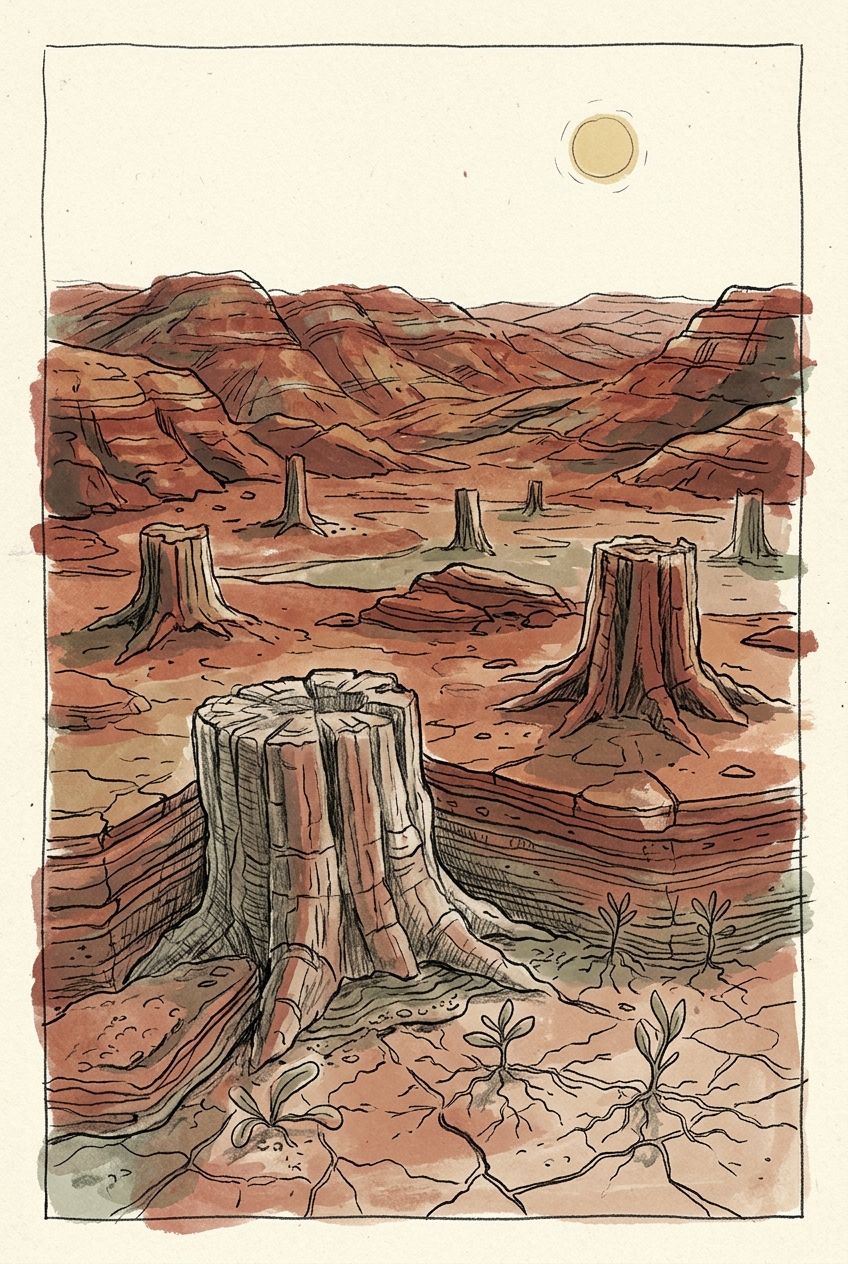
On the edge of the Fortescue Marsh in Western Australia's Pilbara region, a cluster of stubby rock pillars rises from the red dirt. They look like weathered fence posts or the remains of an old jetty. In fact they are fossilised tree stumps, and they stood here 2.7 billion years ago, when the Pilbara was a flat coastal plain under a young sun.
These are the Yarraloola tree stumps, among the oldest known terrestrial fossils on Earth.
The Stumps
The stumps are preserved in sandstone of the Fortescue Group, a sequence of sedimentary and volcanic rocks that accumulated between 2.8 and 2.6 billion years ago. They range from 10 to 30 centimetres in diameter and stand up to 40 centimetres tall. Their outer surfaces are ribbed with vertical striations, and in cross-section they show distinct concentric rings.
They are not trees in the modern sense. No leaves, no bark, no true wood. The Yarraloola fossils are thought to be the remains of large, upright microbial mats—colonies of cyanobacteria that grew in columnar forms, much like modern stromatolites but taller and stiffer. Over time, sediment buried them, and silica-rich groundwater replaced their organic structure cell by cell.
What makes them extraordinary is their context. Before this discovery, most evidence of early life came from marine settings—the stromatolites of Shark Bay or the microfossils of the Apex Chert. The Yarraloola stumps grew on land, in a floodplain or delta environment, at a time when the atmosphere held almost no oxygen and the continents were largely barren.
The Landscape That Held Them
The Fortescue Basin of the late Archean was not the red desert we see today. It was a low-lying coastal plain crossed by braided rivers, dotted with shallow lakes, and bordered by an active volcanic arc to the north. The climate was warm and wet. Tides and seasonal floods spread fine sand and silt across the plain, periodically burying the microbial colonies and preserving them in place.
The rocks that contain the stumps belong to the Hardey Formation, a unit of fluvial and deltaic sandstone that outcrops in scattered locations across the southern Pilbara. The best exposures lie along the southern shore of the Fortescue Marsh, near the Yarraloola homestead, where the stumps appear as a row of low knobs in the bed of a dry creek.
The site is remote and rarely visited. The fossils are fragile. Rain and wind are slowly wearing them away.
What They Tell Us
The Yarraloola stumps push back the record of terrestrial life by nearly a billion years. Before their recognition in the 1990s, the oldest known land fossils were Silurian—about 430 million years old. These stumps are six times older.
They suggest that microbial life colonised land surfaces much earlier than previously assumed. They also hint at the role such communities may have played in weathering rock, stabilising sediment, and altering the chemistry of early soils. In doing so, they may have helped prepare the continents for the more complex land plants that would not appear for another two billion years.
The stumps stood in the open air, under a sky without ozone, bathed in ultraviolet radiation that would kill most modern organisms. That they survived at all tells us something about the resilience of life—and about how different the early Earth really was.
The Unanswered Questions
The Yarraloola fossils raise as many questions as they answer. Were these structures truly photosynthetic, or did they metabolise other compounds? How tall did they grow? Did they form large colonies, or isolated clusters? And why do they appear in only a few thin layers within the Hardey Formation, while similar deposits elsewhere in the Fortescue Group contain nothing comparable?
The stumps remain poorly studied compared to younger fossil forests. Their remote location and the difficulty of extracting petrified material from hard sandstone have limited detailed analysis. No one has yet attempted a systematic excavation of the site.
Some geologists have proposed that the stumps are not microbial at all, but rather gas-escape structures or concretionary features. The consensus, however, leans toward biology. The regular spacing, the radial symmetry, the consistent vertical orientation—these are hard to explain by purely physical processes.
A Quiet Archive
The Yarraloola stumps will not draw crowds. They lack the grandeur of the Bungle Bungles or the drama of Uluru. They are small, weathered, and easy to walk past. But they preserve a moment when life first pushed beyond the shoreline and began the slow work of transforming the continents.
Two and a half billion years later, the stumps are still standing.
More like this
- The 110-Million-Year-Old River That Runs Backwards UndergroundWestern Australia's 110-million-year-old dune system has been slowly dissolving into a labyrinth of caves where an ancient river still flows, carrying the taste of a Cretaceous desert.
- The 5,000-Year-Old Volcanoes That Still Smoke in the SouthIn Victoria's Newer Volcanics Province, 400 volcanic vents erupted as recently as 5,000 years ago—the youngest volcanic field in mainland Australia, where craters still hold blue lakes and scoria cone
- The 560-Million-Year-Old Garden That Never Saw a PredatorIn South Australia's Flinders Ranges, 560-million-year-old Ediacara surfaces preserve entire seafloor communities of fronds, discs, and quilts — a garden of soft-bodied life that flourished before pre