12 May 2026 · 3 min read
The Slate That Holds a Fossil City: The Emu Bay Shale
South Australia's Emu Bay Shale preserves 514-million-year-old Cambrian fossils in extraordinary detail, including the earliest known compound eyes.
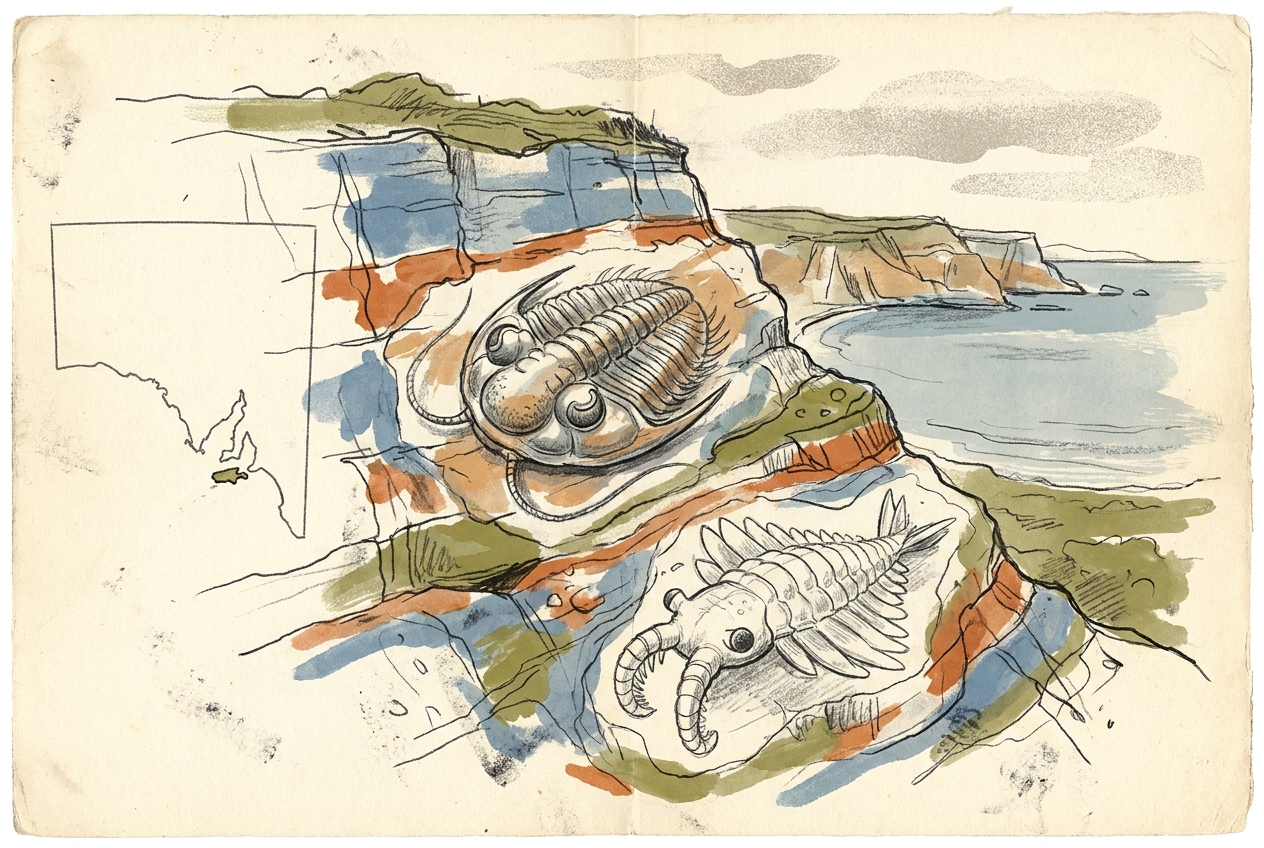
On the north coast of Kangaroo Island, a cliff of dark grey shale falls into the sea. It looks unremarkable—a layered stack of ancient mud, tilted and weathered. But split a slab open and you may find a compound eye, 514 million years old, each individual lens still distinct.
The Emu Bay Shale is one of the world's great Cambrian fossil deposits. It preserves soft tissues—guts, gills, antennae, eyes—in a level of detail matched only by the Burgess Shale in Canada and Chengjiang in China. But it is younger than both, and it formed in a very different setting.
The Shelf Edge That Trapped Life
During the early Cambrian, what is now Kangaroo Island lay on the margin of a shallow sea that covered much of South Australia. A subsiding rift basin—the Stansbury Basin—had created a steep shelf edge. Sediment from the land built out across this slope, and occasional underwater landslides sent mud cascading into deeper, oxygen-poor water.
That low-oxygen environment is what makes the Emu Bay Shale exceptional. Normally, when a marine animal dies, scavengers and bacteria consume the soft tissue within days. But in the stagnant bottom waters of this Cambrian basin, decay stalled. Fine clay particles settled slowly, draping bodies in a seal that preserved even the most delicate structures.
The result is a fossil assemblage that captures a complete ecosystem, not just the hard shells that survive normal burial.
The Eyes That Saw the Cambrian World
The most remarkable specimen from Emu Bay is Anomalocaris, the apex predator of Cambrian seas. This metre-long arthropod swam through open water, grasping prey with spiny frontal appendages and passing it to a circular mouth ringed with teeth.
At Emu Bay, paleontologists have found Anomalocaris eyes—paired stalks, each a compound eye containing over 16,000 individual lenses. These are the earliest high-resolution eyes known in the fossil record. They suggest Anomalocaris could see detail in dim light, perhaps hunting at dawn or in deeper water.
Other fossils from the site include:
- Eoredlichia, a trilobite preserved with its antennae and walking legs intact
- Myoscolex, a worm-like animal whose muscle fibres remain visible as carbon films
- Isoxys, a bivalved arthropod with a gut tract still filled with sediment from its last meal
None of these animals had skeletons in the modern sense. Their bodies were soft, supported only by fluid pressure and thin cuticles. Without the unusual chemistry of the Emu Bay Shale, they would have vanished without trace.
The Slate That Preserves Colour
The shale's preservation goes beyond shape. In some fossils, original organic compounds remain. The dark films that outline Anomalocaris eyes are not mineral replacements but carbon residues—the compressed remains of the animal's own biochemistry.
Recent spectroscopy has detected traces of melanin in these fossils. The same pigment that colours human skin and bird feathers once darkened the cuticle of Cambrian arthropods. Pattern and colour, two aspects of an organism that almost never fossilise, survive here in chemical form.
A fossil that still holds the pigment of a living eye—this is as close as geology gets to a photograph.
The Emu Bay Shale also preserves the earliest known example of moulting behaviour. Clusters of shed carapaces, stacked like nested bowls, show that Cambrian arthropods cast off their exoskeletons to grow, just as crabs and insects do today.
A Narrow Window
The Emu Bay Shale was deposited over a geologically short interval—perhaps no more than 10,000 years. The conditions needed for soft-tissue preservation—rapid burial, fine sediment, anoxic bottom water—are rare and fleeting. The shale represents a single lucky moment in the early Cambrian, when the local geometry of the seafloor and the rate of sediment supply aligned exactly.
The deposit was discovered in the 1950s during quarrying for road stone, but its significance took decades to emerge. Systematic collecting began in the 1970s, and new species are still being described. The site is now a protected fossil reserve, though the cliffs continue to erode, releasing fresh specimens into the surf each winter.
Kangaroo Island itself was devastated by bushfires in 2020. The fossil beds survived, but access remains restricted. Much of the Emu Bay Shale's richness may still be buried, waiting in the tilted grey slate for a hammer and a careful eye.
More like this
- The 560-Million-Year-Old Garden That Never Saw a PredatorIn South Australia's Flinders Ranges, 560-million-year-old Ediacara surfaces preserve entire seafloor communities of fronds, discs, and quilts — a garden of soft-bodied life that flourished before pre
- The 300-Million-Year-Old Forest That Died Standing UpIn New South Wales, a 300-million-year-old fossil forest preserves dozens of trees buried upright by a Permian volcanic eruption—an entire ecosystem frozen in ash.
- The 1.75-Billion-Year-Old Reef That Outranks the BarrierA 1.75-billion-year-old microbial reef in the Kimberley is the largest biological structure ever built by a single species, preserving a world without predators.