12 May 2026 · 3 min read
The Ediacaran Moulds: Nilpena's Fossil Seafloor
In South Australia's Flinders Ranges, the Nilpena Ediacara National Park preserves 550-million-year-old fossil beds showing the first complex life on Earth.
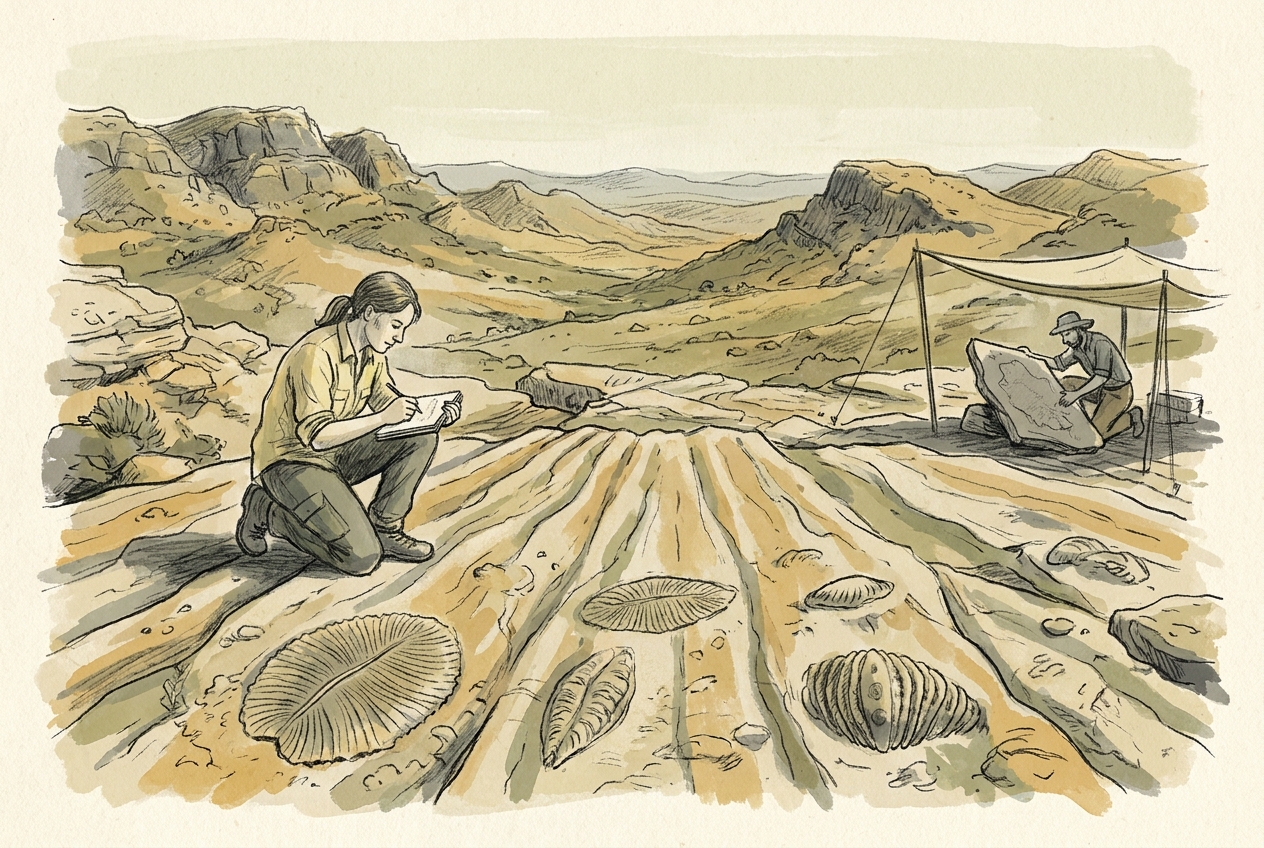
On a slab of sandstone in the South Australian desert, the outline of a frond lies pressed into stone like a leaf in a book. It is not a leaf. Nothing like a leaf existed when this impression was made, 550 million years ago. The frond belonged to Dickinsonia—a ribbed, oval organism that grew up to a metre long and had no mouth, no gut, no organs of any kind. It was one of the first complex life forms on Earth, and it died here, on a shallow seafloor that turned to stone.
The Seafloor That Stopped
The fossils of Nilpena Ediacara National Park, in the Flinders Ranges of South Australia, are not bones or shells. They are moulds and casts preserved in fine-grained sandstone. The Ediacaran seafloor was covered in microbial mats—layers of bacteria that bound sediment into a firm, leathery surface. When currents washed sand over the mat, the sand filled the spaces beneath dying organisms, recording their shapes in three dimensions.
What survived is not the creature itself, but the negative space it occupied. Lift a slab of sandstone from Nilpena, and you may find the raised cast of a Dickinsonia, or the circular impression of a Cyclomedusa, or the branching traces of trace fossils left by something that moved. These are the oldest known fossils of multicellular animals—the Ediacaran biota, named for the Ediacara Hills where they were first recognised in 1946.
More than 40 species have been identified across the Nilpena beds. Many have no clear relationship to any living animal. Some resemble ferns, others like quilts, others like discs with radial spokes. Paleontologists still debate whether they were animals, fungi, lichens, or an entirely extinct kingdom.
A Single Event, Preserved Whole
What makes Nilpena exceptional is not just the age of its fossils, but the way they are preserved. At most fossil sites, organisms are scattered by currents, scavenged, or decayed before burial. At Nilpena, an entire seafloor community was smothered in place by a single event—a pulse of sediment, perhaps from a storm or a turbidity current, that buried the mat and everything on it.
The result is a series of bedding planes that capture a snapshot of Ediacaran life. On some slabs, dozens of specimens lie together, oriented as they grew. On others, trace fossils show that something—perhaps a worm-like creature—was burrowing through the mat, leaving the earliest known evidence of animal locomotion.
The fossils are found within the Rawnsley Quartzite, a formation that records a shallow marine environment at the edge of a subsiding basin. The same deposits extend across the Flinders Ranges, but Nilpena contains the most extensive exposures. The site was declared a national park in 2020 and is now managed jointly with the Adnyamathanha people, whose ancestors have known these stones for millennia.
The Ediacaran biota thrived for about 30 million years. Then, at the boundary of the Cambrian Period, they vanished—replaced by the hard-shelled, fast-moving animals of the Cambrian explosion.
The Frond That Outlasted Its World
Dickinsonia grew by adding segments along its body. Some specimens at Nilpena show clear growth series, from tiny discs a few millimetres across to full-sized adults. The largest known Dickinsonia fossil, found at Nilpena in 2021, measures 1.4 metres long—a giant for a world where nothing had yet evolved to eat it.
For decades, paleontologists argued over what Dickinsonia was. In 2018, researchers extracted organic molecules from a Nilpena fossil and found cholesterol-like lipids—a signature of animal metabolism. The debate is not fully settled, but the evidence tilts toward Dickinsonia being an early animal, perhaps related to the placozoans, a group of simple marine organisms that still exist today.
The Ediacaran biota thrived for about 30 million years. Then, at the boundary of the Cambrian Period, they vanished—replaced by the hard-shelled, fast-moving animals of the Cambrian explosion. No one knows why. Some argue the Ediacarans were outcompeted. Others suggest a change in ocean chemistry or the evolution of predation.
What remains are the moulds. At Nilpena, you can walk across a bedding plane and see, in the late afternoon light, the raised casts of organisms that lived half a billion years ago—before eyes, before jaws, before any animal had a skeleton. The fronds are gone, but their shapes endure in stone.
More like this
- The 560-Million-Year-Old Garden That Never Saw a PredatorIn South Australia's Flinders Ranges, 560-million-year-old Ediacara surfaces preserve entire seafloor communities of fronds, discs, and quilts — a garden of soft-bodied life that flourished before pre
- The 300-Million-Year-Old Forest That Died Standing UpIn New South Wales, a 300-million-year-old fossil forest preserves dozens of trees buried upright by a Permian volcanic eruption—an entire ecosystem frozen in ash.
- The 1.75-Billion-Year-Old Reef That Outranks the BarrierA 1.75-billion-year-old microbial reef in the Kimberley is the largest biological structure ever built by a single species, preserving a world without predators.